
Bermudagrass, Cynodon dactylon, is probably the most popular turfgrass in my area. It is also evil and I hate it.
Strong words?
Perhaps, but there's a reason gardeners call this stuff "Devil's Grass". It's not even FROM Bermuda! It's called Bermudagrass because it's a serious invasive species on Bermuda. That's weird to think about, considering all those sacks of seed at the hardware store with "Bermudagrass" on the label like they're proudly saying, "This stuff has taken over Bermuda and will take over your land too!"
I hate Bermudagrass because once it gets established on your land, it's almost impossible to get rid of, and it's so popular here that pretty much every new garden I've ever had was put where a Bermudagrass turf used to be. I just emptied about 3/4 of a bottle of Roundup in my garden trying to kill all the tufts of Bermudagrass poking up through every single crack and crevice between my limestone rocks lining the beds, the landscape fabric, the cardboard, and whatever else I piled on top of it trying to smother it. If there's even a tiny tear in the landscape fabric, or a crack along the edge of a bed, it will find it, send out runners, and next thing you know the entire garden bed is covered in that ugly, wiry grass.
Usually I stick to organic methods, but when faced with something this invasive, I finally caved and went for the Roundup, even though it's a bit evil itself. I tried solarizing it, smothering it, and dousing it in organic weed killer made of strong vinegar and orange essential oil that I got from the local nursery, but the Bermuda just keeps coming back, and as the weather warms up, it just grows faster and faster.
While I was staring at the Wall of Poison at Home Depot, I was tempted to go with Ortho Grass-b-Gone instead. I had a thought that perhaps a specific grass killer that supposedly doesn't kill other types of plants would be better than a broad-spectrum herbicide like Roundup. However, upon a close reading of the label, I changed my mind when I found that they recommend waiting a whole year after treatment with Grass-b-Gone before planting edible plants, while Roundup said it's safe after 3 days. I knew one of the good things about Roundup is it breaks down very quickly in the soil, but I had no idea it was that big of a difference! Goes to show you how little I know about herbicides.
I feel bad about resorting to this, but I feel the Bermudagrass leaves me no choice. Which of course makes me hate it even more, because without the invading Devil's Grass I could be organic.
If you have a lawn, please don't plant Bermudagrass! Whatever you do, please consider your neighbors and plant something less invasive. Even if Bermuda wasn't already growing here, it spreads by both runners and seeds, so it can always blow in from nearby lawns or creep across property lines.
St. Augustine (Stenotaphrum secundatum) is probably the second most popular turfgrass around here. This is the grass we always had when I was a kid. My mom prefers it because it's much softer than Bermuda, with broad blades that form a thick, carpet-like lawn that even people like me with sissy, sensitive feet can walk on barefoot. It's also much less invasive, though this is partially because it's less drought tolerant, so it doesn't do well in wild areas where it's not being taken care of. I don't think it makes viable seeds either; it just spreads by runners. When I was a kid taking care of the family vegetable garden, our St. Augustine would send runners into the veggie garden, but they were a hundred times easier to pull out than Bermudagrass runners. I'm not sure why. I guess they have shallower roots and they seemed thicker and easier to grab hold of. They just pulled cleanly out, while Bermuda runners will usually end up just breaking off in your hand, leaving most of the plant behind still in the soil.
However, even though I have a soft spot for St. Augustine, what I think is the absolute best thing to do (besides not having a lawn at all) is plant a native grass! Plant the grass that's supposed to be there! Why get imports from Africa when Mother Nature has been planting perfectly good grass right here for millions of years?
For my area, the native turfgrass of choice is Buffalograss. This company sells a nice native turfgrass mix that's 2/3 Buffalograss and 1/3 Blue Grama. However, if my yard wasn't already grassified, I would probably go with some of their other land coverage options. Maybe some Little Bluestem, which is probably my favorite native grass, with some sort of wildflower mix added in for color and biological diversity. I already planted a mixture of their shade wildflower mix and shade grass mix in the back under the elm trees where hardly anything was growing (Bermudagrass doesn't like shade), which I think is much more interesting than any monoculture lawn. Besides, if you don't have a lawn, there's no need for a lawnmower, and does anybody actually like mowing lawns? No, I didn't think so.
By the way, I don't work for Native American Seed or anything. I just think they have some great products for any native plant enthusiasts. They seem to have the biggest selection of native grass and wildflowers for my area that I've seen. There are some garden centers and nurseries here and there that also sell natives, but I haven't yet found a better internet store.
Now of course, I live in Texas, so the plants that do well here might not be the same as somewhere else. If you live in a completely different climate than me, you might need to look elsewhere for plants native to your area.
But if you live in the southern United States, PLEASE DON'T PLANT BERMUDAGRASS! Almost anything else would be better than that! I beg you. Do it for us poor gardeners who have to dig or pull up every last little bit of that stuff because even the tiniest bit of root grows into more grass, and then we have to burn it because if you put in the compost, it'll grow out and cover it up. Really, this stuff is evil, make it go away!
Friday, April 9, 2010

Tuesday, March 30, 2010
Full Worm Moon
March's Full Moon is called the Worm Moon, which is a bit better fit here than the snow moon last month. It's got a nice garden theme, named after the earthworms that should be active in the warming soil by this time. I have seen some, so I decided that's a good moon name.
I think from now on I'm going to do a general garden update each full moon. That will give me a nice, easy to remember, regular interval to keep track of my garden's progress. I haven't done a general overview of my garden since early February, and by now a lot has changed. The days are getting noticeably warmer, for one thing. It's 83 degrees F right now. I'm really looking forward to the summer produce like tomatoes and squash. Not so much the summer heat.

Speaking of tomatoes, I've now got all of them planted except the Yellow Pears, which will be planted soon. I'm planting them in the two foot border around the garden. I like the idea of looking out the bedroom window to a wall of tomatoes. I'm going to end up with about 30 tomato plants. I hope that's enough! It seems like ages since I've tasted a home-grown tomato, and I plan on preserving lots of salsa, pasta sauce, dried tomatoes, and maybe try something new like ketchup. Considering all the tomato products I eat, I figure it's not possible to grow too many tomatoes.
 Two sides of my garden are against the chain link fence, so I am planting vining crops along it. These are scarlet runner beans I got in a seed swap on Garden Web this past winter. I've never grown scarlet runner beans before, but they're supposed to be pretty amazing. They're in the same genus but a different species (Phaseolus coccineus) than the bean most people around here think of when they think of beans (Phaseolus vulgaris). The seeds were large, the size of lima beans, and strikingly colored, black with purple markings. They're supposed to grow long vines with beautiful scarlet flowers and the beans are edible in both the green and shelled stage just like common beans. One problem is they supposedly don't like excessive heat, which may be bad news for me. I'm hoping I'll at least get a decent crop before it really heats up, and maybe if I can keep the vines alive through the summer, I'll get another crop when it cools down in the fall. To cover my bases, I'm also going to grow the other members of the genus Phaseolus, the common bean (I've got several varieties both pole and bush), lima bean (Phaseolus lunatus), and the tepary bean (Phaseolus acutifolius). Lima beans and tepary beans are supposed to be more heat tolerant than either common beans or runner beans.

I've got some more seeds planted that haven't sprouted yet (probably because it hasn't rained since I planted them). The plot in the foreground has Bowling Red Okra. Behind that, along the fence, the lima beans are planted. The lima beans are a pole variety, King of the Garden, left over from when I last had a garden years ago. I'm not sure if the seeds are still good, but I'm giving them a chance.
I'm trying a strategy with my seeds where I don't water them when I first plant and leave Nature to do that. It's hard for me to keep newly planted seeds well-watered artificially in dry weather (guess I'm not patient enough to water them enough to keep them evenly moist), so I'm trying just letting the seeds sit and wait in the soil until it rains and gives them a really good soaking. The worst thing that can happen to a new planting is to have the seeds just start to sprout, and then dry out before they've gotten a deep enough root. Dry seeds are durable, and mature plants have some water reserves, it's the little newborn sprouts that are the most delicate. I'm trying to get used to watering as little as possible in anticipation of another drought year, trying not to "pamper" my plants too much. The soonest rain forecast is this Friday. The seeds should be able to hold out until then. I have been watering the newly planted tomatoes and other young plants that look like they need it with water from the rain barrel. So far I haven't used any city water for irrigation, but I don't know how long we can hold out.
 To the right on this plot we have my lettuce, which is much bigger since the last picture I took of them. Aren't they beautiful? Good enough for a flower bed. They've completely filled in the space between them, which is what I wanted. I try to plant things closely so they form a complete canopy over the soil, which shades it and conserves water (this principle is used in square-foot gardening and other intensive planting methods). I've been hand picking lettuce, but even this small patch is too much for me to eat, and Daniel is not much into lettuce, or other vegetables for that matter. Actually, I'm not that much into lettuce either. Salads have never been my favorite vegetable serving option, though having something more interesting than the iceberg lettuce, carrot, and thousand island dressing salad of my childhood does help. I've also been putting lettuce on any sandwiches I make, but my lettuce patch is still getting by relatively un-grazed. Maybe I should start giving it away to people.
I'm letting the collards go to seed and then I'll collect the seed to plant next time, since I'm out of seed now. One day I'd like to save most of my own seed for all my vegetables.
 The potatoes are still doing well. They got frostbitten by an unusual late March freeze, but are growing back new leaves now so you can hardly tell. These are the Purple Vikings. It's probably about time to bury them in mulch again.
 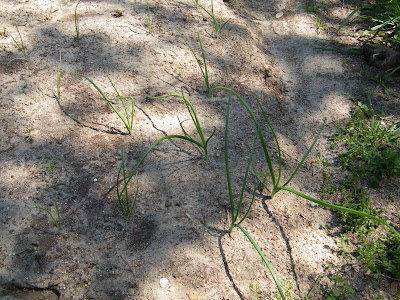 The onions are getting bigger, but I'm still worried they're too small for them to get to a decent size before hot weather. I'm also getting a lot of mortality of newly planted seedlings. I side-dressed them with some bat guano to give them a boost. I don't use much fertilizer (besides compost, if that counts), but I got the bat guano at a local garden center, and the bag said proceeds go to Bat Conservation International, which is a great organization. The bat guano was harvested from Bracken Cave, the largest bat colony in the world, which is found just outside San Antonio, about an hour's drive from here.
 In the herb garden in the front yard, the cilantro is bolting, like it does. Cilantro is notorious for bolting early in the year, as soon as it starts to warm up. This is supposed to be the slow-bolting variety too. The annoying thing is that I need cilantro to make salsa, but the other ingredients, tomatoes and peppers, aren't ready until summer. This year I tried freezing a bunch of cilantro before it bolted to get around this problem. I hope it's still tasty by salsa making time. I know I could buy big bunches of cilantro at the grocery store for about a dollar all year round, but it would be neat to use the cilantro I grow myself.

 I'm proud to announce that I'm almost done digging up my whole garden and laying out the beds and paths! I've only got this one corner left to go. It will still be a while before I've got all the paths covered in black landscape fabric, lined with rocks, and covered with mulch, but at least now anyone can just glance at the backyard and see what's garden and what's lawn. This is certainly the biggest garden I've ever had, so I really hope I can manage to keep up with it.

Lastly, we got ourselves a second rain barrel. It's another pickled jalapeno barrel, and this one needs to be cleaned out because a lot of the pickle juice was left in, with the barrel sitting around in the sun for months, and it smells kind of nasty. We've got a nice spot for it here on the other side of our porch opposite our first barrel. I'd like to have as many rain barrels as possible, but I'm not sure where we can put any more.
I think from now on I'm going to do a general garden update each full moon. That will give me a nice, easy to remember, regular interval to keep track of my garden's progress. I haven't done a general overview of my garden since early February, and by now a lot has changed. The days are getting noticeably warmer, for one thing. It's 83 degrees F right now. I'm really looking forward to the summer produce like tomatoes and squash. Not so much the summer heat.

Speaking of tomatoes, I've now got all of them planted except the Yellow Pears, which will be planted soon. I'm planting them in the two foot border around the garden. I like the idea of looking out the bedroom window to a wall of tomatoes. I'm going to end up with about 30 tomato plants. I hope that's enough! It seems like ages since I've tasted a home-grown tomato, and I plan on preserving lots of salsa, pasta sauce, dried tomatoes, and maybe try something new like ketchup. Considering all the tomato products I eat, I figure it's not possible to grow too many tomatoes.
 Two sides of my garden are against the chain link fence, so I am planting vining crops along it. These are scarlet runner beans I got in a seed swap on Garden Web this past winter. I've never grown scarlet runner beans before, but they're supposed to be pretty amazing. They're in the same genus but a different species (Phaseolus coccineus) than the bean most people around here think of when they think of beans (Phaseolus vulgaris). The seeds were large, the size of lima beans, and strikingly colored, black with purple markings. They're supposed to grow long vines with beautiful scarlet flowers and the beans are edible in both the green and shelled stage just like common beans. One problem is they supposedly don't like excessive heat, which may be bad news for me. I'm hoping I'll at least get a decent crop before it really heats up, and maybe if I can keep the vines alive through the summer, I'll get another crop when it cools down in the fall. To cover my bases, I'm also going to grow the other members of the genus Phaseolus, the common bean (I've got several varieties both pole and bush), lima bean (Phaseolus lunatus), and the tepary bean (Phaseolus acutifolius). Lima beans and tepary beans are supposed to be more heat tolerant than either common beans or runner beans.
What can I say? I like growing beans. They're an instant gratification crop, as far as gardening goes (if you can call anything in gardening "instant gratification"). The seeds are large and easy to sprout, the plants grow quickly, and they come in an endless variety.
In the above picture, you can also see that the Bermuda grass has come out of dormancy and is trying to grow from the next door neighbor's yard into the garden here. Have I mentioned Bermuda grass is evil? I sense a big problem coming in a month or two, even though I'm doing my best to pull this stuff up and zap it with my vinegar and orange oil organic weedkiller stuff. I'm really tempted to resort to Round-Up.

I've got some more seeds planted that haven't sprouted yet (probably because it hasn't rained since I planted them). The plot in the foreground has Bowling Red Okra. Behind that, along the fence, the lima beans are planted. The lima beans are a pole variety, King of the Garden, left over from when I last had a garden years ago. I'm not sure if the seeds are still good, but I'm giving them a chance.
I'm trying a strategy with my seeds where I don't water them when I first plant and leave Nature to do that. It's hard for me to keep newly planted seeds well-watered artificially in dry weather (guess I'm not patient enough to water them enough to keep them evenly moist), so I'm trying just letting the seeds sit and wait in the soil until it rains and gives them a really good soaking. The worst thing that can happen to a new planting is to have the seeds just start to sprout, and then dry out before they've gotten a deep enough root. Dry seeds are durable, and mature plants have some water reserves, it's the little newborn sprouts that are the most delicate. I'm trying to get used to watering as little as possible in anticipation of another drought year, trying not to "pamper" my plants too much. The soonest rain forecast is this Friday. The seeds should be able to hold out until then. I have been watering the newly planted tomatoes and other young plants that look like they need it with water from the rain barrel. So far I haven't used any city water for irrigation, but I don't know how long we can hold out.
 To the right on this plot we have my lettuce, which is much bigger since the last picture I took of them. Aren't they beautiful? Good enough for a flower bed. They've completely filled in the space between them, which is what I wanted. I try to plant things closely so they form a complete canopy over the soil, which shades it and conserves water (this principle is used in square-foot gardening and other intensive planting methods). I've been hand picking lettuce, but even this small patch is too much for me to eat, and Daniel is not much into lettuce, or other vegetables for that matter. Actually, I'm not that much into lettuce either. Salads have never been my favorite vegetable serving option, though having something more interesting than the iceberg lettuce, carrot, and thousand island dressing salad of my childhood does help. I've also been putting lettuce on any sandwiches I make, but my lettuce patch is still getting by relatively un-grazed. Maybe I should start giving it away to people.
To the left in this plot you can see little red plants. Those are Bull's Blood Beets. I hope they do all right. Like most root crops, beets are cool weather plants, so I hope I haven't planted them too late. Years ago I got a summer job at the Austin Farmer's Market, and I was able to take home a bunch of extra produce. One week it was a CRATE of beets! I made enough pickled beets to last me a couple of years and also discovered that beets are really good roasted. Bull's Blood is a variety of beet that has red tops instead of green like most beets. You can supposedly dye Easter eggs pink by boiling them with these red beet tops (and probably dye other things as well, like fabrics), but I don't think my beets will be big enough for that in time.

WHEN is my garlic going to be ready?! I got the garlic sampler from Seed Saver's Exchange last fall. It came with 10 varieties of heirloom garlics. They seem to be growing great. This variety here, Chet's Italian Red, is HUGE. I've noticed that the softnecks are a bit bigger than the hardnecks (at least above ground where I can see). I have heard that softnecks do better in warmer climates than hardnecks, but the variety pack came with both, and who knows what they look like underground right now. I'm getting impatient because the garlic at the grocery store SUCKS. I have to pick though it carefully to find any heads that don't have black mold or soft (and therefore, rotten) spots, and even then sometimes I get home and open up a head of garlic to find mushy, rotten cloves inside.
I eat a lot of garlic, so I can't wait until I can harvest my own. I'm also very curious to find out which of my 10 varieties do the best in my climate and make the cut to be grown next year. I read that I'm supposed to wait until the leaves are 75% dead. If you pull it too early (like my CSA farmer does often), the cloves haven't fully developed yet and you'll get a solid bulb more like an onion (which is still usable but doesn't store well once you open it up). If you leave it in too late, the cloves will fall apart getting ready to grow into separate plants (I guess this is how garlic reproduces "in the wild"). You want to pick it so the bulb has individual cloves, but they're still held tightly together.
So I've got to wait, because my garlic leaves hardly look dead at all, maybe the two at the bottom are a little on the yellow side, but that's about it. Patience!
 My spring planted peas are still small, and my fall planted peas are flowering, but no pea pods found yet. I'm also getting impatient with these, because peas don't like hot weather, so I need a crop before then. The variety is Tall Telephone. I've never grown this variety before, so maybe it's just not a good one for my area. The pea variety I've grown before was Dwarf Grey Sugar, a type of "snow pea" (flat, edible podded peas you see in Chinese food), and they always did great. Definitely have them on the list to plant next year. Tall Telephone still has a chance to impress me, but I keep thinking if I had planted DGS, I would have had pods by now.
 I'm disappointed in my carrots so far. In fall I planted a variety called Tonda di Parigi from Baker Creek Heirloom Seeds. I can't remember why I got that variety, besides it being a round carrot, which is better for heavy soil than long, skinny carrots. Anyway, I planted them in fall and ended up getting two or three decent carrots, and a lot more split, rotten, or partially chewed up carrots. At least, they looked chewed up. Not sure what critter eats carrots underground. I really like carrots, and would love to be able to grow them, but I've never been very successful at it.
I got a few more varieties of carrots in the winter seed exchange, and these pictured are some Chantenay carrots I planted earlier this year. They aren't round, but are still supposed to be short and stubby. I hope I get some before it gets too hot.
I also planted some Harris Model Parsnips with the carrots. That was another pack of seeds I got from the seed exchange, but I wasn't sent very many seeds, and a lot of them didn't germinate, so I ended up with only four or five plants. In the picture the carrots are the ones with the feathery leaves, and the parsnips are the ones with the broader leaves. If these parsnips do make it up to a decent size, I might just save them for seed instead of eating them, so I'll have a good supply of fresh seed to plant this fall. Besides, they're best when grown in cold weather, so these may end up bitter anyway. I think parsnips are an under appreciated vegetable in this country. They're a sweet root vegetable (at least when grown in cold weather) that can be cooked in similar ways to carrots or sweet potatoes, though they don't taste exactly like either of those. I think they're really good roasted. Maybe by next winter I'll be able to harvest some to eat.  No more collard greens for me, because they're bolting. Good, because I'm sick of winter greens. I've been getting collard greens, lettuce, and chard from my garden, plus more collards, chard, mustard greens, kale, lettuce, spinach, and arugula from my CSA. Yes, greens are good for you, but every stir fry I've had for months has had mustard greens in it, I just used up all that Italian green and bean soup I made and froze, and I've been making side dishes of Southern style braised collards or Italian style sauteed garlicky greens (depending on what would go with the meal) every chance I get. Oh, and last night for dinner we had chard, mushroom, and artichoke heart lasagna for dinner. I made two and froze one.
I'm letting the collards go to seed and then I'll collect the seed to plant next time, since I'm out of seed now. One day I'd like to save most of my own seed for all my vegetables.
 The potatoes are still doing well. They got frostbitten by an unusual late March freeze, but are growing back new leaves now so you can hardly tell. These are the Purple Vikings. It's probably about time to bury them in mulch again.
  The onions are getting bigger, but I'm still worried they're too small for them to get to a decent size before hot weather. I'm also getting a lot of mortality of newly planted seedlings. I side-dressed them with some bat guano to give them a boost. I don't use much fertilizer (besides compost, if that counts), but I got the bat guano at a local garden center, and the bag said proceeds go to Bat Conservation International, which is a great organization. The bat guano was harvested from Bracken Cave, the largest bat colony in the world, which is found just outside San Antonio, about an hour's drive from here.
 In the herb garden in the front yard, the cilantro is bolting, like it does. Cilantro is notorious for bolting early in the year, as soon as it starts to warm up. This is supposed to be the slow-bolting variety too. The annoying thing is that I need cilantro to make salsa, but the other ingredients, tomatoes and peppers, aren't ready until summer. This year I tried freezing a bunch of cilantro before it bolted to get around this problem. I hope it's still tasty by salsa making time. I know I could buy big bunches of cilantro at the grocery store for about a dollar all year round, but it would be neat to use the cilantro I grow myself.
I might as well let them go ahead and do their bolting thing and harvest the corriander seed when they're done.
 Also in the front, my potted Meyer lemon tree is flowering. It's got a lot of flower buds on it that are just starting to open. They smell WONDERFUL, and alone would make buying this tree worth it. It gets two crops of lemons a year, and the last winter crop was five large lemons. Not too bad for such a small tree (it's about two or three feet tall). I also have a potted key lime tree, but I don't like it as much. So far I've only gotten one tiny lime off it, and the tree itself has some nasty thorns. I do use its leaves in Thai food as a substitute for Kaffir lime leaves. I have no idea if that's kosher, but I have a key lime, not a kaffir lime, so I use it.
 Also in the front, my potted Meyer lemon tree is flowering. It's got a lot of flower buds on it that are just starting to open. They smell WONDERFUL, and alone would make buying this tree worth it. It gets two crops of lemons a year, and the last winter crop was five large lemons. Not too bad for such a small tree (it's about two or three feet tall). I also have a potted key lime tree, but I don't like it as much. So far I've only gotten one tiny lime off it, and the tree itself has some nasty thorns. I do use its leaves in Thai food as a substitute for Kaffir lime leaves. I have no idea if that's kosher, but I have a key lime, not a kaffir lime, so I use it.
I guess that's all the stuff that's happening in the garden. As you can see, I still have a lot of plants waiting on the porch to go in, including peppers, eggplants, fenugreek, those Yellow Pear tomatoes I mentioned, and I just started some pumpkin seeds in pots. I don't really need to start pumpkins in pots, but I haven't yet decided where I want my pumpkins, and I only got 8 seeds of this variety from the seed exchange, so I'm being extra careful. They're Lady Godiva pumpkins, which are a hulless-seeded variety. I plan on making them into Jack-o-Lanterns in addition to eating the seeds.
I also tried to start some basil seeds, but they were some really old seeds from years ago, so I'm afraid they might not be good anymore. I still have more squash, melon, bean, cowpea, and cucumber seeds to start as well. March through April is a busy gardening time!
 I'm proud to announce that I'm almost done digging up my whole garden and laying out the beds and paths! I've only got this one corner left to go. It will still be a while before I've got all the paths covered in black landscape fabric, lined with rocks, and covered with mulch, but at least now anyone can just glance at the backyard and see what's garden and what's lawn. This is certainly the biggest garden I've ever had, so I really hope I can manage to keep up with it.
Lastly, we got ourselves a second rain barrel. It's another pickled jalapeno barrel, and this one needs to be cleaned out because a lot of the pickle juice was left in, with the barrel sitting around in the sun for months, and it smells kind of nasty. We've got a nice spot for it here on the other side of our porch opposite our first barrel. I'd like to have as many rain barrels as possible, but I'm not sure where we can put any more.
Sunday, March 21, 2010
The Spring Equinox
I'm not sure what's my favorite time of year, the winter holiday period, or the spring holiday period. It's hard to compare because the two have very different, almost opposite energies. From harvest time through Christmas/Yule it's a time to cuddle up indoors by a fire, look inward and reflect (and enjoy how it's not so hot anymore), while spring is a time to look outward, to be active, to go outside and work in the garden and listen to the birds and smell the flowers. Rather than a time to meditate on hidden mysteries and think of the Otherworld (or Inner World), spring is a time to revel in the outer, physical world and all it's pleasures and beauties.
That's how I feel about it, anyway.
Technically yesterday was the actual equinox (at least according to my calendar), but it was unseasonably cold and dreary. Today the clouds are gone and it's once again warm and sunny and spring-like. To celebrate, I went on a walk through our neighborhood and to the nearest park to enjoy all the wildflowers that have exploded into bloom over the last week or so.
 Of course the quintessential spring wildflower in these parts is the Texas bluebonnet. They pop out right around the equinox and cover roadsides, parks, and in this case, churchyards with fragrant, blue and white clusters of blooms.
 Here's another patch of bluebonnets in front of some daffodils. I like daffodils too even though they're not native. They're usually one of the first bulbs to bloom.
 You want natives? How about bluebonnets with prickly pear cactus? That's more like it.
 Another harbinger of spring is the Texas redbud (a more drought resistant strain of the Eastern redbud). I think these make a great native alternative to the (over planted, in my opinion) crepe myrtle.
 Here's a redbud in it's native habitat, as an understory tree in an oak forest.

Here's one of the cooler oak trees in that same forest. Technically the live oaks bloom in spring too, but like most trees their flowers aren't impressive in the least. I just took a pictures because LOOK HOW COOL THIS TREE IS! When I was a kid I loved to climb live oaks. They're so climbable because of their large, sturdy, low to the ground branches. I went ahead and climbed this tree, and yup, they're still just as good to climb now as they were then.
 Another favorite native flowering small tree/large shrub is the Texas Mountain Laurel or Mescal Bean, with large clusters of purple flowers commonly described as "smelling like Grape Kool-Aid". They're just starting to bloom now. This picture shows how WINDY it is today.
 Agarito is another common understory shrub which is now in bloom, with tiny yellow flowers. This shrub is often mistaken for holly, and while we do have native hollies (yaupon and possumhaw), our native hollies don't look like the European "Christmas holly" people usually think of when they think of holly. Actually, our native hollies are a little "friendlier" in that their leaves aren't prickly like agarito (which is in the barberry family) and European holly.
 That said, agarito is a good native choice if you want to plant "sticker bushes" somewhere in your landscape, with the added bonus of fragrant (though not the prettiest) blooms and edible berries later on. Agarito berries were reportedly once used by pioneers to make a lemonade-like beverage, though I would imagine you'd have to pick a lot of the tiny berries to make a whole pitcher of agaritade, and very carefully to avoid the prickly leaves.

Yellow tubular things by the side of the trail. Seems like the sort of plant a butterfly would like.
Edit: This flower might be called "scrambled eggs."
 This picture is a little washed out because of the bright sun. The leaves are deeply lobed, feathery things.
 Then there's this cute little thing here, growing in the shade of the forest. It also got washed out in this picture, and is bluer in real life. To get a better shot, I went to another one more in the shade, and brushed some vegetation out of the way with my hand. This was a mistake.

The surrounding plants turned out to be stinging nettle. This is a plant that DOES NOT LIKE BEING TOUCHED, and unlike cacti, is fairly inconspicuous. Fortunately the "venom" these plants inject you with wears off within an hour and does no permanent damage. Still no fun. First it feels like burning and stinging, then for a while it fades to that pins and needles feeling you get when your foot falls asleep, before it finally gives up. Good thing I was wearing long pants, because I have brushed my legs against stinging nettle one time before. This allowed the plant to cover a much larger area than it did this time with the side of my hand.

Finally, I leave you with a shot of what I wish my own front yard looked like. This person has an entire front yard of bluebonnets. Nice.
That's how I feel about it, anyway.
Technically yesterday was the actual equinox (at least according to my calendar), but it was unseasonably cold and dreary. Today the clouds are gone and it's once again warm and sunny and spring-like. To celebrate, I went on a walk through our neighborhood and to the nearest park to enjoy all the wildflowers that have exploded into bloom over the last week or so.
 Of course the quintessential spring wildflower in these parts is the Texas bluebonnet. They pop out right around the equinox and cover roadsides, parks, and in this case, churchyards with fragrant, blue and white clusters of blooms.
 Here's another patch of bluebonnets in front of some daffodils. I like daffodils too even though they're not native. They're usually one of the first bulbs to bloom.
 You want natives? How about bluebonnets with prickly pear cactus? That's more like it.
 Another harbinger of spring is the Texas redbud (a more drought resistant strain of the Eastern redbud). I think these make a great native alternative to the (over planted, in my opinion) crepe myrtle.
 Here's a redbud in it's native habitat, as an understory tree in an oak forest.
Here's one of the cooler oak trees in that same forest. Technically the live oaks bloom in spring too, but like most trees their flowers aren't impressive in the least. I just took a pictures because LOOK HOW COOL THIS TREE IS! When I was a kid I loved to climb live oaks. They're so climbable because of their large, sturdy, low to the ground branches. I went ahead and climbed this tree, and yup, they're still just as good to climb now as they were then.
 Another favorite native flowering small tree/large shrub is the Texas Mountain Laurel or Mescal Bean, with large clusters of purple flowers commonly described as "smelling like Grape Kool-Aid". They're just starting to bloom now. This picture shows how WINDY it is today.
 Agarito is another common understory shrub which is now in bloom, with tiny yellow flowers. This shrub is often mistaken for holly, and while we do have native hollies (yaupon and possumhaw), our native hollies don't look like the European "Christmas holly" people usually think of when they think of holly. Actually, our native hollies are a little "friendlier" in that their leaves aren't prickly like agarito (which is in the barberry family) and European holly.
 That said, agarito is a good native choice if you want to plant "sticker bushes" somewhere in your landscape, with the added bonus of fragrant (though not the prettiest) blooms and edible berries later on. Agarito berries were reportedly once used by pioneers to make a lemonade-like beverage, though I would imagine you'd have to pick a lot of the tiny berries to make a whole pitcher of agaritade, and very carefully to avoid the prickly leaves.
 Back to the forbs, this plant is new to me, but it's coming up everywhere in my neighborhood, even in my own yard. The leaves look like grass, but the blooms are certainly not. Turns out it's called "spiderwort". I don't see any resemblance to spiders.
 The blooms are really cute. They almost look like the face of some sort of creature. I wonder if these are related to orchids.
Edit: Actually, this flower is not spiderwort, but dayflower. I've got both coming up in my yard. They both have grass-like leaves and purple flowers, but the flowers are shaped differently. Tricky! The picture above this one is correctly identified as spiderwort. If you look closely you can see that the flowers are different.
Though I hoped I was pretty good with my plant identification, I also found some unknowns. If anyone knows what these are, please comment.
 Some kind of small pink thing with grass or sedge-like leaves.

Yellow tubular things by the side of the trail. Seems like the sort of plant a butterfly would like.
Edit: This flower might be called "scrambled eggs."
 This picture is a little washed out because of the bright sun. The leaves are deeply lobed, feathery things.
 That last blue flower was found growing in Prospect Park around what looks like a great spot to do a ritual. I doubt that's what the makers intended, but look, it's a mosaic of the sun surrounded by the directions and the phases of the moon. This is then surrounded by benches. Very cool. If only it wasn't completely out in the open like this.
 Then there's this cute little thing here, growing in the shade of the forest. It also got washed out in this picture, and is bluer in real life. To get a better shot, I went to another one more in the shade, and brushed some vegetation out of the way with my hand. This was a mistake.
The surrounding plants turned out to be stinging nettle. This is a plant that DOES NOT LIKE BEING TOUCHED, and unlike cacti, is fairly inconspicuous. Fortunately the "venom" these plants inject you with wears off within an hour and does no permanent damage. Still no fun. First it feels like burning and stinging, then for a while it fades to that pins and needles feeling you get when your foot falls asleep, before it finally gives up. Good thing I was wearing long pants, because I have brushed my legs against stinging nettle one time before. This allowed the plant to cover a much larger area than it did this time with the side of my hand.

Finally, I leave you with a shot of what I wish my own front yard looked like. This person has an entire front yard of bluebonnets. Nice.
Thursday, March 11, 2010
The Trees Welcome Spring
I feel lucky that I moved into a house with such good trees. The trees in my yard are all native, and they're some of my favorite native trees. In the front we have two Texas ashes (Fraxinus texensis) on either side of the driveway, a cedar elm (Ulmus crassifolia) by the living room window, and a live oak (Quercus fusiformis) out in the middle.
The elms and ashes are already leafing out! I love how they look when they first get their leaves. The leaves are all fresh and bright green.
 As for the oaks, here's a shot of my next door neighbor's oaks.
The elms and ashes are already leafing out! I love how they look when they first get their leaves. The leaves are all fresh and bright green.
 As for the oaks, here's a shot of my next door neighbor's oaks.
 That doesn't look very springy, does it? At least, it doesn't if you're not familiar with evergreen oaks. The live oak is an evergreen oak (which is how it got its name) that keeps its leaves all winter, and then loses them in the spring before immediately growing a new set. In my neighborhood, there are dead oak leaves falling everywhere now.
I'm interested in tree mythology and folklore, and oak, ash, and elm is a nice selection of sacred trees. The oak is sacred to many cultures. In European mythology, it is associated with thunder gods such as Thor and Zeus. The Druids also held oaks in high esteem. The world tree of Germanic mythology, Yggdrasil, is sometimes considered to be an ash, though I personally prefer the interpretation that it's a yew (maybe because yews seem more exotic and mysterious to me). In the creation myth, Odin created the first man out of ash and the first woman out of elm, so ashes are considered masculine trees while elms are feminine.
I also have a grove of four cedar elms in the backyard. Besides shading the house quite nicely while still leaving a big open sunny spot for the vegetable garden beyond, I think of this area as being kind of a sacred grove. I'm trying to think of ways I can dress it up a bit and make it even more cozy.

As you can see there's no privacy, which is needed for a good meditation spot. I just have a short chain link fence to separate me from the next door neighbor, who has loud dogs, and there's a semi-busy street beyond. I thought of the idea of growing some kind of vine on the fence, and someone on a pagan homesteading forum suggested I plant some lower growing shrubs or understory trees to form a sort of hedgerow, but I guess it depends on how much I want to invest in it.
The Potatoes are Doing Great
I wish I had taken some pictures of my potatoes, but that was back in January before I started the blog, so y'all missed out. I got my potatoes from Ronniger's Potato Farm, which has every potato I've ever heard of x10 (or something like that).
I decided to go with one variety each of an early, mid season, and late season potato. Those categories have to do with how long it takes to go from planting to harvest, though I've found that days to maturity for plant varieties are useful only in comparing different varieties to each other, since it also has a lot to do with growing conditions. A 60 day variety will be done sooner than a 90 day variety, but not necessarily in exactly 60 days.
I chose my varieties carefully, because Texas is not exactly potato country. Potatoes are originally from the Andes mountains, and prefer climates similar to that. Idaho is like that, apparently. Ireland, too. Texas, not so much, so I scanned the catalog for varieties that were more tolerant of heat, drought, and heavy, alkaline soils.
For my early variety I ended up getting Red LaSoda, which is boring since it's the red potato everyone grows, but maybe that's for a good reason. Besides, the catalog says it does well in the south, so I figured it would be a safe bet.
For my middle variety I got something much more exciting, Purple Viking. It's purple! With pink stripes! Too bad the inside is white, but at least the outside looks cool. Maybe some day I'll try one of those potatoes that are colored throughout, such as All Blue or All Red, but the catalog says Purple Viking is drought tolerant, so that seemed safer.
For my late variety, I had fewer choices. Early potatoes tend to be the waxy kind, while late potatoes seem to be more likely to be the mealy, Russet types. This also seems to be correlated with how well they do in harsher climates, with the waxy types doing better than the Russets. However, I found one Russet that I thought would be worth a try, Rio Grande. It says nothing about heat tolerance, but it says it's "bred and grown from the waters of the Rio Grande River", and I only know of one Rio Grande River, so I'm making the assumption that it would do well in Texas.
I had been getting worried about my potatoes. I planted them in January like I was supposed to, and then waited, and waited, and waited, until FINALLY last week they started sprouting. In order, too, first Red LaSoda, then Purple Viking, and then Rio Grande. I'm not sure if potatoes always take this long, or if they were waiting until our unusually cold February was over to show themselves.
I decided to use the deep mulch method, which is recommended for less than perfect soils. As the potatoes grow, I'm going to keep piling more mulch on, forcing the potatoes to keep growing up, and putting out tubers along the buried stem. Then when harvest time comes it will be really easy to dig the potatoes out of the loose mulch. I used this method the last time I grew potatoes (which was the first time), back when I had a community garden. The only problem is now I have a lot less mulch than I did then. The community garden had a huge compost pile of leaves and grass clippings trucked in. Here I only have what I can get by myself. So far I have a nice pile of half-finished compost and grass clippings to use, but I hope I have enough to last the whole potato growing season.
Yesterday my Red LaSodas seemed ready to be buried in mulch for the first time.
I decided to go with one variety each of an early, mid season, and late season potato. Those categories have to do with how long it takes to go from planting to harvest, though I've found that days to maturity for plant varieties are useful only in comparing different varieties to each other, since it also has a lot to do with growing conditions. A 60 day variety will be done sooner than a 90 day variety, but not necessarily in exactly 60 days.
I chose my varieties carefully, because Texas is not exactly potato country. Potatoes are originally from the Andes mountains, and prefer climates similar to that. Idaho is like that, apparently. Ireland, too. Texas, not so much, so I scanned the catalog for varieties that were more tolerant of heat, drought, and heavy, alkaline soils.
For my early variety I ended up getting Red LaSoda, which is boring since it's the red potato everyone grows, but maybe that's for a good reason. Besides, the catalog says it does well in the south, so I figured it would be a safe bet.
For my middle variety I got something much more exciting, Purple Viking. It's purple! With pink stripes! Too bad the inside is white, but at least the outside looks cool. Maybe some day I'll try one of those potatoes that are colored throughout, such as All Blue or All Red, but the catalog says Purple Viking is drought tolerant, so that seemed safer.
For my late variety, I had fewer choices. Early potatoes tend to be the waxy kind, while late potatoes seem to be more likely to be the mealy, Russet types. This also seems to be correlated with how well they do in harsher climates, with the waxy types doing better than the Russets. However, I found one Russet that I thought would be worth a try, Rio Grande. It says nothing about heat tolerance, but it says it's "bred and grown from the waters of the Rio Grande River", and I only know of one Rio Grande River, so I'm making the assumption that it would do well in Texas.
I had been getting worried about my potatoes. I planted them in January like I was supposed to, and then waited, and waited, and waited, until FINALLY last week they started sprouting. In order, too, first Red LaSoda, then Purple Viking, and then Rio Grande. I'm not sure if potatoes always take this long, or if they were waiting until our unusually cold February was over to show themselves.
I decided to use the deep mulch method, which is recommended for less than perfect soils. As the potatoes grow, I'm going to keep piling more mulch on, forcing the potatoes to keep growing up, and putting out tubers along the buried stem. Then when harvest time comes it will be really easy to dig the potatoes out of the loose mulch. I used this method the last time I grew potatoes (which was the first time), back when I had a community garden. The only problem is now I have a lot less mulch than I did then. The community garden had a huge compost pile of leaves and grass clippings trucked in. Here I only have what I can get by myself. So far I have a nice pile of half-finished compost and grass clippings to use, but I hope I have enough to last the whole potato growing season.
Yesterday my Red LaSodas seemed ready to be buried in mulch for the first time.
 While I was shoveling on the mulch I found a critter I had been expecting, but hadn't seen yet, a rhinocerous beetle grub!
I know, you've just clicked that link, and now you're like, "RHINOCEROUS BEETLES!?" Yeah, we have those here. I saw one walking around the back yard when we first moved in. Despite their HUGENESS, they're completely harmless detritovores. The grubs LOVE compost piles. Look at this beauty!
I stuck my hand in there to show that he's as big as my thumb, but the perspective made him look smaller. I just let him be and hope I didn't hurt him with all the digging I had done before I noticed him.
Anyway, it took two wheelbarrowfuls of compost to cover my 4x8 foot plot of Red LaSodas, and when I was done it looked like this.


Just a couple of leaves sticking out here and there. The potatoes will then grow up through the compost and I'll bury them again. The other potatoes are sprouting too, but the Rio Grandes are just starting to poke up sprouts, and the Purple Vikings are inbetween those and the reds. They'll get buried next.
Once the potatoes are harvested, all that mulch will leave a really rich bed for whatever gets planted next. Maybe I'll plant a heavy feeder there next, like corn.
Thursday, March 4, 2010
Rain Barrels
 This is our rain barrel. I should give him a name or something. He's nice and full now because of all the rain (and that little bit of snow) we've been getting. I took this picture while it was raining and you can see it overflowing (and it looks like a couple of drops of water got on my camera).
Last summer was our first summer in this house, and it was brutal. It was one of the hottest summers on record, and we had a terrible drought. In my town we were only allowed to do outdoor watering Wednesday evenings after 6 pm. I managed to get a few plants in my brand new garden to survive, but I knew we'd better get a rain barrel for next year. According to the Farmer's Almanac, this coming summer is going to be like last year's. Great.
Rain barrels are a really good idea. If you live in a house with outdoor plants to water I encourage you to install one (or a few). It's free water, after all. Some day when I have my own house, it would be nice to rig up the washing machine and maybe even the shower to flow out into the garden, but for now rain barrels will have to do. Rain barrel water is not safe to drink (mainly because of whatever substances might wash off your roof), but plants don't need their water to be as clean, and watering the garden really made our water bill skyrocket last summer.
If you want a rain barrel you can either buy one already made or make one yourself. I've seen the rain barrels at stores like Lowes and Home Depot and they're not that impressive, so I would suggest either making one yourself or finding some local source for quality rain barrels.
This one we have is a homemade one. It's made from an old jalapeno pickle barrel Daniel's father got a hold of. I'm not sure how many gallons it is, but it's pretty big. It's made of food-grade opaque black plastic, which will prevent algae from growing. The top was in two pieces, a lid and a screw-on ring, kind of like a Mason jar. We discarded the lid and put a piece of window screening over the top to keep mosquitoes and debris out, then screwed it in place with the ring. The downspout was then turned around to pour into the barrel through the screen.
Daniel drilled a hole in the bottom and attached a hose bib. I can either fill a watering can from it or attach a hose to it. The whole thing is up on cinder blocks like a mini water tower which helps the water flow out (if you remember from basic physics, water will flow out as long as the hose is below the level of the water). One of the main problems I've seen in rain barrels at the store is that the spigot is too high up on the barrel. I'm not sure how they expect you to get all the water out once you've emptied it down below the level of the spigot. Tip it over?
So these are the basic elements of a rain barrel: some way to keep mosquitoes out but rain can still get in, opaque so algae can't grow, a spigot at the very bottom so you can get all the water out, and elevated to make it even easier for the water to flow out.
I'd like to get a second one to put on another corner of the house. I'm not sure if Daniel's dad has any more pickle barrels, so I might buy an already made one next time. That is, if I can find a quality one. One last thing to consider when looking into getting your very own rain barrel is whether your city has some kind of rain barrel program. Some of them give you an incentive of some kind to get one, and that's cool. My city gives a $50 rebate, but only if I buy a rain barrel specifically sold for that purpose, not if I make one myself. Maybe I should take advantage of that for my second barrel.
Monday, March 1, 2010
Full Snow Moon
I think I'm going to start keeping track of the full moons here. People tend to ignore the moon now, but it was much more noticable before people had electric lighting, and an obvious natural way to mark time. According to The Farmer's Almanac, Native Americans of the northern United States called the full moon that fell in our month of February the Snow Moon.
Normally this wouldn't really work out, since if we do have snow here, it's usually in January, our coldest month. This year was strange. When we did have precipitation, it was warm enough for it to be rain, and when it did freeze, even though we had record cold a few times, they were dry freezes with no ice, sleet, or snow.
Until last week! Ladies and gentlemen, I bring you snow in Texas:


Of course, this week it's in the 60's and sunny. I got a lot of work done in the garden this past weekend digging up more rocks. Our last average last frost date is supposed to be March 15. I'm not sure how long ago that average was calculated, but it wouldn't surprise me that in the last few years it's gotten earlier. By March it's probably safe to start planting warm-weather crops like tomatoes, peppers, beans, squash, corn, and melons. Ooh, it's exciting!
Normally this wouldn't really work out, since if we do have snow here, it's usually in January, our coldest month. This year was strange. When we did have precipitation, it was warm enough for it to be rain, and when it did freeze, even though we had record cold a few times, they were dry freezes with no ice, sleet, or snow.
Until last week! Ladies and gentlemen, I bring you snow in Texas:


Of course, this week it's in the 60's and sunny. I got a lot of work done in the garden this past weekend digging up more rocks. Our last average last frost date is supposed to be March 15. I'm not sure how long ago that average was calculated, but it wouldn't surprise me that in the last few years it's gotten earlier. By March it's probably safe to start planting warm-weather crops like tomatoes, peppers, beans, squash, corn, and melons. Ooh, it's exciting!
Subscribe to:
Posts (Atom)