Showing posts with label native plants. Show all posts

Sunday, July 13, 2014

The 200th Post

This blog now has 200 posts! I thought I'd do a bit of an overview of how things have been going since I first started this blog.

Most significantly, when I first started this blog, I was unemployed and living in a rented house with my boyfriend. Since then I've found a job, we've gotten married, and bought a house. I don't post nearly as often as I did when I was unemployed and had a lot of time on my hands, but I still try to at least do my garden updates every full moon.

Since we moved into our house, we've done a lot of work on it, but there are still a lot of projects on our to-do list.


Here is the garden in the front. This used to be a patch of mostly dead-looking Bermuda grass that the previous inhabitants parked cars on. Now it has four 4'x20' raised beds made of cedar on it. In the future I'd like to make pathways between them with landscape fabric and cedar bark mulch, and put a small fence around it to keep out the deer and chickens. Right now I have cylinders of wire around a lot of the plants to protect them from getting dug up and eaten, but I'd like a more permanent solution. Still, I think this is a big improvement over what this patch used to look like.


This is mostly my husband's project. In addition to our personal vehicles, he has a work truck, so he built an extension to our driveway with crushed granite, and in between he made this xeric garden. The cenizo was already there, so he built the garden around it with more crushed granite and lined with limestone. Right now it has two prickly pears, an agave, and some Indian blanket. We'd like to add more wildflowers and some type of round or cylindrical cactus, and maybe some kind of yuccas. Except there might not be enough room for that, so now we're looking at the other side of the front yard.


This flowerbed on the other side of the driveway came with the house, but it's not in very good shape. It goes from the driveway all around to the side of the house, and it's made of landscape timbers that are pretty rotten. A lot of the soil is washed out of it, and it's full of weeds. I planted the irises and cannas my mother-in-law gave me here, and there is a dwarf yaupon and boxwood that were there when we moved in. There are also several lantanas, but everything else in there are undesirable weeds. What we've decided to do is make this match the xeric garden on the other side of the driveway. We'll remove the rotten timbers are replace them with more limestone rocks. My husband actually wants to expand it a bit so it comes out further from the house, and that's good because it will reduce how much lawn we have even more. The main difference between this area and the xeric garden along the driveway is this side is much shadier from the big oak trees, so we'll have to put in more shade-tolerant plants. That might be a good thing, though. Limestone and crushed granite can make it match the garden on the other side of the driveway, but having it transition into different species of plants will make it more interesting.

We also discovered something nice when we put the crushed granite in on the other side. The color of crushed granite matches the color of the bricks of our house, so that looks even better than we thought it would.


My husband wanted to plant a hedge along the front of the front yard to provide more privacy. The big oak trees make a nice canopy near the house, but there wasn't really any understory. He planted a few native shrubs right under the oak trees, like yaupon and evergreen sumac, but out here which is not directly under the oak trees, I wanted fruit trees. In the foreground of the above picture is a fig, then after that is a loquat.


Then beyond the loquat we have a kumquat, Satsuma, Myer lemon, and pomegranate.

Right now they look very unnatural, with cages around them to protect them from deer, and lined up so regularly. I hope that once they grow bigger they start to look more interesting. All these different species get to different sizes and shapes, with the fig and loquat getting pretty large (which is why we put them on the end) and the citruses staying short and shrubby. Eventually we'll take the cages off when they're bigger and not as vulnerable to deer munching on them or rubbing their bark off.

We used to have a key lime out here too, but last winter really hurt it bad, even though we covered all the citrus with frost blankets. Most of its branches got killed, and we thought it was a goner, until it sprouted back from the stump. So we dug it up and put it back in a pot, and replaced it with the kumquat. I guess key limes are not quite cold hardy enough to plant in the ground here.


Here is one of the rain barrels we had at our previous residence (with the potted key lime to the right). Another thing on our to-do list is getting some big water tanks. This little rain barrels are nice but just not enough. In a heavy downpour they overflow in only minutes, and in the middle of summer when it's really dry, we use them up quickly. Now we have room for a couple of really big tanks that hold hundreds of gallons. We'd need to first put rain gutters on our roof (weirdly, our house didn't already have them), and then we think we have room for one tank on each side of the house. We can keep the rain barrels and attach them to our garden shed or something like that.

I think it would be great to hook up the soaker hoses for the vegetable gardens up to the big rainwater tanks. I wonder if I might be able to do all the watering for the vegetables from the rainwater tanks once they are full. That would sure be nice.

After that, I also want to set up some kind of greywater system. My husband says it wouldn't be too hard to divert the washing machine and shower drains outside to water plants.


Along the side of our house we have a patio that cuts into the hillside a little bit, and is lined with bricks to form a bit of a ledge. When we first moved in, there was nothing growing there except for two esparanzas and two rose bushes. I thought this was a perfect place for an herb garden, so that the patio would be lined with fragrant herbs. Plus it's right by the back door which opens straight into the kitchen.
 
 
The right side is a little shady, so here I planted things like mint, catnip, and lemon balm. My husband planted some yarrow, and has been decorating it with interesting rocks and fossils he's collected over the years.
 
The left side is sunnier, so here's where I have things like rosemary, oregano, thyme, marjoram, sage, etc. Also right now I have basil flourishing in the heat, and parsley going to seed. 
 

Then right along the house I planted some of the more tender herbs so they can be better protected: bay, lemongrass, and pineapple sage. I really should have put the lemon verbena and Mexican mint marigold here too, so I might move them over. My husband put some extra crushed granite here, but I think that actually makes them too hot. My plan is to mulch the herbs with cedar bark eventually, and I think I'll put some bark over here too. When the afternoon sun is hitting this area directly, the pineapple sage gets badly wilted.


Speaking of my husband, this is a project he's been working on. This big hole will eventually be a water garden. It's directly behind the house, and used to be just an open grassy area. Since then my husband has been digging away at it, by hand. He used a shovel for about a foot down until he hit bedrock, and from then on has been using a rock bar. This weekend he finally rented a jackhammer to finish it up. It will eventually have a waterfall, and water plants in it. We thought about putting fish in, but after we read up on it more, it sounds like a lot of trouble. Now we're leaning towards just letting frogs and toads colonize it. We're also looking into powering the waterfall's pump with a solar panel to make it more eco-friendly.


Here is the compost pile in the back that needs some work. Right now it's built of cinderblocks we already had in the yard, and those got full so I had to start piling new stuff beside it. I planted my extra sweet potato plants in it as an experiment. I'd like to make it more permanent and expand it so it has at least two sections, since one is turning out not to be enough.


And finally in the very back corner of the back yard is the other vegetable garden. It's looking a bit messy and neglected, but it does have pole beans, squash, cucumbers, and melons planted in it. I've been putting more effort getting the garden in the front looking nice. The back garden is right next to the old garden shed (which I should have included in the photo, now that I think of it) that came with the house. We'd like to replace it some day, because it's rotting and falling apart. After that I'll probably redo this back garden to make it neater and tidier, maybe putting in some permanent beds and pathways like the front garden is going to have. Removing the old shed will also give us more room. It's taking up some of the sunny area back here, so we're going to put our new shed in the shade, to leave us more room in the sun to plant edibles.

So that's the work we've done so far in the two years we've been living in this house, and what we still have on our to-do list. But we're both very happy to have a big yard like this we can do so many things with. I always wanted a really big vegetable garden and fruit trees, and my husband always wanted a garden pond, so now we can have them.

Friday, April 12, 2013

Black Swallowtail Caught in the Act

A few days ago I caught a Black Swallowtail (Papilo polyxenes) in the act of laying eggs on my parsley in the herb garden.


I don't really mind too much, just like I don't mind the Giant Swallowtails (Papilio cresphontes) on my lemon tree. As long as there aren't too many of them, I don't mind sharing. I have a lot of parsley growing.

I don't know if it shows up on the picture that well, but here are the eggs. Little yellow dots scattered here and there on the parsley.

People love butterflies, but I think they often forget about the caterpillars they start out as. When a person sees a caterpillar eating a garden plant, their first reaction is to kill it. Now, I don't like it when caterpillars completely decimate my garden any more than the next gardener, but I do try to hold off on the bug-killing unless they're really causing serious damage. I plant a lot of parsley and never come close to eating it all myself, so I don't mind sharing.

I'm reminded of an article I read a little while ago about how Monarch butterflies (Danaus plexippus) are having trouble finding enough milkweed, because milkweeds are usually killed by farmers and gardeners, being a weed and all. The article recommended to plant milkweed to give the caterpillars something to eat. I think milkweed is pretty cool looking, especially Antelope Horn, but I understand that it's the kind of plant most people would not consider pretty. It's certainly no Texas Bluebonnet or Indian Blanket.

People like butterflies, but butterflies come from caterpillars, and caterpillars need something to eat. That means you need to have their host plants (and they're usually very picky about host plants), and then you need to have the caterpillars eat the plants. If a gardener doesn't like the host plant, they're probably not going to have it in their garden to begin with, and if they do like the host plant, they probably won't like letting a caterpillar eat it.

But that's what you have to do if you want butterflies.

Tuesday, February 26, 2013

The Mockingbird Moon

Maybe I should call this the Mountain Laurel moon instead. The Texas mountain laurels have started blooming, filling the air with their sweet fragrance. That means it's officially spring!

I've still got tomatoes, peppers, and eggplants to plant out in the garden. I'm going to do that ASAP. I don't care if they say our last frost date is in March. I really don't think we're getting any more frosts.

In addition to the purple potato seedlings I talked about last time, I planted out my purple tomatillos at the end of the same bed where the potato seedlings are. I had just the right amount of room.

In the back, the potatoes grown from tubers are starting to sprout. It took them a long time, but they're finally starting to poke out.


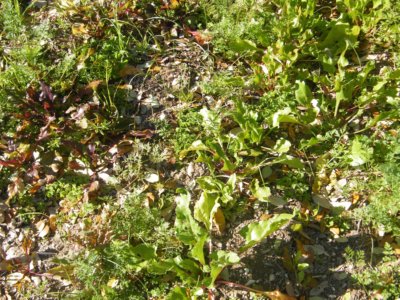
The beets I planted back in fall still aren't doing that well. They just haven't gotten enough rain, so they're just sitting there hardly growing. I'm really starting to wonder if I'll get a decent harvest from them at all, let alone be able to tell which varieties are best.

The second batch of beets are also still tiny. They only have two or three months left before it starts to get too hot for them.

The celery is also growing very slowly. I've heard celery needs a lot of water, and these just aren't getting much. I guess I need to buy a lot more drip hoses.

The kale and garlic are not doing much either, but at least the cabbage worms are finally gone. I haven't harvested any kale, and I might not. I get kale from my CSA, and the kale I'm growing is doing so poorly I think I might just leave it alone. I planned to save seed from this kale, since I used up the seed I had for this variety. Maybe I'll just leave it alone and let it do that.


Speaking of seed saving, the arugula is starting to make seed pods. The bees really like the flowers too.

The shallots seem to be doing ok. I've never grown shallots before, so I hope they do well. Onions are hard to grow here, so I'm looking for alternatives. Plus shallots are so expensive at the grocery store! I don't think I've ever eaten shallots before.

The fava beans seem to be doing fine. That's another thing I've never eaten before, but they grow during the winter, which is a good time to grow things here.

Some of the overwintered peppers are starting to put out some little leaves, though some look like they have died. I think once I can tell for sure which lived and which didn't make it, I'm going to transplant them into the front yard bed I just made. Peppers are pretty plants and would make good front yard plants.

I went ahead and put up some bird netting over the bamboo tee-pees I put up for the peas. It's not to keep birds away, but to give the peas something to climb on, since they were having trouble clinging onto the bamboo.

Well, spring is certainly in the air! I'm going to plant the rest of my nightshade transplants as soon as I get the chance, and I need to start seeds for some warm-weather things like basil soon. It's starting to become one of the busiest times of year for gardening!

Sunday, December 9, 2012

Winter Coming Late

For the last month or so, it seems like the deciduous trees just don't know what to do. We had a little cold weather, but then it's been in the 70's and even 80's for a while and very dry. Most of the trees usually turn in October, but some still seem confused and are turning color late, or some of their leaves are falling while some are still green.


Here are the Western Soapberry trees growing along the side of the old garden shed. Usually these turn a lovely golden color, but as you can see here, some of their leaves are still green, while others are already falling off.

The Flameleaf Sumac was also late in changing color to brilliant red. Usually it does that in October and would be leafless by now, but mine still has about half it's leaves left.

Other trees in the area, like the Cedar Elms, Red Oaks, and Pecans also seem confused, with some green leaves still hanging on even though it's December already!

Meanwhile, the Yaupon Hollies have plenty of berries and have for a while. It's kind of weird seeing them, a tree associated with winter and Christmas because of their winter berries, all loaded up with berries while it's 85 degrees outside.

The good news is we're supposed to get a good cold front tonight! It's supposed to get down to freezing every night for the next few days. I'm looking forward to it. Sure, it means I need to go out there today and pick all the rest of the peppers and tomatoes, and they probably won't survive, but it's just felt so wrong to be listening to Christmas carols and putting up lights when it's this warm. It's about time for it to be winter already.

Tuesday, November 13, 2012

A Roadside Diner for Butterflies

Hey migrating monarchs! Eat at Amanda's! I've got the most delicious Esparanza flowers for you!

Now that cold weather is setting in it's time to fuel up for that long flight down to Mexico. Be sure to stop by and fuel up. Here are some pictures of one of my satisfied customers from Saturday.


Wednesday, November 7, 2012

New Fruit Trees and a New Butterfly

A couple of weeks ago we started planting fruit trees in the ground here at our new house. Fall and winter is a good time to plant fruit trees here in Texas, and really any perennials. Since summer is our most stressful season for plants, it gives them the maximum amount of time to establish a good root system before the heat sets in.

I'm still not sure about all the fruit trees I'll end up planting. I have dreams of homegrown oranges, apples, pears, peaches, and plums, but our space is limited. There are few places on our property where fruit trees could grow without the competition from our numerous live oaks, and in a contest against a mighty oak, a puny dwarf fruit tree doesn't have much of a chance.

I already had a Meyer Lemon and Key Lime in a pot, then my father-in-law gave us a fig tree he grew from a cutting from the fig tree in his own yard. Then my husband bought us a small pomegranate tree from a local nursery.

We finally decided to plant them in the front yard, right along the street. The front yard has a mott of live oaks, but they're nearer the house, leaving a sunny strip right up front. And fruit trees are attractive, right? They should make fine front-yard plants!

I think we should cut back the oaks limbs a little bit. A couple of them stretch over very close to the fruit trees, but cutting them off shouldn't hurt the oak trees too much. A little bit of shade might actually be beneficial in this climate, but for the most part they're in the sun. There should be plenty of sun coming in from the street side (which is where I was standing when I took this picture).

Here's the pomegranate with a tomato cage around it to protect it from deer. It's a Wonderful, which is the variety they commonly sell in stores. I considered looking for a more unusual variety, but that was the only kind the nursery had. We paid $7 for it, and considering that pomegranates cost $3 or $4 each at the store, I think it was a good investment.

Here's the fig tree, without a cage, which turned out to be a bad idea, because I just checked on it this morning, and it looks like the deer might have sampled it. I thought fig leaves would have some kind of latex substance (like other members of the genus Ficus) that would deter deer, but it's only got two leaves left now. However, the leaves that got torn off are laying on the ground, so either I'm wrong and it wasn't deer after all, or they spit the leaves out. I'm sure it will grow back, but in the meantime, I should get a cage for it too.

The last tree we planted is the Meyer Lemon tree. We haven't planted the Key Lime yet, but plan to. No cage, because I'm sure deer wouldn't like the strong-smelling citrus leaves. Except, as I was watering the tree here, I noticed someone who does!

On one of the leaves I saw what at first glance looked like a great big bird poop, but upon closer inspection...

It's actually a caterpillar! A caterpillar trying to look like bird poop! Turns out it's a Giant Swallowtail caterpillar, one of the most impressive butterfly species around here. Very appropriate during the Butterfly Moon. Their host species are any members of the Citrus family, including some native trees that are common around here, like Wafer Ash and Tickle-tongue, but obviously they like the domesticated Citrus species as well. I decided to leave the caterpillar be. My lemon tree is very healthy, and can probably spare a few leaves for such a cool butterfly. It's funny how something so beautiful can grow from something that looks like poop!

Saturday, September 1, 2012

The Blue Moon

Last night was the Blue Moon, since it was the second full moon in one month. I tried to find out why it's called the blue moon, but with no luck. Last night during our evening walk I looked up at the moon and thought of Neil Armstrong, who died only a few days ago. He was a true hero. I can't imagine how terrifying and thrilling it must have been to be the first human ever to walk on the moon.

Back here on Earth, I'm glad August is finally over and that means it must be cooling down soon! Alas, it's still been in the high 90's most days. We had a weak cold front earlier in the month that made it more like the low 90's and even high 80's for a few days, but it went away quickly.

This Labor Day weekend is also the 1 year anniversary of the horrible Bastrop wildfires. It's a good reminder that at least this summer was not nearly as bad as last summer. No big wildfires this time around.

Out in the garden, the peppers are the healthiest looking plants. They quit setting fruit, but will probably start up again and give a second crop in fall. Which means I'm going to end up with a lot of peppers!

A few of the fall tomatoes didn't make it, and the ones that did are still small. It's just an experiment, so I'm not getting my hopes up too much. If they get some fruit, that would be great, but they might not have time before frost, with how slowly they're growing out there in the heat.

As for the spring tomatoes that I pruned back, it looks like about half of them died, and half of them are starting to grow back, like this one here. I think they're probably more likely to give another crop before frost than the fall tomatoes, since the plants already bigger.

The one honeydew melon I had rotted before I picked it. What a disappointment! The rest of the vines aren't looking too good either. I think maybe this isn't such a good variety after all. Even if the fruit hadn't rotted, it did only set one fruit among four plants. It's San Juan from Native Seeds/SEARCH, and I didn't notice this when I bought it, but the catalog says it's a variety for the "high desert". I'm not completely sure what they mean by high desert vs. low desert varieties, but I think the low desert ones are more heat tolerant than the high desert ones. Maybe from now on I should stick to low desert varieties when I buy seeds from there. They recommend runner beans for the high desert, and I know they don't do well here at all. I grew Scarlet Runner once and got one pod.

This is my tangle of cucumber, luffa gourd, and mustang grape vines, and they aren't looking too good either. The luffa vines look the best, though they still haven't set any fruit. I expect cucumbers to die in summer anyway, so no surprise there. I'd like to find a more heat tolerant cucumber variety that could actually survive a Texas summer, but so far no luck. I am a little worried about the wild mustang grape vine that was already growing there on its own.. It seems to have some sort of fungal infection, with rusty spots on the leaves. I wanted that grape vine to cover the fence, so I hope it recovers.

I was sure the Rattlesnake pole beans were all dead, but it looks like a few are starting to grow back. I found a few still-green vines mixed in with all the dead ones. Maybe I'll get a second batch of beans before frost.
Yes, the leeks are still here. I'm really surprised they haven't bolted yet. I've left them in the garden to see if they'll produce bulbils that can be planted next year. Those are little mini-bulbs that grow out the sides of old leeks, and can be replanted to propagate leeks asexually. I ought to dig some up to see if they have any yet. If it works out, this might be a better way for me to propagate leeks in the garden than from seed.

The basil I planted in the summer is still hanging in there, though in this picture it's very wilted. It's growing slowly, but should pick up in fall, hopefully well enough to make some batches of pesto to put in the freezer. Basil is very heat tolerant as long as it gets enough water. It bolts when it gets very hot, but I just pinch the flowers off (except for the basils I'm growing for seed). Bolting doesn't seem to adversely affect the flavor of basil like it does for some other herbs.

Here's a picture of what I plan on becoming an herb garden this fall. We have a nice patio in the back of the house, and I thought it would be neat to plant herbs along the brick ledge. That way the trailing herbs like thyme and mint will cascade over the bricks, and once we get a table and chairs and start having dinner parties out there, people can brush up against the herbs surrounding them and smell the fragrance. That's the idea, anyway. There's already esparanza there and a couple of rose bushes, but still plenty of room for herbs.  I've been piling leaves and grass clippings up to start improving the soil and choking out the grass and weeds.  On the patio you can see three of my potted herbs that I'm going to plant in the ground. They've been in these pots for a long time, but now that I have my own place they're going in the ground. Herbs always seem to do better in the ground anyway. I'll probably plant these pretty soon. It's a bit too hot and humid out there right now to make me feel much like digging holes, but the first cooler day we have when I have time, they're going in!

And then there's my fall vegetables. I've got mustard greens, collard greens, arugula, broccoli raabe, kale, chard, parsley, dill, and cilantro waiting for their turn in the garden too. Most of them are still small and can stay in the pots a bit longer, but it won't be too much longer before it's time for them to go in the ground too.