
It's seed catalog season, so I thought I'd let you know about some of my favorite companies to get seeds and why. Where you get your seeds from does matter. You want to get varieties that are well adapted to your climate, and a seed catalog that's based in a climate similar to yours will have more of those varieties.
When I first started gardening, I was surprised about how many seed companies are in New England or the Pacific Northwest. They advertised varieties that were quick maturing for short growing seasons, tolerant of cold, etc. Not very helpful for me here in Texas. What I need is heat tolerance and drought tolerance. After a while I finally found some catalogs based in the South that had more of what I was looking for.
Here are my favorites:
Southern Exposure Seed Exchange
More of my seeds come from here than any other company. They are based in Virginia, so most of their varieties are adapted to the Southeast. That's a little bit wetter than my climate, but many of them still do well, and I hedge my bets by also getting seeds from the next company on my list. Their website also has lots of useful information on it, and I like the cute gnome pictures on the front of their printed catalog.
Besides the usual things like squash, beans, and tomatoes, they have a great selection of heirloom collard varieties, many of which I haven't seen anywhere else. Their potato varieties have also been serving me very well, especially since potatoes are considered to be difficult to grow in Texas.
Overall, this is my go-to seed catalog that I check first if I feel like trying a new variety.
Native Seeds/SEARCH
This my second-biggest source of seeds. They are based in Arizona, which is a drier climate than mine, so combining their varieties with Southern Exposure's varieties works out great. This is actually a nonprofit organization whose main mission is to preserve crop varieties that have been grown by Native Americans in the Southwest, so I'm happy to fork over money to them to help support their mission. You can get varieties here you can't find anywhere else, plus some more common varieties that do well in hot, dry conditions.
This is where I bought 10 bulbs of I'itois onions that have continued to thrive and multiply in my garden ever since. My favorite okra, Beck's Gardenville, also came from here (and it's a local San Antonio variety). They also have a good variety of melons, but of course their biggest selection is of the three sisters: beans, corn, and squash.
There's also this really neat ADAPTS tool on their website where you can type in your address, and it will find varieties of plants that came from climates similar to yours. I've used this to help me decide which varieties to try next.
Those two seed catalogs above are where I get the vast majority of my seeds from, but here are some honorable mentions that I shop at occasionally, or get some specialty things from.
Baker Creek Heirloom Seeds
This company is famous for their "vegetable porn" catalog and huge selection. Yet I've found that over the years I get fewer and fewer seeds from them. Most of the varieties I did get from Baker Creek that did well for me are also carried by Southern Exposure. I've also gotten a lot of varieties from Baker Creek that did not do well. I think it's because they don't concentrate on one specific region, so I got sucked in by the beautiful pictures and bought varieties that were not adapted to my climate.
Baker Creek's strategy seems to be to try to accumulate as many varieties as possible from all over the world. That means you can get some really interesting stuff that's not found anywhere else, but you also have to be careful to pay attention to where the variety is from. Here in Texas, varieties from the Mediterranean, or the Middle East, or India will probably be OK. But not things from Northern Europe or Japan, no matter how pretty they look.
So basically, I don't actually buy a lot of things from Baker Creek, but it's still fun to browse their catalog and order a thing or two just to experiment with something unusual. They also have huge seed packets with generous amounts of seeds in them, which may be advantageous with certain crops.
Filaree Garlic Farm
This is where I go for garlic. They have the best selection I've found, including the very hard to find Creole varieties. The bulbs they send are always in very good shape, and their website has tons of information about growing garlic. They specify which of their varieties do well in warm climates, and which need cold climates, and also which ones harvest earlier or later, and which ones keep longer.
Sand Hill Preservation Center
This is where to go for sweet potatoes, though Duck Creek Farms is also good. Sand Hill has the largest variety of sweet potatoes anywhere, many varieties you can't find anywhere else. My only problem with them is sometimes they arrive a little late since they are in Iowa, and I am in Texas, so I can plant much earlier here. If you are in a hurry, try Duck Creek Farms instead, since they are in Oklahoma and ship earlier in the year.
I've never ordered any seeds from Sand Hill yet, but they do have some interesting things listed that I might like to try some day. They do have the problem of being based in Iowa, so I'd have to be careful not to order something that's not suitable for my climate.
Seed Savers Exchange
Another one in Iowa, but this gets an honorable mention because it's such an important organization. This is where the whole "heirloom vegetable" trend probably got started, and they also got me into heirloom vegetables. I used to order more stuff from them before I discovered my two favorites listed there at the top. Their retail catalog is OK. It has a lot of the more famous heirlooms, but many that either are also found in lots of other catalogs (like Southern Exposure), or wouldn't do well in my climate anyway (sorry Pink Brandywine tomato).
If you are into seed saving though, you need to get on the Exchange. I started listing some of my seeds last year. It took a while for them to finally get into the 21st century and make an online Exchange (before that it was just in print), but now that they do have it up and running, it is very easy to list your seeds. Online seed swapping is lots of fun, you get to share the excess seeds that you have saved, and you might find something really interesting listed by another member. Seed catalogs are great, but you never know when they are going to run out of or discontinue a favorite variety, so it's always good to have a network of home seed savers as a backup.
So there are my favorite places to get seeds (and other planting materials) for my garden. If you also live in the South, consider giving them a try if you haven't already. Even if you don't live in the South, maybe I've given you some ideas on what to look for when searching for your own favorite seed company.
Happy seed ordering!
Showing posts with label sweet potatoes. Show all posts
Showing posts with label sweet potatoes. Show all posts
Thursday, January 9, 2020

Monday, December 8, 2014
Sweet Potato Pie
I'm the pie maker for our family's Thanksgiving at my in-law's house. Each year I bring two pies. This year I made an apple pie, and a sweet potato pie from homegrown sweet potatoes.

It was a good opportunity to use up the Garnet sweet potatoes that had split (like the one in the picture) or been damaged during harvest (a few of them got broken in half or stabbed with the digging fork). The damaged sweet potatoes weren't going to last very long in storage and needed to be used up soon. I ended up having enough damaged Garnets to get the 2 cups mashed sweet potato needed for the pie. I considered using the Molokai purple sweet potatoes, but decided to save those for something else. I wasn't sure how a purple sweet potato pie would look.

One of my sweet potatoes was a bit confused about whether it was an orange or purple sweet potato, but once I had them cooked and mashed up, the purple streaks didn't show. I cooked the sweet potatoes in the microwave and then mashed them with a fork.
Sweet potato pie is similar to pumpkin pie, but not exactly. Sweet potatoes have a denser texture than pumpkin, with more starch. I used a recipe from my Better Homes and Gardens red and white checkered cookbook, so I'm not sure if it's legal for me to reprint it here.
One difference from a pumpkin pie is it used a prebaked pie crust, which I made myself. With pumpkin pies, you use a raw crust, and the crust and filling cook together. It also needed 3 eggs, while a pumpkin pie needs 4 (maybe because sweet potatoes are denser) and a cup of buttermilk. The buttermilk seemed weird, but it gave the pie a nice tangy flavor. The spices were allspice and nutmeg. No cinnamon or ginger like pumpkin pie.
The recipe also called for only half a cup of sugar. It probably depends on how sweet your sweet potatoes are to begin with, and I was afraid mine weren't sweet enough, so I increased the sugar to 3/4 a cup. I'm glad I did too, because the pie still ended up being not especially sweet and probably could have been OK with a full cup of sugar. It was fine the way it was, though, and probably healthier than a sweeter dessert. Next time I think I'll use brown sugar instead of white.

And here is the finished pie. A lot of the time my pumpkin pies end up too soft and the slices don't stay together, but we had no problem with this pie holding together because of the density of the sweet potatoes. It looked like a pumpkin pie but had a distinctly different flavor because of the different spices and buttermilk.
Oh, and of course it was served with plenty of whipped cream.
The only problem I think needs improvement is the pie filling was a little bit lumpy. Next time I'm going to try mashing the sweet potatoes in the food processor or stand mixer to get a perfectly smooth puree.
But overall both pies were a big hit, judging by how we only had one piece leftover from each for us to take home.
It was a good opportunity to use up the Garnet sweet potatoes that had split (like the one in the picture) or been damaged during harvest (a few of them got broken in half or stabbed with the digging fork). The damaged sweet potatoes weren't going to last very long in storage and needed to be used up soon. I ended up having enough damaged Garnets to get the 2 cups mashed sweet potato needed for the pie. I considered using the Molokai purple sweet potatoes, but decided to save those for something else. I wasn't sure how a purple sweet potato pie would look.
One of my sweet potatoes was a bit confused about whether it was an orange or purple sweet potato, but once I had them cooked and mashed up, the purple streaks didn't show. I cooked the sweet potatoes in the microwave and then mashed them with a fork.
Sweet potato pie is similar to pumpkin pie, but not exactly. Sweet potatoes have a denser texture than pumpkin, with more starch. I used a recipe from my Better Homes and Gardens red and white checkered cookbook, so I'm not sure if it's legal for me to reprint it here.
One difference from a pumpkin pie is it used a prebaked pie crust, which I made myself. With pumpkin pies, you use a raw crust, and the crust and filling cook together. It also needed 3 eggs, while a pumpkin pie needs 4 (maybe because sweet potatoes are denser) and a cup of buttermilk. The buttermilk seemed weird, but it gave the pie a nice tangy flavor. The spices were allspice and nutmeg. No cinnamon or ginger like pumpkin pie.
The recipe also called for only half a cup of sugar. It probably depends on how sweet your sweet potatoes are to begin with, and I was afraid mine weren't sweet enough, so I increased the sugar to 3/4 a cup. I'm glad I did too, because the pie still ended up being not especially sweet and probably could have been OK with a full cup of sugar. It was fine the way it was, though, and probably healthier than a sweeter dessert. Next time I think I'll use brown sugar instead of white.
And here is the finished pie. A lot of the time my pumpkin pies end up too soft and the slices don't stay together, but we had no problem with this pie holding together because of the density of the sweet potatoes. It looked like a pumpkin pie but had a distinctly different flavor because of the different spices and buttermilk.
Oh, and of course it was served with plenty of whipped cream.
The only problem I think needs improvement is the pie filling was a little bit lumpy. Next time I'm going to try mashing the sweet potatoes in the food processor or stand mixer to get a perfectly smooth puree.
But overall both pies were a big hit, judging by how we only had one piece leftover from each for us to take home.
Friday, November 21, 2014
Sweet Potato Harvest 2014

This past weekend I decided it was time to harvest the sweet potatoes, because it looked like the last weekend we'd have before a freeze. Even without a freeze, as you can see in the picture above, my sweet potatoes thought it was too cold anyway. They're such tropical plants, that even temperatures under 40 degrees F makes them wilt.
My harvest this year was a bit disappointing. Still not as good as what I got in 2010. I'll have enough to eat for the holidays, but not the bumper crop I was hoping for.
I planted slips I grew from three varieties I got last year from Duck Creek Farms: Garnet, Molokai Purple, and Carolina Nugget. I discontinued White Yam because it didn't do well at all.
This year they ranked about the same as last year. Garnet was the best, followed by Molokai Purple, followed by Carolina Nugget.

Again this was my best variety, with a few specimens getting pretty large. Nice bright red skin. I'll keep growing this one unless/until I find a better orange variety.

This variety also did well again. Love the color! Now I have enough to actually do a taste comparison between purple and orange sweet potatoes. In 2010 I learned that White Yam was much drier and firmer than orange sweet potatoes. It made excellent sweet potato fries, while orange sweet potatoes can sometimes fall apart when they cook (fine if you're mashing them, but bad for fries). I'm interested to see what purple sweet potatoes are like in flavor and texture.

Again Carolina Nugget was OK but not great. I got a few nice-looking potatoes, but not many. I gave it a second chance, but now I've decided to discontinue it. It's too similar to Garnet, but inferior, so out it goes.
For new varieties to try, I ordered three from Southern Exposure Seed Exchange: Sweetie Pie, O'Henry, and Violetta. They came in bundles of six plants each, but sadly none of them did well.

Sweetie Pie
This is another ordinary orange variety, but unlike Garnet it has normal leaves instead of ivy leaves. I only got one root that wasn't split (the one at the top right of the picture), but it did get damaged by my digging fork. The rest were badly split all over.
This may not be completely their fault. This variety was right next to a big leak in the soaker hose, so when the sweet potatoes were watered, they got flooded. I didn't realize it would make that big of a difference, but maybe that's what split them.
Still, they went in the compost pile. I'll stick with Garnet for my orange variety for now.

This was my attempt to find another white variety, but as you can see, it turned out to be pretty pathetic.
Violetta
I don't even have a picture for Violetta. I think all the plants for this one died. I couldn't find any. It was supposed to be a variety with purple skin and white flesh. I was curious to find out what a potato like that would taste like (more like a purple or like a white?), but I guess I'll have a try another one next year.
Conclusions
I'm keeping Molokai Purple and Garnet again for next year, but that's it. They didn't give quite the bumper crop I wanted, but still did respectably, especially compared to all the other varieties I tried this year.
The plants I got from Southern Exposure Seed Exchange weren't quite as good as Duck Creek Farms. DCF's slips were in excellent condition when they arrived, while SESE's slips were in more typical condition for slips that just spent some time packed up in a box. I'm not sure if DCF does something special to help their plants make the journey, or if I was just lucky that time. I'm also not sure if it matters all that much, since the slips I grew in 2010 were from Shumway's, and they looked more like SESE's slips, but ended up growing just fine.
Another problem was DEER! The deer feasted on the sweet potato leaves several times before I discovered I Must Garden Deer Repellent. Even though the plants grew back, I'm sure having to regrow all those leaves diverted a lot of resources away from growing lots of roots.
Finally, Bermudagrass is starting to invade my raised beds. It was especially bad on the side where I planted the new varieties from SESE. I hate that stuff! It's coming in from the surrounding lawn. A project on my to-do list is to put landscape fabric and mulch around all the raised beds so that there isn't grass right next to them.
I'm already wondering which new sweet potato varieties I should try next year. Should I get some other varieties from Duck Creek Farms, since they did so well? Should I try a different place, like Sand Hill Preservation Center? Should I go back to Shumway's and get more White Yam since they did so well in 2010?
In the meantime, I think this year I'll make sweet potato pie for Thanksgiving.
Thursday, November 21, 2013
Sweet Potato Harvest 2013
In 2010 I had a nice sweet potato harvest, but then in 2011 the drought killed them all, and in 2012 I was busy moving.
Now I have just harvested Sweet Potato Class of 2013! It's not nearly as good as 2010, but hey at least I got sweet potatoes.
I got the slips from Duck Creek Farms this time, and they arrived in excellent condition. I don't think I've ever had mail-order plants look this good before. I only ordered 5 plants of each variety just to test them out.
To be fair to the sweet potatoes, I didn't plant them in the best spot. They were in the back garden, on the very back row, near the trees which probably shaded them a bit. They were also neglected a bit back there. I didn't get much of a harvest, but frankly I'm glad I got anything at all this time.
I probably won't eat many of these if I eat any at all. I'm going to save most of them for growing slips to replant next year. Next time I'm planting them in my new raised beds with lots of nice soil that won't be so hard on either me (to dig them up!) or the sweet potatoes.
 Carolina Nugget
This variety had a bushy growth habit, rather than long vines. It has what I think are called "ivy leaves" in sweet potato terminology. The leaves had deep lobes and were very pretty. I didn't get very many roots from them, but the ones I did get were nice looking. The skin ranges from orange to red, and the interior is "normal" orange sweet potato color.
 Garnet
This variety is also listed as Dianne by Duck Creek Farms, but I think Garnet is a more descriptive name, because most of the roots had a nice red color. The inside is also orange. It was basically like a more vigorous version of Carolina Nugget. The leaves were not as deeply lobed, and the vines were much longer. This was actually the most vigorous plant above ground, with lots of vines trailing all over the place, and it ended up flowering with pretty purple morning glory flowers (sweet potatoes being a species of morning glory, after all). When I dug them up, I angered several honeybees that were working on the flowers, but didn't get stung. Too bad they didn't have time to make seeds, since growing true sweet potato seeds would be an interesting project.
Below ground matched above ground. This variety gave me the biggest yield of the biggest roots.
 Molokai Purple
This is a variety from Hawaii, and was the second most vigorous variety, with the second biggest yield. The vines had "normal" leaves, which means they weren't deeply lobed like the orange varieties I grew. They were also very pretty, with a purple tint to the newer leaves.
This variety got the most damage from the frost we had a few days ago, which is what prompted me to go ahead and harvest them before the next frost hits.
The coolest thing about this variety is it's purple through and through. I accidentally broke one potato, and the color inside doesn't look real.
 White Triumph
This variety was not particularly triumphant. I got it because some sources say that this is the same variety as White Yam and Southern Queen. White Yam was one of my best varieties from 2010, so I was eager to grow it again.
Now I'm pretty sure this is not the same thing. The vines were always yellow and sickly looking, and by August most of them had died. When I dug up what was left of them today, what you see in the picture is literally all I got.
Next year I'd like to get the "real" White Yam again, which R.H. Shumway still carries. Or maybe I'll get Southern Queen which is carried by Sand Hill Preservation Center, because I've heard good things about that variety too. White Triumph went in the compost pile.
To sum things up, in order from best to worst this year were: Garnet, Molokai Purple, Carolina Nugget, and White Triumph.
I'm not growing White Triumph again and will need to seek out a better white variety. I think the other three all deserve a second chance. I will probably eliminate one of the orange ones eventually, since they seem kind of redundant, but I don't have the heart to eliminate Carolina Nugget just yet.
Now I have just harvested Sweet Potato Class of 2013! It's not nearly as good as 2010, but hey at least I got sweet potatoes.
I got the slips from Duck Creek Farms this time, and they arrived in excellent condition. I don't think I've ever had mail-order plants look this good before. I only ordered 5 plants of each variety just to test them out.
To be fair to the sweet potatoes, I didn't plant them in the best spot. They were in the back garden, on the very back row, near the trees which probably shaded them a bit. They were also neglected a bit back there. I didn't get much of a harvest, but frankly I'm glad I got anything at all this time.
I probably won't eat many of these if I eat any at all. I'm going to save most of them for growing slips to replant next year. Next time I'm planting them in my new raised beds with lots of nice soil that won't be so hard on either me (to dig them up!) or the sweet potatoes.

This variety had a bushy growth habit, rather than long vines. It has what I think are called "ivy leaves" in sweet potato terminology. The leaves had deep lobes and were very pretty. I didn't get very many roots from them, but the ones I did get were nice looking. The skin ranges from orange to red, and the interior is "normal" orange sweet potato color.

This variety is also listed as Dianne by Duck Creek Farms, but I think Garnet is a more descriptive name, because most of the roots had a nice red color. The inside is also orange. It was basically like a more vigorous version of Carolina Nugget. The leaves were not as deeply lobed, and the vines were much longer. This was actually the most vigorous plant above ground, with lots of vines trailing all over the place, and it ended up flowering with pretty purple morning glory flowers (sweet potatoes being a species of morning glory, after all). When I dug them up, I angered several honeybees that were working on the flowers, but didn't get stung. Too bad they didn't have time to make seeds, since growing true sweet potato seeds would be an interesting project.
Below ground matched above ground. This variety gave me the biggest yield of the biggest roots.

This is a variety from Hawaii, and was the second most vigorous variety, with the second biggest yield. The vines had "normal" leaves, which means they weren't deeply lobed like the orange varieties I grew. They were also very pretty, with a purple tint to the newer leaves.
This variety got the most damage from the frost we had a few days ago, which is what prompted me to go ahead and harvest them before the next frost hits.
The coolest thing about this variety is it's purple through and through. I accidentally broke one potato, and the color inside doesn't look real.

This variety was not particularly triumphant. I got it because some sources say that this is the same variety as White Yam and Southern Queen. White Yam was one of my best varieties from 2010, so I was eager to grow it again.
Now I'm pretty sure this is not the same thing. The vines were always yellow and sickly looking, and by August most of them had died. When I dug up what was left of them today, what you see in the picture is literally all I got.
Next year I'd like to get the "real" White Yam again, which R.H. Shumway still carries. Or maybe I'll get Southern Queen which is carried by Sand Hill Preservation Center, because I've heard good things about that variety too. White Triumph went in the compost pile.
To sum things up, in order from best to worst this year were: Garnet, Molokai Purple, Carolina Nugget, and White Triumph.
I'm not growing White Triumph again and will need to seek out a better white variety. I think the other three all deserve a second chance. I will probably eliminate one of the orange ones eventually, since they seem kind of redundant, but I don't have the heart to eliminate Carolina Nugget just yet.
Sunday, July 28, 2013
The Thunder Moon


The Rattlesnake pole beans are still getting eaten like crazy by the deer. Well, now I know not to plant beans in the front without a lot of protection.
We actually aren't have too bad of a summer this year. We actually got a couple of good rainstorms, once of which dumped 4 inches of rain on us. The deer and chickens are causing a much bigger problem than the weather this year.
Friday, June 7, 2013
Greening Moon - belated full moon update
I'm back! Last week we went on vacation to the Big Bend area, and before that I was really busy with final exams and getting final grades in, so May's full moon post is about two weeks late.
May is supposed to be our wettest month, and we did get around 3 inches of rain, which isn't actually that much, but better than we have been getting.
Lots of things have been happening in the garden that probably deserve their own post. First the neighbor's chickens were causing a lot of damage digging up things in the front garden, then while we were on vacation the deer found it! I also got my sweet potato plants from Duck Creek Farms and planted them. I've been harvesting a few paste tomatoes, but I think the deer are eating a lot of them too. That makes comparing yields from the different varieties I planted difficult. I might have to leave out that bit of data this time around and just compare things like plant vigor and heat tolerance.

I knew I was risking things by planting my Rattlesnake beans in the front, and sure enough, the deer have been eating the leaves off of them. The funny thing is it looks like my deer are lazy, and are only eating the leaves in the middle of the vine, not bothering to bend down to eat the ones near the ground, or stand up to reach the higher ones.

The chickens dug up a lot of the beans, so in their place I planted the rest of my Waltham Butternut squash seeds. There were from Seed Savers Exchange in 2009, and I guess they were getting old because I was having trouble getting them to germinate. I went ahead and planted all the rest of my seeds in the ground before we left, and when we came back some of them were sprouting.
 The deer are also eating the ends of the shoots on the tomatoes and peppers. I guess the new growth is more tender. Some of my peppers are getting fruit anyway, but I'm sure the deer have eaten a lot of the blossoms.
 Weirdly, they don't seem to like the eggplants. The remaining eggplants I have that didn't get dug up by the chickens are making fruits now. This variety is Fengyuan Purple, and the eggplants growing on it are really long and skinny! The biggest one I have so far looks like it's over a foot long. Guess I need to make some more Thai Green Curry paste to make these into curry with.
 The tomatillos aren't looking so good. I've harvested a lot of them, but now it looks like they're starting to die down. I don't know if it's because they aren't getting enough water or something else. The deer haven't bothered them either, even the ones outside the wire cage my husband made for them.
 I should be harvesting lots of tomatoes now, but the deer have been mostly beating me to them. When I got back from vacation there were hardly any ripe ones to be found, except for a few that look like this. This is a nice big Red Brandywine with a big chomp out of it. Another annoying this is it appears deer don't know the difference between a ripe and an unripe tomato. Maybe because they're colorblind? I found lots of green tomatoes, including a really nice Opalka that was the size of a Poblano pepper with bites out of them.
 The only thing I have left to plant is my okra. Some of them took a really long time to come up, which isn't that unusual with okra. I got three varieties from Native Seeds/SEARCH, all from Texas: Beck's Gardenville, Eagle Pass, and Hill Country Red. I know I'm a bit late on okra planting, but okra can really take the heat, so I think they'll be OK.

 I'm still waiting on the potatoes to die down. It's taking longer than I thought it would. I also haven't harvested the garlic or shallots yet. The garlic still doesn't look good, but the shallots are still pretty green.
 This is Tatume squash, a Mexican heirloom that is in the C. pepo species but is supposed to be more resistant to squash vine borers. I planted five, and it looks like the borers already got one, but the others are doing pretty well, so we'll see.

 The Christmas Lima beans are in the back, so the deer aren't eating them, and they're doing great. They're just starting to get blossoms.
 Here are my sweet potatoes I just planted right before we went on vacation. They probably deserve a post of their own. They've just gotten settled after transplanting and are starting to grow.
 The fava beans just aren't doing too great though. It started getting hot just as they were making pods, so I think they just didn't have enough time. This fall I'll have to plant them much sooner.
OK, that's my update. By now I should be getting my summer crops in if it wasn't for the darn deer.
May is supposed to be our wettest month, and we did get around 3 inches of rain, which isn't actually that much, but better than we have been getting.
Lots of things have been happening in the garden that probably deserve their own post. First the neighbor's chickens were causing a lot of damage digging up things in the front garden, then while we were on vacation the deer found it! I also got my sweet potato plants from Duck Creek Farms and planted them. I've been harvesting a few paste tomatoes, but I think the deer are eating a lot of them too. That makes comparing yields from the different varieties I planted difficult. I might have to leave out that bit of data this time around and just compare things like plant vigor and heat tolerance.

I knew I was risking things by planting my Rattlesnake beans in the front, and sure enough, the deer have been eating the leaves off of them. The funny thing is it looks like my deer are lazy, and are only eating the leaves in the middle of the vine, not bothering to bend down to eat the ones near the ground, or stand up to reach the higher ones.

The chickens dug up a lot of the beans, so in their place I planted the rest of my Waltham Butternut squash seeds. There were from Seed Savers Exchange in 2009, and I guess they were getting old because I was having trouble getting them to germinate. I went ahead and planted all the rest of my seeds in the ground before we left, and when we came back some of them were sprouting.


Taking a quick look at the herb garden, the Esperanza is starting to overwhelm things again, like I knew it would. The other plants aren't doing too bad though. Herbs really like being in the ground much more than in pots. Once I planted all my herbs in the ground, ones that had been in pots on my apartment balcony for years, they really took off. In the background here is the Mexican oregano flowering like crazy. To the gnome's right is marjoram, while to his left is thyme. Elsewhere in the herb garden I've got Greek oregano, rosemary, peppermint, orange mint, catmint, catnip, lemon balm, yarrow, skullcap, horehound, parsley, and now a few different kinds of basil.


The Moon and Stars watermelon plants are also doing well. I planted four of them. I also just planted three Melon de Castilla plants, a cantaloupe from Native Seeds/SEARCH.


OK, that's my update. By now I should be getting my summer crops in if it wasn't for the darn deer.
Thursday, October 13, 2011
The Butterfly Moon
The traditional name for October's full moon is the Harvest Moon, which would be nice if I were harvesting anything. This is another case of Phoenix Moon Grove's name being more appropriate, because I have seen quite a few butterflies around, especially since things have finally cooled down. This is the time of year monarch butterflies, the state insect of Texas, migrate through on their way to Mexico for the winter. I've also seen quite a few swallowtails of various sorts feeding from the flowers that have bloomed now that we got some rain.
I think it's safe to say the Worst Summer Ever is finally over! Cold fronts have brought cool weather and rain, and that 100 degree October day I feared won't happen after all.

In the garden there are a few survivors of summer's wrath. The California Wonder bell pepper plants have started putting out fruit, at last. The problem is I'm not sure if I'll get any to mature before frost. It might be too late for that. I'll save seeds from them if I do.

Only two tomatillos survived. I never got any fruit before the extreme heat set it, and like with the peppers, I am afraid I might not get any before frost. We usually get our first freeze somewhere around Thanksgiving. Looks like it turns out that watering these plants all through summer wasn't worth it, if I don't get a fall crop. I guess now I know better for next year.

Here's something unexpected. Once it started raining again, some of my sweet potatoes have re-sprouted! I was sure they were all dead, and I had mowed that spot down. Looks like I've got a couple of Vardamans and a couple of Nancy Halls coming back. Maybe I'll dig them up and put them in pots to overwinter them for next spring.

I've been working on planting the fall crops I started in pots. This autumn is turning out to be much more a time for planting than for harvesting. Here's my bed of cauliflower, mustard, and collards. They're doing pretty well so far.

In another bed I direct-seeded peas, and root crops like radishes, carrots, turnips, and beets. Most of them are sprouting well.

Now I'm thinking it may have been a mistake to start peppers in the fall. They didn't get big enough in time to plant them and get a harvest before frost, so I'll try to keep them in post over winter, but they're getting big now. I just pruned them back a bit because they were starting to get tall and leggy. Maybe once it gets colder that will slow down their growth.

Here's my lettuce I've started in flats. The last time I did an online seed swap I got a whole lot of lettuce seeds. Since lettuce seeds don't have a long shelf-life, I decided to plant a whole bunch this winter. It will be much more lettuce than I could ever eat. This will be more of a trial to see which varieties do the best, and then I'll save seed from the best ones (thankfully lettuce doesn't cross-pollinate much, so I can save seed from more than one variety at a time). As you may be able to tell from the picture, some of the lettuce varieties have much higher germination rates than others, so it's probably a good thing that I'm renewing them this winter before germination drops off even more.
Well, it's a huge relief that summer is finally over! I'm worried that the drought will continue next summer, but at least for now the weather is bearable, and even if we stay behind on rain, cooler temperatures will make that a little less bad.
I think it's safe to say the Worst Summer Ever is finally over! Cold fronts have brought cool weather and rain, and that 100 degree October day I feared won't happen after all.

In the garden there are a few survivors of summer's wrath. The California Wonder bell pepper plants have started putting out fruit, at last. The problem is I'm not sure if I'll get any to mature before frost. It might be too late for that. I'll save seeds from them if I do.

Only two tomatillos survived. I never got any fruit before the extreme heat set it, and like with the peppers, I am afraid I might not get any before frost. We usually get our first freeze somewhere around Thanksgiving. Looks like it turns out that watering these plants all through summer wasn't worth it, if I don't get a fall crop. I guess now I know better for next year.
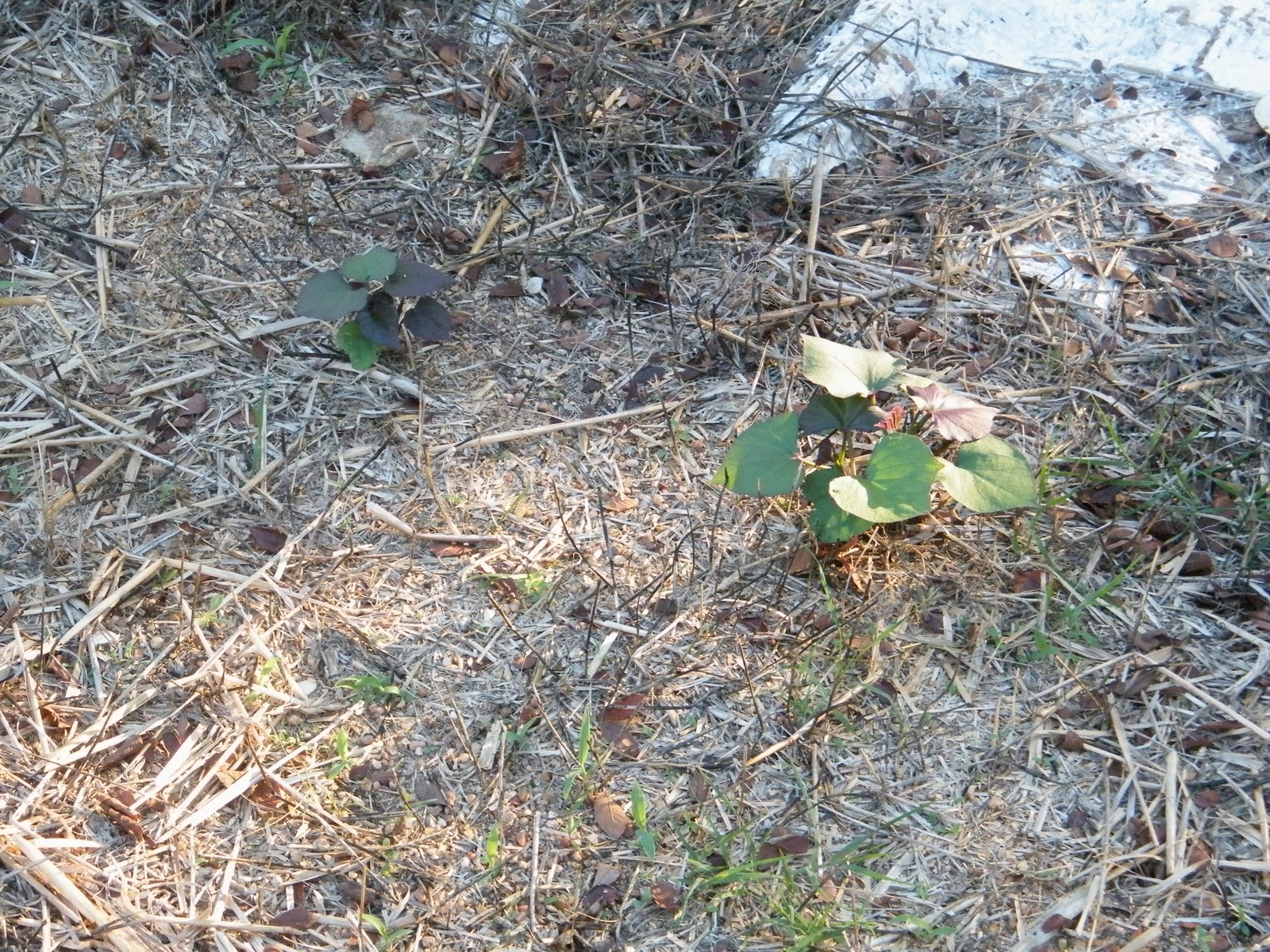
Here's something unexpected. Once it started raining again, some of my sweet potatoes have re-sprouted! I was sure they were all dead, and I had mowed that spot down. Looks like I've got a couple of Vardamans and a couple of Nancy Halls coming back. Maybe I'll dig them up and put them in pots to overwinter them for next spring.

I've been working on planting the fall crops I started in pots. This autumn is turning out to be much more a time for planting than for harvesting. Here's my bed of cauliflower, mustard, and collards. They're doing pretty well so far.

In another bed I direct-seeded peas, and root crops like radishes, carrots, turnips, and beets. Most of them are sprouting well.

Now I'm thinking it may have been a mistake to start peppers in the fall. They didn't get big enough in time to plant them and get a harvest before frost, so I'll try to keep them in post over winter, but they're getting big now. I just pruned them back a bit because they were starting to get tall and leggy. Maybe once it gets colder that will slow down their growth.

Here's my lettuce I've started in flats. The last time I did an online seed swap I got a whole lot of lettuce seeds. Since lettuce seeds don't have a long shelf-life, I decided to plant a whole bunch this winter. It will be much more lettuce than I could ever eat. This will be more of a trial to see which varieties do the best, and then I'll save seed from the best ones (thankfully lettuce doesn't cross-pollinate much, so I can save seed from more than one variety at a time). As you may be able to tell from the picture, some of the lettuce varieties have much higher germination rates than others, so it's probably a good thing that I'm renewing them this winter before germination drops off even more.
Well, it's a huge relief that summer is finally over! I'm worried that the drought will continue next summer, but at least for now the weather is bearable, and even if we stay behind on rain, cooler temperatures will make that a little less bad.
Subscribe to:
Posts (Atom)