
I've been a bit of a food hoarder ever since the Great Recession. I always buy nonperishable food and toiletries in bulk at Costco. I have a chest freezer in my utility room that I keep full of frozen meat and extra vegetables from the garden. It's all stuff I use anyway (it's not like I'm buying buckets of freeze dried food or MRE's), so I figured it was a harmless habit, but one that I'd probably never really need anyway.
And then this pandemic happened, and suddenly it's all come in really handy. I still have plenty of toilet paper!
Seed saving is similar. Saving seeds is fun, but I figured I was kidding myself to think I'd ever really need it. I don't have any varieties that are unique or special. They are ones always available in seed catalogs or from other gardeners. I could always get more if I have to. I don't have any varieties that are relying on just me to save them or else they will go extinct.
And now since the pandemic, all the seed companies are shut down due to "high demand" that they can't keep up with. I guess suddenly everyone decided they are going to grow their own food.
Since I had the baby, I've scaled back my gardening, and have just been concentrating on my favorites that do really well for me. No experimenting with new things, at least not right now. So I don't really need the seed catalogs right now. I have jars full of all my favorite varieties in my freezer. I only use seed catalogs for trying out new varieties. I have all my old favorites in plentiful supply.
I have enough that I could share them with people. I'm listed on Seed Savers Exchange. I'm assuming, since with the Exchange you request seeds directly from other gardeners, that you can still do that right now while all the seed companies are closed.
I'm surprised I haven't gotten any requests for anything since the pandemic. Actually, I've gotten very few requests overall since I joined. Just one for tomato seeds and two for I'itois onions (I'm waiting for them to mature before I send out bulbs). Maybe not a lot of people know about Seed Savers Exchange.
But suddenly the online seed exchange seems a lot more useful than it did before. Before it just seemed like fun. Now it seems like one of the only safe ways to get seeds right now.
Showing posts with label seed saving. Show all posts
Showing posts with label seed saving. Show all posts
Monday, April 13, 2020

Thursday, January 9, 2020
My Favorite Seed Catalogs
It's seed catalog season, so I thought I'd let you know about some of my favorite companies to get seeds and why. Where you get your seeds from does matter. You want to get varieties that are well adapted to your climate, and a seed catalog that's based in a climate similar to yours will have more of those varieties.
When I first started gardening, I was surprised about how many seed companies are in New England or the Pacific Northwest. They advertised varieties that were quick maturing for short growing seasons, tolerant of cold, etc. Not very helpful for me here in Texas. What I need is heat tolerance and drought tolerance. After a while I finally found some catalogs based in the South that had more of what I was looking for.
Here are my favorites:
Southern Exposure Seed Exchange
More of my seeds come from here than any other company. They are based in Virginia, so most of their varieties are adapted to the Southeast. That's a little bit wetter than my climate, but many of them still do well, and I hedge my bets by also getting seeds from the next company on my list. Their website also has lots of useful information on it, and I like the cute gnome pictures on the front of their printed catalog.
Besides the usual things like squash, beans, and tomatoes, they have a great selection of heirloom collard varieties, many of which I haven't seen anywhere else. Their potato varieties have also been serving me very well, especially since potatoes are considered to be difficult to grow in Texas.
Overall, this is my go-to seed catalog that I check first if I feel like trying a new variety.
Native Seeds/SEARCH
This my second-biggest source of seeds. They are based in Arizona, which is a drier climate than mine, so combining their varieties with Southern Exposure's varieties works out great. This is actually a nonprofit organization whose main mission is to preserve crop varieties that have been grown by Native Americans in the Southwest, so I'm happy to fork over money to them to help support their mission. You can get varieties here you can't find anywhere else, plus some more common varieties that do well in hot, dry conditions.
This is where I bought 10 bulbs of I'itois onions that have continued to thrive and multiply in my garden ever since. My favorite okra, Beck's Gardenville, also came from here (and it's a local San Antonio variety). They also have a good variety of melons, but of course their biggest selection is of the three sisters: beans, corn, and squash.
There's also this really neat ADAPTS tool on their website where you can type in your address, and it will find varieties of plants that came from climates similar to yours. I've used this to help me decide which varieties to try next.
Those two seed catalogs above are where I get the vast majority of my seeds from, but here are some honorable mentions that I shop at occasionally, or get some specialty things from.
Baker Creek Heirloom Seeds
This company is famous for their "vegetable porn" catalog and huge selection. Yet I've found that over the years I get fewer and fewer seeds from them. Most of the varieties I did get from Baker Creek that did well for me are also carried by Southern Exposure. I've also gotten a lot of varieties from Baker Creek that did not do well. I think it's because they don't concentrate on one specific region, so I got sucked in by the beautiful pictures and bought varieties that were not adapted to my climate.
Baker Creek's strategy seems to be to try to accumulate as many varieties as possible from all over the world. That means you can get some really interesting stuff that's not found anywhere else, but you also have to be careful to pay attention to where the variety is from. Here in Texas, varieties from the Mediterranean, or the Middle East, or India will probably be OK. But not things from Northern Europe or Japan, no matter how pretty they look.
So basically, I don't actually buy a lot of things from Baker Creek, but it's still fun to browse their catalog and order a thing or two just to experiment with something unusual. They also have huge seed packets with generous amounts of seeds in them, which may be advantageous with certain crops.
Filaree Garlic Farm
This is where I go for garlic. They have the best selection I've found, including the very hard to find Creole varieties. The bulbs they send are always in very good shape, and their website has tons of information about growing garlic. They specify which of their varieties do well in warm climates, and which need cold climates, and also which ones harvest earlier or later, and which ones keep longer.
Sand Hill Preservation Center
This is where to go for sweet potatoes, though Duck Creek Farms is also good. Sand Hill has the largest variety of sweet potatoes anywhere, many varieties you can't find anywhere else. My only problem with them is sometimes they arrive a little late since they are in Iowa, and I am in Texas, so I can plant much earlier here. If you are in a hurry, try Duck Creek Farms instead, since they are in Oklahoma and ship earlier in the year.
I've never ordered any seeds from Sand Hill yet, but they do have some interesting things listed that I might like to try some day. They do have the problem of being based in Iowa, so I'd have to be careful not to order something that's not suitable for my climate.
Seed Savers Exchange
Another one in Iowa, but this gets an honorable mention because it's such an important organization. This is where the whole "heirloom vegetable" trend probably got started, and they also got me into heirloom vegetables. I used to order more stuff from them before I discovered my two favorites listed there at the top. Their retail catalog is OK. It has a lot of the more famous heirlooms, but many that either are also found in lots of other catalogs (like Southern Exposure), or wouldn't do well in my climate anyway (sorry Pink Brandywine tomato).
If you are into seed saving though, you need to get on the Exchange. I started listing some of my seeds last year. It took a while for them to finally get into the 21st century and make an online Exchange (before that it was just in print), but now that they do have it up and running, it is very easy to list your seeds. Online seed swapping is lots of fun, you get to share the excess seeds that you have saved, and you might find something really interesting listed by another member. Seed catalogs are great, but you never know when they are going to run out of or discontinue a favorite variety, so it's always good to have a network of home seed savers as a backup.
So there are my favorite places to get seeds (and other planting materials) for my garden. If you also live in the South, consider giving them a try if you haven't already. Even if you don't live in the South, maybe I've given you some ideas on what to look for when searching for your own favorite seed company.
Happy seed ordering!
When I first started gardening, I was surprised about how many seed companies are in New England or the Pacific Northwest. They advertised varieties that were quick maturing for short growing seasons, tolerant of cold, etc. Not very helpful for me here in Texas. What I need is heat tolerance and drought tolerance. After a while I finally found some catalogs based in the South that had more of what I was looking for.
Here are my favorites:
Southern Exposure Seed Exchange
More of my seeds come from here than any other company. They are based in Virginia, so most of their varieties are adapted to the Southeast. That's a little bit wetter than my climate, but many of them still do well, and I hedge my bets by also getting seeds from the next company on my list. Their website also has lots of useful information on it, and I like the cute gnome pictures on the front of their printed catalog.
Besides the usual things like squash, beans, and tomatoes, they have a great selection of heirloom collard varieties, many of which I haven't seen anywhere else. Their potato varieties have also been serving me very well, especially since potatoes are considered to be difficult to grow in Texas.
Overall, this is my go-to seed catalog that I check first if I feel like trying a new variety.
Native Seeds/SEARCH
This my second-biggest source of seeds. They are based in Arizona, which is a drier climate than mine, so combining their varieties with Southern Exposure's varieties works out great. This is actually a nonprofit organization whose main mission is to preserve crop varieties that have been grown by Native Americans in the Southwest, so I'm happy to fork over money to them to help support their mission. You can get varieties here you can't find anywhere else, plus some more common varieties that do well in hot, dry conditions.
This is where I bought 10 bulbs of I'itois onions that have continued to thrive and multiply in my garden ever since. My favorite okra, Beck's Gardenville, also came from here (and it's a local San Antonio variety). They also have a good variety of melons, but of course their biggest selection is of the three sisters: beans, corn, and squash.
There's also this really neat ADAPTS tool on their website where you can type in your address, and it will find varieties of plants that came from climates similar to yours. I've used this to help me decide which varieties to try next.
Those two seed catalogs above are where I get the vast majority of my seeds from, but here are some honorable mentions that I shop at occasionally, or get some specialty things from.
Baker Creek Heirloom Seeds
This company is famous for their "vegetable porn" catalog and huge selection. Yet I've found that over the years I get fewer and fewer seeds from them. Most of the varieties I did get from Baker Creek that did well for me are also carried by Southern Exposure. I've also gotten a lot of varieties from Baker Creek that did not do well. I think it's because they don't concentrate on one specific region, so I got sucked in by the beautiful pictures and bought varieties that were not adapted to my climate.
Baker Creek's strategy seems to be to try to accumulate as many varieties as possible from all over the world. That means you can get some really interesting stuff that's not found anywhere else, but you also have to be careful to pay attention to where the variety is from. Here in Texas, varieties from the Mediterranean, or the Middle East, or India will probably be OK. But not things from Northern Europe or Japan, no matter how pretty they look.
So basically, I don't actually buy a lot of things from Baker Creek, but it's still fun to browse their catalog and order a thing or two just to experiment with something unusual. They also have huge seed packets with generous amounts of seeds in them, which may be advantageous with certain crops.
Filaree Garlic Farm
This is where I go for garlic. They have the best selection I've found, including the very hard to find Creole varieties. The bulbs they send are always in very good shape, and their website has tons of information about growing garlic. They specify which of their varieties do well in warm climates, and which need cold climates, and also which ones harvest earlier or later, and which ones keep longer.
Sand Hill Preservation Center
This is where to go for sweet potatoes, though Duck Creek Farms is also good. Sand Hill has the largest variety of sweet potatoes anywhere, many varieties you can't find anywhere else. My only problem with them is sometimes they arrive a little late since they are in Iowa, and I am in Texas, so I can plant much earlier here. If you are in a hurry, try Duck Creek Farms instead, since they are in Oklahoma and ship earlier in the year.
I've never ordered any seeds from Sand Hill yet, but they do have some interesting things listed that I might like to try some day. They do have the problem of being based in Iowa, so I'd have to be careful not to order something that's not suitable for my climate.
Seed Savers Exchange
Another one in Iowa, but this gets an honorable mention because it's such an important organization. This is where the whole "heirloom vegetable" trend probably got started, and they also got me into heirloom vegetables. I used to order more stuff from them before I discovered my two favorites listed there at the top. Their retail catalog is OK. It has a lot of the more famous heirlooms, but many that either are also found in lots of other catalogs (like Southern Exposure), or wouldn't do well in my climate anyway (sorry Pink Brandywine tomato).
If you are into seed saving though, you need to get on the Exchange. I started listing some of my seeds last year. It took a while for them to finally get into the 21st century and make an online Exchange (before that it was just in print), but now that they do have it up and running, it is very easy to list your seeds. Online seed swapping is lots of fun, you get to share the excess seeds that you have saved, and you might find something really interesting listed by another member. Seed catalogs are great, but you never know when they are going to run out of or discontinue a favorite variety, so it's always good to have a network of home seed savers as a backup.
So there are my favorite places to get seeds (and other planting materials) for my garden. If you also live in the South, consider giving them a try if you haven't already. Even if you don't live in the South, maybe I've given you some ideas on what to look for when searching for your own favorite seed company.
Happy seed ordering!
Saturday, December 7, 2019
Seed Saving Projects
Knowing that I wouldn't have much time to garden when I have a newborn baby, I've been trying to reduce how much stuff I had going on in the garden this past year. I decided to focus more on a few seed saving projects rather than trying to grow lots different varieties of vegetables for food. In a way growing seeds is easier than growing food because you just plant the plants and then mostly leave them alone. Instead of trying to prevent the lettuce or other greens from bolting, you just let them bolt. Instead of picking pea pods, cucumbers, or okra everyday to make sure you get them while they're still tender enough to eat, just let them all turn brown and then harvest them all at once. Instead of growing several different varieties of a species, just concentrate on growing one favorite variety so it won't cross with anything else. And if the plants get neglected a bit, tell yourself you're selecting them for harsh conditions.
So once I found out I was pregnant, I went through my seed collection and picked out varieties that were getting a bit old or that I was getting low on, which meant it's time to save a new batch of seeds from them.
I also went ahead and started listing varieties on Seed Savers Exchange. For a while I thought you had to be an actual member of SSE to list seeds, but it turns out you don't. (Or maybe that's how it used to be, but they changed their policy.) I have seeds listed on there now. I've only gotten one request so far, which is disappointing, but maybe I'll get more once the print yearbook comes out.
Here's are some varieties I've saved this year and listed on Seed Savers Exchange:
Cougar Lettuce - I got this lettuce from Bountiful Gardens. When they were going out of business I bought a packet of every lettuce they carried that said it was heat tolerant. Cougar is one that's done well for me, so I saved seeds from it this year. Lettuce seeds are easy to save. You just plant a bunch of lettuce and leave it alone and let it bolt. I've read that lettuce doesn't cross, so you can save seeds from multiple varieties, but I just saved this one variety this time around. The hardest part might be cleaning the seeds since they have this white fluffy stuff on them like dandelions. Last Christmas I requested these seed cleaning frames and screens from Southern Exposure Seed Exchange, so that makes it much easier.
Tall Telephone Peas - I originally got this variety from Baker Creek in 2009, and this is the third generation I've saved. I like the big long vines this variety produces. That means I get lots of peas for the same amount of space. I grow them on a tall trellis made of cattle panels turned sideways. I didn't harvest any peas to eat this year and just let all the pods turn brown and papery, and then harvested the mature seeds all at once. Easy.
Texsel Greens - I didn't plan on saving seeds from this, since this was the first year for me to grow them, and I still have plenty of seeds left in the packet, but they did so well that when they finally bolted I let the seeds mature. They are Brassica carinata, which is a tetraploid hybrid between Brassica oleracea (which is the species that collards, kale, and broccoli are in) and Brassica nigra (black mustard), so they won't cross with any other plants I grow. And they are just like a cross between collards and mustard! The leaves are like collard greens, but thinner and a little more spicy. I got a good harvest of them and cooked them the same way I cooked collard greens, and they grew faster than my collard greens (hybrid vigor maybe?).
I also listed some seeds that I harvested in 2018 and 2017 that have been kept in airtight containers in the freezer. I mentioned that in the description just in case anyone cares about that, but they should still be good. I've got several varieties of tomatoes, Tatume squash, Seminole pumpkins, Sugar Snap peas, and Texas Hill Country Red okra. All of them are varieties that have proven their worth in my garden, so I saved seeds from them.
I tried to save seeds from Tuscan Kale, but they didn't make it. It's definitely my favorite kale to eat. It's so much better than the curly kale my grocery store carries. But it doesn't seem to like this hot climate. I think I planted my kale too late this time. It wasn't able to mature before it got hot, and I waited and waited for it to bolt, but instead it just got totally eaten up caterpillars. I have more seeds, so I'll try again some day.
Genetically Diverse Carrot Mix
Speaking of plants that have trouble making it in my climate, I've also decided to try my hand at so-called "Landrace Gardening." I found out about it from this article in Mother Earth News. I'm not sure if "landrace" is really the correct term for something like this, but that's what this Lofthouse fellow is calling it.
It takes almost an opposite approach from what people usually do with seed saving. Instead of going to all the trouble to keep separate varieties pure and free of crossing, you plant a bunch of different varieties together and let them cross. Then you save seeds from them and plant them and repeat the process until you have a population of plants that are well adapted to your climate.
This past winter I decided to try this out with carrots. I picked carrots for my first experiment with this technique for the following reasons:
So once I found out I was pregnant, I went through my seed collection and picked out varieties that were getting a bit old or that I was getting low on, which meant it's time to save a new batch of seeds from them.
I also went ahead and started listing varieties on Seed Savers Exchange. For a while I thought you had to be an actual member of SSE to list seeds, but it turns out you don't. (Or maybe that's how it used to be, but they changed their policy.) I have seeds listed on there now. I've only gotten one request so far, which is disappointing, but maybe I'll get more once the print yearbook comes out.
Here's are some varieties I've saved this year and listed on Seed Savers Exchange:
Cougar Lettuce - I got this lettuce from Bountiful Gardens. When they were going out of business I bought a packet of every lettuce they carried that said it was heat tolerant. Cougar is one that's done well for me, so I saved seeds from it this year. Lettuce seeds are easy to save. You just plant a bunch of lettuce and leave it alone and let it bolt. I've read that lettuce doesn't cross, so you can save seeds from multiple varieties, but I just saved this one variety this time around. The hardest part might be cleaning the seeds since they have this white fluffy stuff on them like dandelions. Last Christmas I requested these seed cleaning frames and screens from Southern Exposure Seed Exchange, so that makes it much easier.
Tall Telephone Peas - I originally got this variety from Baker Creek in 2009, and this is the third generation I've saved. I like the big long vines this variety produces. That means I get lots of peas for the same amount of space. I grow them on a tall trellis made of cattle panels turned sideways. I didn't harvest any peas to eat this year and just let all the pods turn brown and papery, and then harvested the mature seeds all at once. Easy.
Texsel Greens - I didn't plan on saving seeds from this, since this was the first year for me to grow them, and I still have plenty of seeds left in the packet, but they did so well that when they finally bolted I let the seeds mature. They are Brassica carinata, which is a tetraploid hybrid between Brassica oleracea (which is the species that collards, kale, and broccoli are in) and Brassica nigra (black mustard), so they won't cross with any other plants I grow. And they are just like a cross between collards and mustard! The leaves are like collard greens, but thinner and a little more spicy. I got a good harvest of them and cooked them the same way I cooked collard greens, and they grew faster than my collard greens (hybrid vigor maybe?).
I also listed some seeds that I harvested in 2018 and 2017 that have been kept in airtight containers in the freezer. I mentioned that in the description just in case anyone cares about that, but they should still be good. I've got several varieties of tomatoes, Tatume squash, Seminole pumpkins, Sugar Snap peas, and Texas Hill Country Red okra. All of them are varieties that have proven their worth in my garden, so I saved seeds from them.
I tried to save seeds from Tuscan Kale, but they didn't make it. It's definitely my favorite kale to eat. It's so much better than the curly kale my grocery store carries. But it doesn't seem to like this hot climate. I think I planted my kale too late this time. It wasn't able to mature before it got hot, and I waited and waited for it to bolt, but instead it just got totally eaten up caterpillars. I have more seeds, so I'll try again some day.
Genetically Diverse Carrot Mix
Speaking of plants that have trouble making it in my climate, I've also decided to try my hand at so-called "Landrace Gardening." I found out about it from this article in Mother Earth News. I'm not sure if "landrace" is really the correct term for something like this, but that's what this Lofthouse fellow is calling it.
It takes almost an opposite approach from what people usually do with seed saving. Instead of going to all the trouble to keep separate varieties pure and free of crossing, you plant a bunch of different varieties together and let them cross. Then you save seeds from them and plant them and repeat the process until you have a population of plants that are well adapted to your climate.
This past winter I decided to try this out with carrots. I picked carrots for my first experiment with this technique for the following reasons:
- Carrots are hard for me to grow but not impossible. Joseph Lofthouse lives in a climate that is too cold for most melons to do well, so decided to try a landrace of them that do. My problem is I live in a climate where it's too hot for cool weather plants like carrots. The seeds have to be planted while it's still pretty hot outside in late summer/early fall in order to harvest them before it gets hot again in spring. I also have dense, rocky clay soil. So when I plant carrots, a lot of them don't make it, but usually at least a few of them do. That means I can plant seeds from the few survivors and maybe eventually get carrots that are better adapted to my garden.
- Carrots are strong outbreeders. Unlike tomatoes, which don't tend to cross pollinate much, carrots have to cross pollinate with each other, and they are very prone to inbreeding depression. Lack of genetic diversity doesn't really hurt tomatoes, but it does hurt carrots. So mixing a bunch of varieties of carrots together and letting them cross makes a very diverse carrot population, and I won't have to worry about inbreeding for several generations at least.
- I don't mind having a mixture of different looking carrots to eat. "Rainbow carrots" are trendy right now, and that's just a mixture of different varieties of carrots with different colors besides all orange. And then people sell them at the store and farmer's markets for twice as much money as orange carrots! So my carrots are going to be selected for surviving in my conditions (probably they'll end up having short, stubby roots, better heat and drought tolerance, and maybe faster maturity), but I'm going to try to save seed from different colors of carrots so I'll always have a fun mixture.
So this past fall I planted three varieties of carrots: Chantenay, Atomic Red, and Purple Dragon. I planted more Chantenay than the other two. It's an orange carrot with short, stubby roots, so I expected that it would do the best, so I wanted more of its genetics in my population. Purple Dragon is also a shorter carrot, but the main cool thing about it is it's purple! Atomic Red is long and skinny, unfortunately, but it's red, so I put it in too so I'll have more colors.
Then when I harvested them, I separated out the biggest, prettiest carrots, and replanted them instead of eating them. I ended up with mostly Chantenays, a few Purple Dragons, and 2 or 3 Atomic Reds that could be replanted for seed.
I'm was surprised at how long it took to get mature seeds from them. It took until late summer for the seeds to mature. That's another thing to keep in mind about seed saving. It makes the crop take up space in your garden for a much longer period of time, preventing you from planting anything else in that spot. But maybe that's a good thing for me, since it prevented me from succumbing to the temptation to plant more things in that bed to take care of while I was in in my third trimester of pregnancy. Snipping off the brown carrot seedheads and throwing them in a bucket to finish drying wasn't that hard.
 |
| Bucket of drying carrot seeds |
I discovered that carrot seeds are also hard to clean. Their seeds have these sticky hairs on them, similar to a very annoying weed I get in my yard called Beggar's Lice, which looks a lot like a carrot plant, so I think they are related. The carrot seeds are not as sticky as the Beggar's Lice, but when I cut off the umbels and pull the seeds out, they do stick to my gloves. At least they smell good while I'm working on them.
I ended up with a lot of seeds from this. I filled up a pint mason jar with seeds and put them in the fridge. I wasn't able to get them as clean as commercial seeds, so there is some chaff taking up that space, but that's still a lot of carrot seeds. That's another good thing about seed saving. I always end up with many more seeds than I'll ever need, so I have plenty to share and swap, but I can also plant lots of seeds and not worry as much about some of them not making it.
I haven't planted any yet, but I plan to soon. I think I'll just toss some of them in the garden somewhere and see how they do. Since I have a lot of seeds, I can plant a lot of them and don't have to worry if a lot of them don't make it. With the new baby taking up most of my time, they'll probably end up being pretty neglected. I might not have time to water, thin, weed, and otherwise pamper these carrots as much as I have with carrots in the past. But that might be a good thing, because if any of them do make it, I can save seeds from them to select them for surviving neglect. If none of them make it, I have plenty more to try again next year.
I also plan to add more varieties in the future. I've had luck before with Danvers carrots, another short orange variety, so I'd like to add that one. And maybe I should add some more colors. I don't really like the looks of white carrots, but maybe some yellow and some other varieties of red or purple. Baker Creek Heirloom seeds has some strange and unusual carrot varieties that might be good to add to the mix.
I can only list pure varieties on Seed Savers Exchange, so I can't list my carrot mix, but I'm still looking forward to seeing what I come up with.
And maybe I'll try this with some other species in the future. I don't really see the point of growing a landrace tomato, for instance, because tomatoes don't mind inbreeding and I already have some heirloom varieties of tomatoes that do well for me, so I'm just going to keep growing those. But there might be some other plants that I might want to try doing this with for similar reasons as the carrots. Maybe landrace beets next?
One more limitation I might have is space. Joseph Lofthouse is a farmer, so he grows entire fields of his landraces. I'm just a suburban home gardener. Carrots plants aren't that big. I planted my carrots for seed about six inches apart, and they ended up taking up about a 6x4 foot space, so that's room for... about 96 carrots? I probably ended up with less than that, but that's still a good population number for right now, giving me plenty to select from. Lofthouse grows a lot of melons and squash, which take up a lot of room. I probably don't have enough room to grow 50-100 melon vines. For those species it would probably also also be best to seek out existing varieties that do well for me and doing traditional seed saving where the varieties are kept pure.
One more limitation I might have is space. Joseph Lofthouse is a farmer, so he grows entire fields of his landraces. I'm just a suburban home gardener. Carrots plants aren't that big. I planted my carrots for seed about six inches apart, and they ended up taking up about a 6x4 foot space, so that's room for... about 96 carrots? I probably ended up with less than that, but that's still a good population number for right now, giving me plenty to select from. Lofthouse grows a lot of melons and squash, which take up a lot of room. I probably don't have enough room to grow 50-100 melon vines. For those species it would probably also also be best to seek out existing varieties that do well for me and doing traditional seed saving where the varieties are kept pure.
Squash Vine Borer Resistant Summer Squash
I've written about this project before, and it's still not going well. To recap, I want to cross Tatume, a variety of Mexican summer squash with long vines that can outgrow squash vine borers, with bush varieties of summer squash like zucchini or yellow squash. I'm still having trouble getting the different varieties of squash to be timed just right so they have male and female flowers on them at the same time and can cross. Tatume takes longer to mature than bush varieties, so won't cross with bush varieties if I plant them at the same time. And since bush varieties grow so fast and then get killed by the SVB's so fast, there's a very short window where they can have a chance to cross with Tatume.
I've started focusing more on trying to get my bush squash varieties to survive longer. The latest trick I've been trying out is covering them with tulle fabric to keep the SVB's away until female flowers show up. Then I uncover them so the bees can get to the flowers. This gives them a head start to grow nice and big before the borers start getting them.
I could keep them covered up all the time and hand-pollinate them, but that seems like a lot of trouble. Squash flowers open at dawn and then wilt after only a couple of hours, so I'd have to be out there hand-pollinating during that short window of time. I'd rather just let the bees do it, but that does leave them exposed.
So last year I saved seeds from Tatume so I'll have an ample supply of pure Tatume seeds to experiment with, but all my other summer squash varieties didn't make it long enough to save seeds from or even to cross with Tatume. So still no summer squash crosses.
Wednesday, November 29, 2017
Bountiful Gardens is Going out of Business
Heads up everyone! One of my favorite seed companies, Bountiful Gardens, is going out of business. Everything is on clearance and selling out fast. Better go there are order all the varieties you want before they sell out. They are closing December 13.
My favorite thing about this seed company has always been their wide selection of greens, especially ones that tolerate hot weather. They have heat-tolerant lettuce varieties that I don't see in any other catalogs. I just ordered a packet each of all of them, plus a few other unusual species of greens that most other catalogs don't carry.
When I first got into seed-saving, I read a lot about the problem of seed companies going out of business when they're the only one that carries a particular variety of plant, and then the variety goes extinct if home seed savers don't maintain it. Honestly, I wasn't too worried about that. I thought it was an exaggeration. I mean, come on, how many times does that actually happen? And if only one catalog was carrying that variety anyway, was it even really that great of a variety to begin with?
I don't believe that anymore after finding some varieties that did really great in my garden that really are only carried in one seed catalog. I still think that it probably doesn't happen that often, but it does happen.
So go to www.bountifulgardens.org and if you see anything interesting or unusual, snatch it up now before it sells out! And then when you grow it, if it does well in your garden, save the seeds.
My favorite thing about this seed company has always been their wide selection of greens, especially ones that tolerate hot weather. They have heat-tolerant lettuce varieties that I don't see in any other catalogs. I just ordered a packet each of all of them, plus a few other unusual species of greens that most other catalogs don't carry.
When I first got into seed-saving, I read a lot about the problem of seed companies going out of business when they're the only one that carries a particular variety of plant, and then the variety goes extinct if home seed savers don't maintain it. Honestly, I wasn't too worried about that. I thought it was an exaggeration. I mean, come on, how many times does that actually happen? And if only one catalog was carrying that variety anyway, was it even really that great of a variety to begin with?
I don't believe that anymore after finding some varieties that did really great in my garden that really are only carried in one seed catalog. I still think that it probably doesn't happen that often, but it does happen.
So go to www.bountifulgardens.org and if you see anything interesting or unusual, snatch it up now before it sells out! And then when you grow it, if it does well in your garden, save the seeds.
Friday, August 5, 2016
A Snag in my Zucchini Breeding Project
Well, you know what they say about the best laid plans.
Here's a quick update on how the zucchini breeding project has gone. It looks like this is going to take longer than I thought.
Since summer squash usually put out male flowers before female flowers, I planted Tatume a couple of weeks earlier than Costata Romanesca this spring, since I wanted to use Tatume as the female parent. What I need for that is male flowers on CR and female flowers on Tatume at the same time.
The Tatume plants were up and growing when I planted Costata Romanesca, but as soon as the CR seeds sprouted, they started growing very fast.
By the time CR started making male flowers, Tatume just started making vines.
By the time CR started making female flowers, Tatume had just started making male flowers.
By the time CR started making fruit, Tatume was still just making male flowers. At this point I thought maybe I could try switching things, and making CR the mother and Tatume the father, so at least I'd get something. So I didn't harvest any of the zucchinis for eating (like I had planned to do), and instead left them on the plants to mature.
And then the Squash Vine Borers showed up. The CR plants started to collapse. The borers even bored into the fruits themselves and made them rot before maturing.
By June or so, the Costata Romanesca zucchini plants were all dead, without even making one good mature fruit with seeds with Tatume as their father.
Now, in early August, Tatume is still around, still growing vines, and still only making male flowers!
I don't know what its problem is. Did I plant it in a bad spot? Is it not getting enough sun or nutrients? Why won't it make fruits?
It's almost that time of year where Texans can plant more summer squash for a quick fall crop before it gets too cold. Since it looks like my Tatume squash are going to survive the summer (which is one of the great things about that variety), I'm going to try planting more zucchini to try again for a cross this fall. And I might have to be less picky about which one is the father and which one is the mother and just try to get any mature fruits at all.
See? I told you growing summer squash in Central Texas is tricky!
Here's a quick update on how the zucchini breeding project has gone. It looks like this is going to take longer than I thought.
Since summer squash usually put out male flowers before female flowers, I planted Tatume a couple of weeks earlier than Costata Romanesca this spring, since I wanted to use Tatume as the female parent. What I need for that is male flowers on CR and female flowers on Tatume at the same time.
The Tatume plants were up and growing when I planted Costata Romanesca, but as soon as the CR seeds sprouted, they started growing very fast.
By the time CR started making male flowers, Tatume just started making vines.
By the time CR started making female flowers, Tatume had just started making male flowers.
By the time CR started making fruit, Tatume was still just making male flowers. At this point I thought maybe I could try switching things, and making CR the mother and Tatume the father, so at least I'd get something. So I didn't harvest any of the zucchinis for eating (like I had planned to do), and instead left them on the plants to mature.
And then the Squash Vine Borers showed up. The CR plants started to collapse. The borers even bored into the fruits themselves and made them rot before maturing.
By June or so, the Costata Romanesca zucchini plants were all dead, without even making one good mature fruit with seeds with Tatume as their father.
Now, in early August, Tatume is still around, still growing vines, and still only making male flowers!
I don't know what its problem is. Did I plant it in a bad spot? Is it not getting enough sun or nutrients? Why won't it make fruits?
It's almost that time of year where Texans can plant more summer squash for a quick fall crop before it gets too cold. Since it looks like my Tatume squash are going to survive the summer (which is one of the great things about that variety), I'm going to try planting more zucchini to try again for a cross this fall. And I might have to be less picky about which one is the father and which one is the mother and just try to get any mature fruits at all.
See? I told you growing summer squash in Central Texas is tricky!
Friday, January 8, 2016
Introducing the Squash Vine Borer Resistant Zucchini Project
It's a new year, and I'm rethinking what I do with this blog. It had gotten boring and tedious for me, but after taking a break for a while, I thought about some things I could write about that might make things more interesting.
One of my Christmas gifts was The Tao of Vegetable Gardening by Carol Deppe. I already had Breed Your Own Vegetable Varieties and The Resilient Gardener, so I was really glad to receive her newest book.
When I first started this blog, I was unemployed and gardening was a way to feel like I was doing something productive with my time. Now I have a full time job, but gardening is still very important to me for a lot of the same reasons Deppe talks about in her books.
She talks a lot about seed saving and plant breeding, and says that all gardeners should do it. I've been saving seeds for years, but I think it's finally about time I try my hand at a breeding project. If nothing else, it sounds like a lot of fun, but maybe it will also result in me getting a really useful new plant variety, or maybe even distribute to other people in my region.
A project like this should have a clear goal, so my goal is to breed a zucchini squash that can produce a good crop despite the bane of all people who attempt to grow summer squash in my area: the dreaded Squash Vine Borer.
Because of SVBs, the idea of having too much zucchini so you have to sneak some onto your neighbor's porch is a fantasy to gardeners around here. Squash Vine Borers are moths (actually really cool looking moths) that lay their eggs on squash plants. The caterpillars then bore into the squash plant’s stem and eat them out from the inside until the whole plant collapses and dies. They especially like Cucurbita pepo and Cucurbita maxima. (Cucurbita moschata and Cucurbita argyrosperma are resistant.)
Most summer squash is in the species C. pepo. Whenever I try to grow zucchini, pattypans, or yellow crooknecks, I might get a squash or two before they collapse from getting eaten from the inside by those darn borers. I haven't even tried growing any of the winter squash varieties of C. pepo like delicatas or acorns because I'm sure they won't make it to maturity.
But I have an idea for a solution! Tatume is the only C. pepo summer squash variety I’ve found so far that gives me a good crop before succumbing to the borers. I think that’s because unlike most summer squash varieties, it has long vines instead of a bushy growth habit. That allows it to outgrow the borers and root at the nodes. Borers still get into it, but I still get a decent crop of squash from it. Most other summer squashes die before I get any fruit at all because they have such short stems that the borers eat them up really fast.
People like bush squash because they take up less room, but I don't think that helps any when you don't even get any squash at all from them before the borers kill them. I know I'm kind of going backwards here, but I want more vigorous, viney summer squash varieties instead of compact bush varieties.
One of my Christmas gifts was The Tao of Vegetable Gardening by Carol Deppe. I already had Breed Your Own Vegetable Varieties and The Resilient Gardener, so I was really glad to receive her newest book.
When I first started this blog, I was unemployed and gardening was a way to feel like I was doing something productive with my time. Now I have a full time job, but gardening is still very important to me for a lot of the same reasons Deppe talks about in her books.
She talks a lot about seed saving and plant breeding, and says that all gardeners should do it. I've been saving seeds for years, but I think it's finally about time I try my hand at a breeding project. If nothing else, it sounds like a lot of fun, but maybe it will also result in me getting a really useful new plant variety, or maybe even distribute to other people in my region.
A project like this should have a clear goal, so my goal is to breed a zucchini squash that can produce a good crop despite the bane of all people who attempt to grow summer squash in my area: the dreaded Squash Vine Borer.
Because of SVBs, the idea of having too much zucchini so you have to sneak some onto your neighbor's porch is a fantasy to gardeners around here. Squash Vine Borers are moths (actually really cool looking moths) that lay their eggs on squash plants. The caterpillars then bore into the squash plant’s stem and eat them out from the inside until the whole plant collapses and dies. They especially like Cucurbita pepo and Cucurbita maxima. (Cucurbita moschata and Cucurbita argyrosperma are resistant.)
Most summer squash is in the species C. pepo. Whenever I try to grow zucchini, pattypans, or yellow crooknecks, I might get a squash or two before they collapse from getting eaten from the inside by those darn borers. I haven't even tried growing any of the winter squash varieties of C. pepo like delicatas or acorns because I'm sure they won't make it to maturity.
But I have an idea for a solution! Tatume is the only C. pepo summer squash variety I’ve found so far that gives me a good crop before succumbing to the borers. I think that’s because unlike most summer squash varieties, it has long vines instead of a bushy growth habit. That allows it to outgrow the borers and root at the nodes. Borers still get into it, but I still get a decent crop of squash from it. Most other summer squashes die before I get any fruit at all because they have such short stems that the borers eat them up really fast.
People like bush squash because they take up less room, but I don't think that helps any when you don't even get any squash at all from them before the borers kill them. I know I'm kind of going backwards here, but I want more vigorous, viney summer squash varieties instead of compact bush varieties.
It also makes sense for Tatume to do well here because it’s a
South Texas heirloom. Having long vines is only one of its advantages. It's also much more tolerant of heat and drought than other C. pepo squash. It probably has other useful genes that help it survive in Texas besides just the gene for a vine growth habit.
The fruits of Tatume are sort of like an oval shaped zucchini. They are green when at immature
eating stages, and turn yellow when mature, looking a lot like a small spaghetti squash. They taste just fine, so if Tatume is just fine, why not just grow Tatume and that will be my one variety of summer squash I can grow?
Part of the reason is just for the heck of it, so I can try out a breeding project. But I also think it might be good to have more varieties of C. pepo I can grow here than just one. Crossing other varieties of C. pepo with Tatume could give me all kinds of different fruits on Tatume's drought tolerant, heat tolerant, squash vine borer tolerant vines.
I decided to start with crossing Tatume with a zucchini.
Maybe later I can try with other varieties, but I think zucchini is a good place to start because zucchini isn't as different from Tatume as some varieties. I won’t have to deal
with trying to change the fruit color that way, since Tatume is already green like a zucchini. They're also both good as summer squashes. Starting out crossing Tatume with a winter squash like a delicata might be complicated because then I'd have to select for fruits that are good as winter squash. I'll see how it goes with the Tatume/zucchini cross and then think about making other Tatume crosses.
The next step was to choose which variety of zucchini to use for the cross, since there are several. Carol Deppe and several other people consider Costata Romanesca to
be the best zucchini, so last year I tried it out. I got the seeds from
Bountiful Gardens. I planted six plants, and got three fruits, one on one plant
and two on another plant. The other three plants all died from borers before
producing fruits, though they did make some male flowers that may have contributed
pollen. I ate one fruit off the plant that had two to see if it really did
taste as good as people say, and it did. I let the other two fruits mature to
see if that was even possible, and they did manage to mature before the plants
died of borers, but just barely. I saved the seeds from the survivors, and I
also have 16 of the original seeds left in the packet.
Costata Romanesca seems like a good zucchini, so now I have
the parents for my new squash variety picked out. Next comes deciding which will
be the mother (to get fruits and seeds from) and which will be the father (to
get pollen from). The choice here is obvious. Tatume needs to be the mom and CR
will be the dad. It’s easier for a plant to make male flowers and pollen than a fruit with
mature seeds, so the mom should always be the better survivor of the two. I
just barely got any fruits when I grew CR, so it makes a lot more sense to get
pollen from CR and have Tatume make the fruits.
That means this year I should make my cross. I will need to
grow both varieties, and get some female Tatume flowers pollinated by male
Costata Romanesca flowers. Then the F1 seeds inside that Tatume fruit will have
Tatume for a mom and CR for a dad.
After I get the F1 seeds is when things get tricky. Then
what do I do for the next generation? Self the F1’s or cross back to one of the
parents?
I want my new variety to have long vines, not bushes, so I
needed to find out which is the dominant trait. I looked it up and, bad news,
vines are recessive to bush. It’s a great example of how the “wild type” is not
always the dominant gene. That’s going to make it harder than if vine was
dominant. You’ll see why.
I don’t know what the real abbreviation for the gene for
vine vs. bush, so I’ll use B and b. That means Tatume is bb and Costata
Romanesca is BB. The F1 hybrid would then be Bb. That means my F1 generation
will all be bushes since bush is dominant. Not good news, since bushes are the
ones that are more susceptible to SVBs.
If I backcross the F1 to Tatume I’ll get more vines but also
more Tatume-like fruit. If I backcross to CR I’ll get more zucchini-like fruit
but also more bushes, so it looks like the best thing to do will be to self the
F1’s. I’ll grow all F1’s that time around and let them cross with each other.
I’ll have to give them extra pampering so I’ll get some fruits, since they’ll
all be bushes being attacked by SVBs.
The seeds I get from that batch will be the F2 generation.
That’s when things get interesting. When they are grown, if Gregor Mendel was
right, they will be ¾ bushes and ¼ vines. Finally the vine trait will be back!
In that generation, it will be easy to weed out the bush plants and only leave
the vines. Carol Deppe says one way to do this is to sow the seeds thickly and
then thin out the smallest plants pretty early on. The ones left will be mostly
vines, since the viney plants grow faster than the bushes, long before their
final growth form is obvious.
If I cull all the bushes early on I will just have F2 vines
left to produce fruits, and then I can finally start selecting for fruit
characteristics. The F2 vines should have a mixture of different fruit types,
so I can start selecting for the most zucchini-like ones, and not saving seed
from the Tatume-like ones.
Here’s my plan year by year:
Year 1: Grow Tatume and Costata Romanesca and pollinate
female Tatume flowers with male CR flowers to get the F1 seeds.
Year 2: Grow out the F1 seeds, which will all be bushes with
whatever fruit characteristics are dominant. Let them cross with each other.
Year 3: Grow out the F2 seeds. Pull out bush plants and
leave only vines. See what kind of fruits the vines make. Save seeds from the
most zucchini-like fruits.
Year 4: This depends on what the F2’s from last year
were like. I might have to grow out some more F2’s, or I might try growing some
F3’s. At this point space will be my main limitation. Since I can only grow out maybe a dozen plants at a time, I'll just have to see if I get lucky and find some that have the kind of fruits I want.
This means it will be at least three years before I even
have a chance of having a vining zucchini like I want. However, since both Tatume and Costata Romanesca are perfectly edible summer squashes, I can still eat any of the squashes I don't want to save seeds from. There's not much to lose.
One thing that might speed things up is if I can grow two
crops a year, since we really have two short growing seasons here rather than
one long one. The spring summer squash crop is usually dead by July or August
of either SVBs or heat and drought, but I might be able to grow a fall crop
that might have time to mature before it freezes. It would be worth a try if I
have enough seeds. That means I could get to the interesting F2 generation by
Year 2 instead of Year 3. Then by Year 3 I'd already be at the stage where I have only vines and am selecting for fruit characteristics.
So that's the first breeding project I'm going to do. I've got some other ideas for things I'd like to try, but I'd better not get ahead of myself. This will be a good start.
Take that, Squash Vine Borers.
Friday, August 16, 2013
2013 Tomato Reviews (and Paste Tomato Trial Results)
This year's tomato reviews are going to be a bit less detailed than usual, mainly because those darn deer and chickens caused so much damage to the tomatoes that I don't feel I can judge them adequately. Still, I feel that I managed to gather at least a little data that may be useful.
I attempted to do a paste tomato trial with these five varieties:
 Amish Paste
This turned out to be the only indeterminate variety of the bunch. The plants grew much larger and more vigorously than the rest, and were ready to harvest the earliest.
The thing is, the tomatoes I got didn't match the descriptions from most of the catalogs. I got this variety from a GardenWeb seed swap, and I wonder if there was a mix-up or the seeds were crossed. All the catalogs say that Amish Paste is supposed to be large for a paste tomato, and this turned out to be my smallest variety, about the size of a small chicken egg. I also had one plant that produced these weird deeply ribbed fruits, that I wish I remembered to get a picture of.
The only thing that did match the descriptions was how this was the juiciest paste tomato. A lot of the catalogs say this isn't really much of a paste tomato, since it has more of the consistency of a tomato for fresh eating.
Still, I have a strong suspicion I got some atypical seeds. I'm reserving judgment on this variety until I get some from a more reputable source for comparison. It's possible Amish Paste just makes smaller tomatoes in my climate, but I want to make sure.
 Opalka
I got these from the same source as Amish Paste, but they seemed to match the catalog descriptions. They were the latest of all the varieties, but they did make large, pepper-shaped fruits. This variety made the largest fruits of the bunch, some of them the same size and shape as a Poblano pepper. As you can see from the picture, they were much less juicy than Amish Paste.
I was pretty happy with this variety and think it deserves another chance. I liked having great big fruits, which are much easier to harvest than lots of little fruits. The plants seemed vigorous and healthy. Some of them had green shoulders and some cracking on top, but that's not a big deal. Little to no blossom end rot.
The other three tomatoes were ones I grew before, and I didn't get pictures of them this time.
Hawkins Plum was disappointing again. Last time I grew it, it had a lot of blossom end rot and didn't yield well, but I had nothing to compare it to. Now that I had it next to other paste tomatoes, I'm sure this one isn't good for me. The foliage was noticeably wispier than the other varieties too, which was something I hadn't noticed before I did a side-by-side comparison. It's disappointing since I got it from someone on GardenWeb who said it was a beloved old family heirloom. Oh well, he can keep it. I'm going to discontinue this variety.
Big Month and Rio Grande were very similar and hard to tell apart. Both had short, stocky plants that yielded large, blocky fruits. Both seemed to have yielded well, with little to no blossom end rot or other cosmetic defects. The plants seemed healthy. One of the Rio Grande plants got completely dug up by the chickens and died, so I only had three plants of that one, making it hard to do a fair comparison.
Both of these deserve another chance in another trial where I can better compare the two varieties.
To summarize Paste Tomato Trial 2013: Big Month, Rio Grande, and Opalka are all worth growing again. Hawkins Plum and Amish Paste probably won't be grown again. Some day maybe I'll get Amish Paste from another source and give it another chance, but from what I've read even the "real" variety isn't much of a paste variety, and there are so many other varieties of tomatoes out there to try I might never get around to it.
I also grew a couple of other varieties of non-paste tomatoes just to I'd have them to eat.

Dr. Carolyn
The only other yellow tomato I'd grown before was Yellow Pear, and it wasn't any good. I wasn't surprised, because everything I've read about that tomato agrees that it isn't good and is only grown for the cute shape. I wanted to try a yellow cherry tomato that did get good reviews, so this was the one I chose. The first batch of tomatoes I harvested were bland just like Yellow Pear, which made me start thinking maybe yellow tomatoes are all this way.
They got considerably better later in the year as things heated up. Hot, dry weather seems to concentrate the flavors of all sorts of garden fruits, and this tomato got considerably sweeter, though it never has developed the deep flavor of something like Black Cherry. Tomato color seems to be correlated with flavor, with the darkest tomatoes having the most intense flavors. It's probably unfair to expect a light yellow tomato to be anything more than sweet.
Still, this tomato has some other things going for it. I only planted two plants, and I'm still getting more tomatoes than I can keep up with. It's still yielding here in mid-August after all the other tomatoes have quit, though cherry tomatoes are usually more heat-tolerant than other types. It is fun to have a variety of colors of cherry tomatoes. I can see this working well mixed with some Black Cherry and a red variety in a salad or pasta dish.
I'm keeping this one.
I also planted some Red Brandywine to use for sandwiches. I grew this once before, and again it did great just like last time, so nothing new to report. Because of deer damage I didn't get the yields I expected, but I still got plenty for sandwiches until the heat got it.
Now I know not to plant tomatoes (or peppers, squash, or beans) in the front garden without some kind of protection. I still got a lot of tomatoes, especially once we put chicken wire around them to keep the critters out. I stuck most of them in freezer bags, and plan to make a big batch of pasta sauce with them once the weather cools down so I feel like slaving over a hot stove again. I just would have gotten a lot more without the deer and chickens.
I attempted to do a paste tomato trial with these five varieties:
- Amish Paste - obtained from an online seed swap in 2012
- Big Month - seed saved myself in 2012, originally from Baker Creek
- Hawkins Plum - seed saved myself in 2010, originally from an online seed swap
- Opalka - obtained from the same swap as Amish Paste
- Rio Grande - seed saved myself in 2011, originally from an online seed swap

This turned out to be the only indeterminate variety of the bunch. The plants grew much larger and more vigorously than the rest, and were ready to harvest the earliest.
The thing is, the tomatoes I got didn't match the descriptions from most of the catalogs. I got this variety from a GardenWeb seed swap, and I wonder if there was a mix-up or the seeds were crossed. All the catalogs say that Amish Paste is supposed to be large for a paste tomato, and this turned out to be my smallest variety, about the size of a small chicken egg. I also had one plant that produced these weird deeply ribbed fruits, that I wish I remembered to get a picture of.
The only thing that did match the descriptions was how this was the juiciest paste tomato. A lot of the catalogs say this isn't really much of a paste tomato, since it has more of the consistency of a tomato for fresh eating.
Still, I have a strong suspicion I got some atypical seeds. I'm reserving judgment on this variety until I get some from a more reputable source for comparison. It's possible Amish Paste just makes smaller tomatoes in my climate, but I want to make sure.

I got these from the same source as Amish Paste, but they seemed to match the catalog descriptions. They were the latest of all the varieties, but they did make large, pepper-shaped fruits. This variety made the largest fruits of the bunch, some of them the same size and shape as a Poblano pepper. As you can see from the picture, they were much less juicy than Amish Paste.
I was pretty happy with this variety and think it deserves another chance. I liked having great big fruits, which are much easier to harvest than lots of little fruits. The plants seemed vigorous and healthy. Some of them had green shoulders and some cracking on top, but that's not a big deal. Little to no blossom end rot.
The other three tomatoes were ones I grew before, and I didn't get pictures of them this time.
Hawkins Plum was disappointing again. Last time I grew it, it had a lot of blossom end rot and didn't yield well, but I had nothing to compare it to. Now that I had it next to other paste tomatoes, I'm sure this one isn't good for me. The foliage was noticeably wispier than the other varieties too, which was something I hadn't noticed before I did a side-by-side comparison. It's disappointing since I got it from someone on GardenWeb who said it was a beloved old family heirloom. Oh well, he can keep it. I'm going to discontinue this variety.
Big Month and Rio Grande were very similar and hard to tell apart. Both had short, stocky plants that yielded large, blocky fruits. Both seemed to have yielded well, with little to no blossom end rot or other cosmetic defects. The plants seemed healthy. One of the Rio Grande plants got completely dug up by the chickens and died, so I only had three plants of that one, making it hard to do a fair comparison.
Both of these deserve another chance in another trial where I can better compare the two varieties.
To summarize Paste Tomato Trial 2013: Big Month, Rio Grande, and Opalka are all worth growing again. Hawkins Plum and Amish Paste probably won't be grown again. Some day maybe I'll get Amish Paste from another source and give it another chance, but from what I've read even the "real" variety isn't much of a paste variety, and there are so many other varieties of tomatoes out there to try I might never get around to it.
I also grew a couple of other varieties of non-paste tomatoes just to I'd have them to eat.

Dr. Carolyn
The only other yellow tomato I'd grown before was Yellow Pear, and it wasn't any good. I wasn't surprised, because everything I've read about that tomato agrees that it isn't good and is only grown for the cute shape. I wanted to try a yellow cherry tomato that did get good reviews, so this was the one I chose. The first batch of tomatoes I harvested were bland just like Yellow Pear, which made me start thinking maybe yellow tomatoes are all this way.
They got considerably better later in the year as things heated up. Hot, dry weather seems to concentrate the flavors of all sorts of garden fruits, and this tomato got considerably sweeter, though it never has developed the deep flavor of something like Black Cherry. Tomato color seems to be correlated with flavor, with the darkest tomatoes having the most intense flavors. It's probably unfair to expect a light yellow tomato to be anything more than sweet.
Still, this tomato has some other things going for it. I only planted two plants, and I'm still getting more tomatoes than I can keep up with. It's still yielding here in mid-August after all the other tomatoes have quit, though cherry tomatoes are usually more heat-tolerant than other types. It is fun to have a variety of colors of cherry tomatoes. I can see this working well mixed with some Black Cherry and a red variety in a salad or pasta dish.
I'm keeping this one.
I also planted some Red Brandywine to use for sandwiches. I grew this once before, and again it did great just like last time, so nothing new to report. Because of deer damage I didn't get the yields I expected, but I still got plenty for sandwiches until the heat got it.
Now I know not to plant tomatoes (or peppers, squash, or beans) in the front garden without some kind of protection. I still got a lot of tomatoes, especially once we put chicken wire around them to keep the critters out. I stuck most of them in freezer bags, and plan to make a big batch of pasta sauce with them once the weather cools down so I feel like slaving over a hot stove again. I just would have gotten a lot more without the deer and chickens.
Monday, April 29, 2013
The Grackle Moon
Thursday was April's full moon, and I'd say that the warm-season crops are just about all planted. Finally time to relax a little bit after the frantic March and April planting season and watch things grow.

 I put sticks over the ground to keep the neighbor's chickens from digging up the sprouting beans. That seems to be working so far.
 Most of the peppers that survived the winter are coming back nicely. I transplanted them to the front garden, but I'm afraid a few of them might not have survived the trip. Or maybe they're just taking their time.
 The tomatillos already have lots of fruit on them. The husks grow first, and then the fruit grows into them (right now the fruits are about the size of marbles). I got the seeds from an online trade, and they were supposed to be purple tomatillos, but they sure don't look like it to me.
 In the back, the Tuscan kale is starting to bolt. I think I'll go ahead and let them and save seeds from them. I'm not going to plant anything in that spot anymore. It's too shady. Too close to an oak tree. The Elephant garlic is starting to make scapes, but it looks like the Romanian Red garlic is all dead now.
 The potatoes are starting to turn a little yellow, and I can't tell if that means they're starting to finish up and get ready for harvest, or if they haven't been getting enough water.
 The arugula seed pods are starting to dry and shatter. I've been going out there and clipping pods off to save seeds, but a lot of seed is ending up on the ground anyway. I guess I'll have lots of arugula volunteers.
 I just planted some Calico lima beans around two bean tepees right next to this year's new pepper plants. I put these pepper plants in the back to isolate them from the peppers in the front for seed saving purposes.
 I've started harvesting peas, but only enough to eat fresh right off the plant. The peas are turning out to be a disappointment this year. I think it's a combination of planting them late (after we moved here in March), a dry winter, and then the trellis I made for them keeps falling down and damaging the plants. I'll do better next time, when I will plant them in fall (like I usually do) so they can grow through the winter, and I'll be sure to build a much sturdier trellis for them.
 The fava beans are starting to make pods. I'm not sure if I'll have enough to eat some, or if I should just let the seeds mature to increase my seed supply and plant more this fall.
 The herb garden is doing great. The roses are finally starting to bloom, about a month later than they did last year. I trimmed back the esparanza and now it's coming back.
 I planted watermelons, squash, cucumbers, cantelope, and okra seeds in pots to buy me a little more time to decide where I want to plant them, and to let some of my winter crops finish out before I plant them out. Also, some of the seeds were kind of old, so I wanted to make sure they were going to germinate. I also have basil plants in pots I need to plant out soon.
I've been getting lots of compliments from neighbors about my front yard vegetable garden. I'm really glad I did that. I think it might actually be a better spot than the one in the back (less shade, less rocky), and I'm feeling rebellious because a lot of neighborhoods don't allow front yard vegetable gardens at all. It's like I'm stickin' it to the Man!

Here is the front garden. The only thing left to do is mulch that last bed, but I'm waiting until the pole beans get a bit bigger and start climbing the poles. Getting the front garden ready took up a lot of my time, so some of the planting was a little late this year.


I've been getting lots of compliments from neighbors about my front yard vegetable garden. I'm really glad I did that. I think it might actually be a better spot than the one in the back (less shade, less rocky), and I'm feeling rebellious because a lot of neighborhoods don't allow front yard vegetable gardens at all. It's like I'm stickin' it to the Man!
Friday, February 22, 2013
Growing Potatoes from True Potato Seed
The potato seedlings I'm growing from some "Purple Potato Seed" I got a couple of years ago are doing great! This was seed that got thrown in as an extra in an online seed trade. I tried to grow some of them last year, and none of them made it, so I went ahead and planted the rest this year. Honestly, at this point I don't even remember where I got them from.
Now I have more than 50 healthy potato seedlings! And here I was thinking I'd be lucky to end up with just a few.
Most people plant potatoes using "seed potatoes" which are not the same thing as "potato seeds". Seed potatoes are tubers that you cut up and plant, so you end up with genetically identical clones. This is great if uniformity is what you want, but if you want to genetic diversity, you need to let your potatoes have sex.
Planting potato tubers, just like taking cuttings from a plant, is asexual reproduction. Sexual reproduction allows for the genes of the parent plants to recombine into new varieties. Potatoes have a lot of genes to recombine too, since they're tetraploids. That means they have four sets of chromosomes instead of the usual two, so there's even more combinations you can get in the offspring than with a diploid organism (like we are).
In a nutshell, when you let your potatoes flower, have sex, and produce fruits with seeds, each seed is genetically unique, and all your plants are going to be different from each other.
My goal in growing potatoes from seed is to find which of my genetically individual plants do the best for me, and start growing them again year to year, eventually resulting in the evolution of potatoes that actually grow well in my climate. Which is kind of a tall order considering how Central Texas is not potato country at all. Potatoes prefer cool weather and loose, acidic soil, but maybe out of my 50 plants, I'll find at least one that actually does all right in my alkaline rocky clay soil, and can produce a good crop of tubers before May, when it starts to get hot. I can then name my new potato whatever I want and become famous for developing a potato variety just for Central Texas! (Or something like that.)


Here are the potato seedlings in the new plot getting watered with a soaker hose. I got another sack of cheap dog food and mixed it into the soil for fertilizer. One thing I noticed while tilling is that the soil in the front yard is much less rocky than the back. I wonder if it will turn out to actually be a better spot for growing things. I just hope the deer don't find them. Potato leaves are supposed to be poisonous, but it probably just depends on how hungry the deer get. I have another bale of moldy hay I'm going to mulch them with.
From what I've read about potato seedlings, I shouldn't expect to get a good harvest this year, but I might get some small tubers I can save and re-plant next year, just like regular seed potatoes. I'm really getting my hopes up since so many of them already had little tubers in their pots before they even went in the ground. Hopefully those will just keep getting bigger.
It's also possible for them to flower and produce another generation of potato seeds, giving me further opportunity for breeding Texas-adapted potatoes.
And I do have the potatoes I planted from tubers in the back: Purple Viking and Red Pontiac. I just noticed yesterday that they're starting to sprout. Both of those varieties are supposed to be better for warm climates, so we'll see. Maybe I'll get a good crop from them to tide me over until my seedling potatoes start giving good crops.
Wednesday, October 3, 2012
The Gold Moon
Sorry this post is a couple of days late. The full moon was actually Sept. 30. I think traditionally this moon is called the Harvest Moon, the full moon closest to the Autumn Equinox. It's just not very gold out there right now, it's mostly very green. We got lots of rain in September, about 5 inches, so everything is looking very lush and green out there. The weather has cooled down so we're having highs in the low 80's and lows in the low 60's.
 The garlic is starting to sprout, but so are a lot of rain lilies that are in the bed with them, so it's a little hard to tell what is what. I planted the garlic in the last bed on the end, which is very close to some oak trees, so I hope that wasn't a bad move. I think after I harvest the garlic next summer I'm going to abandon that bed. Hopefully by then I'll have the old shed taken down and that prime sunny area it's now taking up made into more garden space. (We plan on rebuilding a new shed in the shade.)
I also haven't gotten around to mulching the garlic yet. It's probably OK for now since we've gotten a lot of rain and it's not cold yet, but it's on my to-do list.
 The Red Giant mustard is growing bigger, but it's still not very red. Does it need cold weather to get red? You can see some more rain lilies coming up there too. They're so pretty, I just don't have the heart to pull them out. They're hard to pull out anyway because of the bulb.
 I've also planted some arugula, which you can see here with another wildflower, purple wood-sorrel growing up among it. That's another "weed" I don't like to pull up. It gets pretty purple flowers on it and the leaves are edible. A whole bunch started coming up in the yard after the rain.
I also planted kale, chard, and dill plants which have also settled in nicely. Still left to plant are parsley, cilantro, and celery.
 The beets are just starting to sprout as well. Don't see any carrot sprouts yet. This year I also planted leek and onion seeds directly in the ground instead of trying to transplant them like I've done before. No sprouts of them yet.
 The fall tomatoes are doing OK but still pretty small. I don't know if they'll have time to set a crop of tomatoes before frost. Maybe fall tomatoes just aren't worth it.
 The tomatoes that survived the summer aren't looking much better than the fall-planted ones. Still no fruit being set. Maybe in the future I should concentrate my efforts on getting a good tomato harvest in the spring and summer, and just accept that there will be no more fresh tomatoes after July or so.
 The basil is doing great. I think I should plant basil earlier next year so I'll have some to harvest earlier in the year (like when I have tomatoes!), but no problem with getting a fall harvest of basil too. The only problem I'm having is pinching off the flowers on the varieties I'm not saving seed from this year fast enough to keep them from cross pollinating with the variety I am saving seed from this year.
Well, another problem is figuring out what to do with so much Cinnamon Basil. I've found a few recipes for it, but most of the time when I do a search for "cinnamon basil recipes", I get recipes that have both cinnamon and basil in them but not Cinnamon Basil.
 The luffa gourds are another summer survivor that I'm not sure are going to do anything before frost. I wonder if they are in too much shade? They're on the extreme other end of the garden from the garlic. They have grown up into the Ashe juniper tree that shades them on that side, but even the part that's up there isn't setting any fruit.
 The hot peppers are putting out a second crop, but disappointingly the bell peppers haven't. The plants look fine, but no peppers. I feel like I'm up to my eyeballs in hot peppers already, but it would be nice to have some more bells before frost.
 The leeks I planted in spring are still there, and I still think that's weird. They still haven't bolted or made any bulbs. They've just sat there all through the summer. I was going to try either saving seeds or bulbs from them but they haven't made either. I think this week I'll try cooking with some and seeing if they're at least edible. I keep thinking they're probably tough or bad-tasting by now, but maybe not.


I also haven't gotten around to mulching the garlic yet. It's probably OK for now since we've gotten a lot of rain and it's not cold yet, but it's on my to-do list.


I also planted kale, chard, and dill plants which have also settled in nicely. Still left to plant are parsley, cilantro, and celery.


Well, another problem is figuring out what to do with so much Cinnamon Basil. I've found a few recipes for it, but most of the time when I do a search for "cinnamon basil recipes", I get recipes that have both cinnamon and basil in them but not Cinnamon Basil.


Lastly, the Austrian Winter Peas I planted as a cover crop in the bed I plan on planting potatoes in are growing nicely, with all the rain. The idea is for them to fix nitrogen in the bed before I plant nitrogen-loving potatoes in there in January or February.
Which reminds me, I still need to plant my edible peas and fava beans, but I've run out of room. This is why I'm a bit annoyed with my tomatoes, bell peppers, and luffa gourds right now. They're taking up valuable garden room, as it becomes increasingly doubtful I'm going to get anything more out of them this year. I wonder if I should go ahead and yank any of them up, or if I should wait until they freeze to death before I plant my peas. Except that might delay the pea harvest, and I'm really looking forward to some delicious, fresh homegrown peas. This winter I want to grow enough peas to freeze some for later.
Sunday, May 13, 2012
Rogue Peppers
One of these peppers is not like the other. One of these peppers just doesn't belong...
Actually I've got two pepper plants that don't belong, but that's how the song goes. Looks like there was a little bit of a mix-up with some of my pepper seeds.
 One of the varieties I planted is Emerald Giant, a bell pepper from Baker Creek Heirloom Seeds. I noticed a while ago that one of them looked different, with much smaller leaves then the others. Here you can see the oddball on the left, with a normal looking one with large leaves on the right (and more behind).
I thought maybe something had happened to that one. Maybe it got damaged or chewed on by bugs or something that stressed it out, causing it to grow smaller leaves.
 Well, now that they're setting fruit, I'm sure that's not what happened. Here is what all the other plants in that patch look like, with small bell peppers growing.
 And here's the fruit on the one with the small leaves. Definitely not a bell pepper. Looks like a Cayenne, or some other long, very skinny pepper.
So Baker Creek got a seed of some kind of Cayenne-like pepper mixed in with my Emerald Giants. I've heard of these sorts of things happening before (mistakes are bound to happen at seed companies), but I've never had it happen to me. The thing that worries me is that I was planning on saving seeds from those Emerald Giants, so I wonder if they've cross-pollinated by now. At least now I know what to look for if I do try to grow a second generation of these.
 But that's not the only "wrong" pepper out there. Meanwhile, in the Lemon Drop patch, I noticed a while ago that one of them was much taller than the other plants. It's a little hard to see in this picture, but one of the plants towers above the rest. So I thought maybe that plant also had something happen to it to grow more vigorously. Maybe all the other plants got stressed and that one didn't. It also has larger, darker leaves.
 Here are what normal Lemon Drop peppers look like. When they set fruit, the fruit sticks up in the air, and doesn't flop over until it gets big and heavy. With most peppers I've grown before, the fruit grows down from the beginning.
 Here's the fruit from the much taller plant among the Lemon Drops. It's another long pepper, but much bigger and fatter than the small-leaved pepper, so it's yet another mystery pepper different from the other one. The fruits also point down right from the beginning, and the fruits are a darker green. I really don't know what kind of pepper it is.
At least the Lemon Drops are a different species of pepper from the others, so cross pollination isn't a worry. I got the Lemon Drop seeds from a trade online, not a seed company, so that shows you that it's not only seed companies which can make these mistakes.
The lesson I've learned here is that different varieties of pepper plants can look a lot more different than I expected. I never grew this many different pepper varieties before, and I thought that all the plants pretty much looked the same, and it was just the fruit that looked different. Well, now I know better. I've heard of "roguing for off-types" when I've read about seed saving, so I guess that's probably what I should have done with these odd-looking pepper plants before they flowered, but I had assumed it was an environmental, not genetic, difference. After all, these poor plants have been horribly abused by me (being planted in pots in fall, then kept over the winter, pruned until they're practically bonsai, then chewed on by a caterpillar infestation), so I expected that to have some effect on them.
I don't have the heart to pull the mystery peppers out now, though. I want to see how they end up tasting. This also makes me even more eager to grow a big variety of peppers next year and see more of the variation between them.
Actually I've got two pepper plants that don't belong, but that's how the song goes. Looks like there was a little bit of a mix-up with some of my pepper seeds.

I thought maybe something had happened to that one. Maybe it got damaged or chewed on by bugs or something that stressed it out, causing it to grow smaller leaves.


So Baker Creek got a seed of some kind of Cayenne-like pepper mixed in with my Emerald Giants. I've heard of these sorts of things happening before (mistakes are bound to happen at seed companies), but I've never had it happen to me. The thing that worries me is that I was planning on saving seeds from those Emerald Giants, so I wonder if they've cross-pollinated by now. At least now I know what to look for if I do try to grow a second generation of these.


At least the Lemon Drops are a different species of pepper from the others, so cross pollination isn't a worry. I got the Lemon Drop seeds from a trade online, not a seed company, so that shows you that it's not only seed companies which can make these mistakes.
The lesson I've learned here is that different varieties of pepper plants can look a lot more different than I expected. I never grew this many different pepper varieties before, and I thought that all the plants pretty much looked the same, and it was just the fruit that looked different. Well, now I know better. I've heard of "roguing for off-types" when I've read about seed saving, so I guess that's probably what I should have done with these odd-looking pepper plants before they flowered, but I had assumed it was an environmental, not genetic, difference. After all, these poor plants have been horribly abused by me (being planted in pots in fall, then kept over the winter, pruned until they're practically bonsai, then chewed on by a caterpillar infestation), so I expected that to have some effect on them.
I don't have the heart to pull the mystery peppers out now, though. I want to see how they end up tasting. This also makes me even more eager to grow a big variety of peppers next year and see more of the variation between them.
Tuesday, May 1, 2012
This Spring's Seed Saving

This latest seed saving effort was done sort of opportunistically. Our old landlord wouldn't let us get out of our lease early, so we've been stuck with our rent house ever since we moved. This month is the last month of our lease, so we visited one last time the other day to get the last of the cleaning done. In my abandoned garden, a lot of my poor plants had died, but several had gone to seed. I wish I had gotten a picture, because it was a pretty crazy sight. People aren't used to seeing things like mustard and lettuce in a reproductive state. I think it makes them look much wilder and weedier than they do when they're normally harvested.
With all this plant sex going on, it seemed only fair that I, their neglectful gardener, save their progeny they worked so hard to produce, to bring with me to my new garden, even though I hadn't really planned on it.
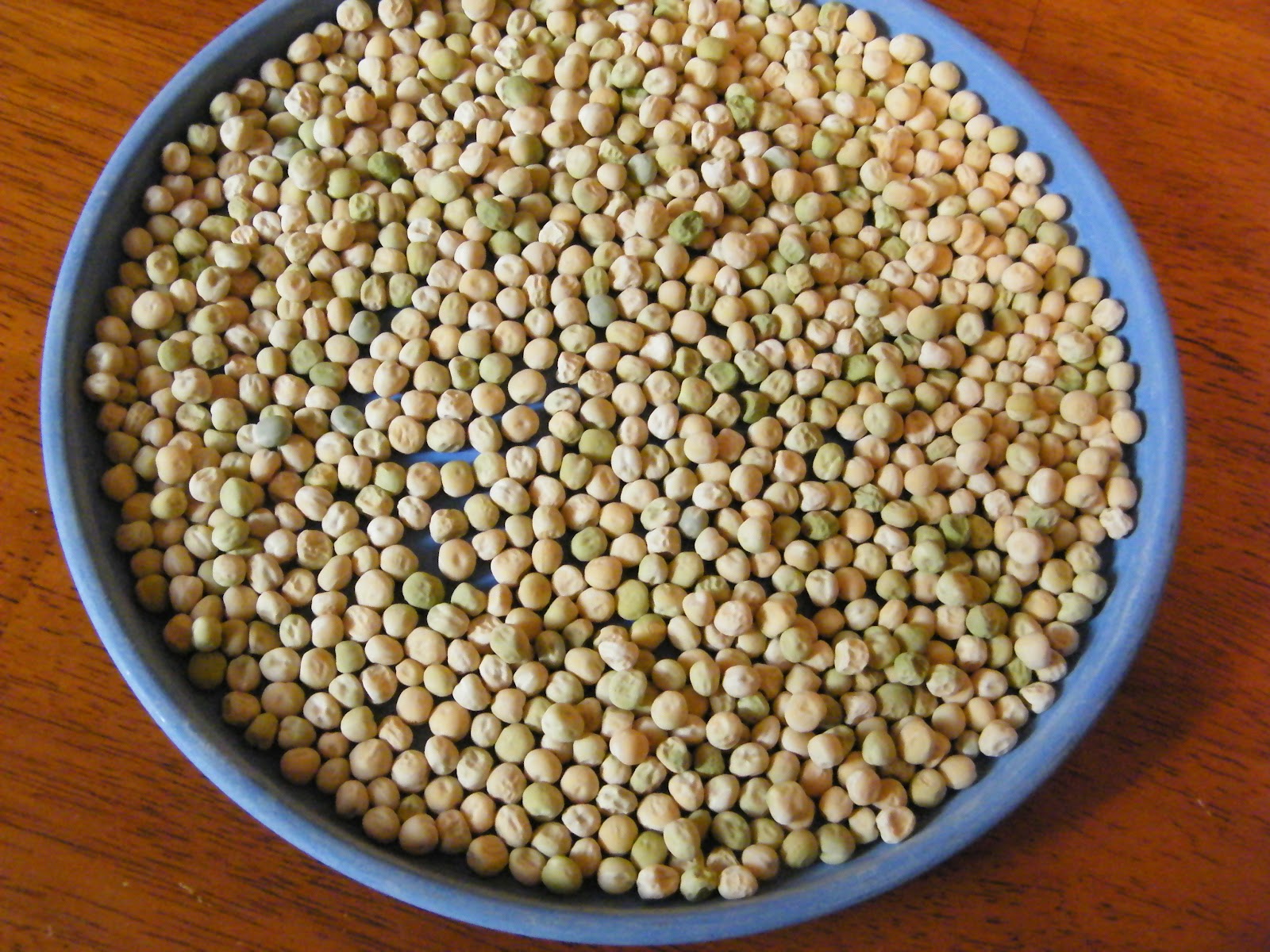
After they're completely dry, legume seeds need to be frozen, even if you don't plan on keeping them that way for long. There are bugs that like to lay their eggs on the seeds, and freezing kills them. If you don't do this step, and just put them in a jar at room temperature, you might come back later to a jar full of bugs and chewed up pea dust. I can't remember how long you have to freeze them for, but two weeks should probably do it.
This is my second generation of saved Tall Telephone peas. I really like this variety because it gets so HUGE. This variety gets vines that rival pole beans in length, at 6 feet or more, while most peas get more like 3 feet high. That translates to lots more peas for the space, and the peas themselves are bigger too, which makes shelling them more efficient. The only disadvantage I discovered this past winter, growing them with Lincoln Shell, that they started making pods a bit later than Lincoln Shell. I guess that makes sense that a larger plant will mature later than a smaller plant. However, Lincoln Shell also died much sooner than Tall Telephone. I will definitely continue to grow Tall Telephone as my main pea crop, but I might consider trying out some more smaller, earlier pea varieties to extend the harvest a bit.

On the other hand, Carol Deppe has convinced me to not be too fussed about keeping things pure. I know some seed savers are very particular about saving pure seed, making sure no other varieties cross with them, and I can see how that's important in some situations, like when you're trying to preserve a rare variety, or if you're sending seed to someone who is expecting a certain variety. But I only had 6 Horned Mustard plants to begin with, which isn't even enough to prevent inbreeding depression, so maybe it's OK they might have crossed with the Curly Mustard. I decided to collect the seed anyway just as an experiment.
Brassica seeds are also kind of easy to save, but not as easy as legumes. They get these thin little seed pods on them, but unlike the peas, these guys were ready to just pop open on their own with only the tiniest bit of jostling. As I picked the dry plants, mustard seeds were flying everywhere! I crammed them into a plastic grocery bag, and when I got home, the bottom of the bag had already collected quite a bit of the tiny, dark seeds. I dumped the contents of the bag into a plastic tub and started scrunching it around to get the rest of the seeds to come out (I put on gloves after my hands started getting irritated by the fine little plant fibers). After running the results through a sieve from the kitchen, I ended up with about a quarter cup of seeds for very little effort.
A quarter cup of mustard seeds is a LOT of seed for planting! That seems to always happen when I save seed. I'm always surprised about how much I get, more than I can ever use myself.
When it comes time to plant them, I think I will just sprinkle a bunch of these seeds directly in the garden somewhere and see what comes up. If they are crossed, I might get some interesting hybrids coming up. And I have enough seed that pulling out any crosses that turn out to be not-so-tasty won't seem like too much of a waste.

The Red Romaine lettuce was the biggest pain to save. It was the only lettuce that had matured with seeds ready (all the other lettuce varieties had died from neglect), so I felt it deserved it, but it was a lot more work than the pea or mustard seeds. If you let your lettuce flower and go to seed, you can easily see why it's classified in the same family as dandelions. I scrunched around the dry plants the same way as the mustard, but this time I got a big bowl of lettuce seeds with almost as much fluff and other debris mixed in. Shaking it and blowing it around didn't help, because the seeds blew around just as much as the chaff (unlike the mustard seeds which sank to the bottom of the pile while the chaff stayed on top to be skimmed off). Passing them through the sieve helped a little, but I still ended up with lettuce seeds that have a lot of other stuff mixed in.
I finally gave up, and started wondering how important it really is to have perfectly clean seed. I spread the lettuce seed out on that yellow plate you see in the top picture.
While I was in seed-saving mode, I also went ahead and finished cleaning the Ms. Burns Lemon Basil seed I saved last summer. I had picked off the tops of the plants, but had a lot of trouble separating the seeds out of their little capsules. After asking online, I was told maybe they weren't dry enough, so I crammed them into a paper bag, and that paper bag has been sitting in the garage every since. With gloved hands, I rubbed them around in the plastic tub, and did get some seed to release, but now I'm worried that maybe I picked the seedheads too early. A lot of the seeds still didn't want to come out, and the ones that did aren't all black like basil seed is supposed to be. Some of them are brown. I'm worried that the brown ones may not be mature.
Good thing I still have some of my original Ms. Burn's Lemon Basil seed left, in case this seed is no good. I should probably do a germination test on this seed to see. Maybe it's fine, but next time I save basil seed, I guess I'd better leave it on the plant longer.
So to recap, here are the seeds I have saved so far this year...
Tall Telephone Peas
Horned Mustard (possibly crossed)
Red Romaine Lettuce
Ms. Burns Lemon Basil
And in my freezer are seeds I've already saved before...
Vates Collards (from only 6 plants, so probably not enough genetic diversity to maintain for long)
Dwarf Gray Sugar Peas
Jalapeno Peppers
Chihuahua Landrace Cushaw Squash
Black Cherry Tomato
Hawkins Plum Tomato
Mortgage Lifter Tomato
Pink Ponderosa Tomato
Red Brandywine Tomato
Rio Grande Paste Tomato
Of course I plan on saving even more seed later this year, from more tomatoes, peppers, squash, and beans.
Subscribe to:
Posts (Atom)