Friday, February 21, 2014

The Mockingbird Moon

Last week was the Mockingbird Moon, but the blog post is a bit delayed because I was so busy working on the garden, I was too tired to blog about it!

Here's what I was working on.


We got a load of manure compost from Gardenville and topped off the raised beds in the front with it. Next I'd like to work on the pathways between. I plan on putting down landscape fabric and then cedar mulch on top of that. But right now they're ready to plant in, and that's good because I have these...


Pretty soon it will be time to start planting things like tomatoes, peppers, and eggplant. It hasn't frozen again since we had that little bit of snow. In fact, it's been quite warm, with some days getting into the low 80's. I put all the seedlings outside and they seem to be loving this weather.


I'm afraid the peppers didn't make it through the winter. These peppers survived last winter, but this time they don't have any signs of life, despite my efforts at covering them with a frost blanket during each freeze. I'm going to give them some more time, just in case, but if they don't sprout back after we've had a bit more warm weather like this, I'm afraid it means I won't have any three-year old pepper plants.


The artichoke seems fine, though. I seem to remember that artichokes are supposed to flower during their second year, so that means maybe this year I'll get some buds.


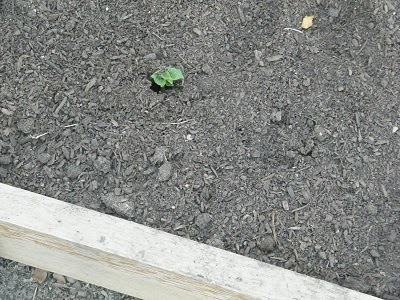
When we got the compost, I went ahead and covered the potatoes over with a layer of it, and they're already poking through again. The ones that I planted later and weren't hurt by the last freeze are doing better than the ones I planted earlier that got frozen back. I'll have to see how that translates into yields once they're ready to harvest.


The multiplier leeks I transplanted are recovering nicely. It looks like almost all of them made it, and they perked right up.


The garlic also looks fine. I put some compost on them too, so they can get some more nutrients from it.


The peas in the back got a little damaged by frost, which surprised me a little. However, they're growing back already, so they should be fine.


The greens in the back are not doing as well. I just haven't had luck growing greens for a long time. I don't know if they're not getting enough water or it's too cold or what. They just seem to be growing very slowly, and it won't be much longer before it's warm enough for them to start getting eaten up by bugs again.


The fava beans are the best looking things in the back garden. The warm weather has encouraged them to put out more blooms. I hope this turns into a good harvest of beans.

Next month is March and time to plant warm-weather crops! I've already got what I'm going to plant all picked out.

Wednesday, February 12, 2014

Riding the February Weather Rollercoaster

Groundhog Day has come and gone, and I'm further reminded of how much sense a seemingly silly holiday would make to someone who has to live off the land. Because if you do the question, "is it spring yet?" is very important. Last Thursday, it looked like this outside:


Tonight it's supposed to freeze again, while tomorrow it's supposed to be in the high 70's.

This is February in Texas, and this year seems to have been particularly bad. Last year we only had one hard freeze where it got down into the 20's. Other than that, maybe only a few times where it dipped slightly below 32.

This year we've had several hard freezes, maybe about five or six, but with warm days in the 60's or 70's sandwiched between. It's hard to get used to such extreme swings in temperature. I'm getting tired of covering plants with frost blankets for a day or two, and then needing to uncover them so they won't bake underneath them when it turns 75 and sunny.

As you can see in the fourth picture above, I forgot to re-cover the potatoes I planted in fall during the last freeze. It killed all their top growth, so I guess I'll just have to see if they can recover. At least I have a second planting of potatoes I did in January that haven't poked up out of the soil yet. Those should be fine.

I'm disappointed by that, but otherwise I must admit it's exciting in a way. We don't get white stuff on the ground that often around these parts.

Friday, February 7, 2014

Fermented Lemon Drop Hot Pepper Sauce

I finished the fermented hot sauce I started back in October in time to give a bottle away as a Yule gift and keep a bottle for myself. When I made my previous post, the peppers were still bubbling in their jars, and I was unsure of how long to wait.

It turned out that about a month after I first mixed up the chopped peppers, wine, and salt in the jar, the bubbling stopped. After waiting a couple of days to make sure it had really stopped, I decided that it must mean the peppers were done.

 
I drained the peppers, reserving the brine (to use to jump-start my next fermentation), and pureed them in the blender. Then I strained them with my food mill to get out the seeds and skins. I ended up with a nice smooth bright yellow pepper puree. I took a little taste, and the fruity taste of the Lemon Drop peppers had been preserved... along with a LOT of heat that hits you right afterward!


I finished off the sauce with some white wine vinegar, to give a little bit of bright acidity (and it will probably help the shelf life too), and some honey to take a little bit of the edge off. I put in about a quarter cup of vinegar and two tablespoons of honey for a little over a pint of pepper puree.
 
But these amounts are all "to taste" and I think they might need some tweaking. After refrigerating the sauce for a while (I'm not sure if it's acidic enough to be kept in the pantry, so I'm playing it safe), it got so thick I couldn't get it out of the bottle. It was like ketchup. I ended up adding some of the reserved brine back in, and some more vinegar until it was thin enough to pour out of the bottle, but not so thin that it pours out too fast.
 
By the way, I'm using reused bottles that held other sauces or vinegars. I just wash them in the dishwasher and peel the labels off. You can buy new hot sauce bottles, but this seems to work fine for the small amounts I've been making so far. Plus it's one of the three R's.
 
I'm pretty happy with the hot sauce I got, but I'll do some more experimenting with my next hot pepper crop. My Lemon Drop plants are covered in frost blanket, but I'm not sure if that's been enough, since we've had a colder winter this year than last year. They look pretty dead right now, but maybe they'll come back once it warms up out there.
 
I started some Habanero and Serrano pepper seeds to grow this year. Both should make good hot sauces.
 
I even found a recipe for making your own fermented Sriracha sauce that I'd like to try some time. You're supposed to use red jalapenos, which are hard to find unless you grow them yourself. I had a couple of jalapeno plants that I'm also trying to overwinter, but just like with the Lemon Drops next to them, I worry this winter was too hard for them.
 
I wonder if red Serranos or maybe even some other varieties would work too.
 
I wonder what Sriracha with Lemon Drops would be like.
 
A lot of fermented hot sauce recipes, including that Sriracha recipe, call for garlic. I didn't put any in my Lemon Drop sauce, but I'd like to try it in a future batch.
 
I hope my peppers do well in 2014 so I can try some more hot sauce variations!


Wednesday, January 29, 2014

Farewell, Pete Seeger


Pete Seeger is a personal hero of mine. I found out about him when I was a teenager, and always listened to him when I was feeling down. Something about his voice was so comforting.

He didn't write "The Garden Song", but I felt it was appropriate for this blog.

Out of the songs he did write, "Where Have All the Flowers Gone?", "If I Had a Hammer," and "Turn, Turn, Turn" seem to be the most famous and popular, but I'm also quite fond of this one...

Friday, January 17, 2014

The Cedar Moon

When the "polar vortex" was visiting North America, we had a couple of nights with some good hard freezes (though in the daytime it always got back up above freezing, as usual). We thoroughly covered up the citrus trees, peppers, and some of the more tender herbs (pineapple sage, lemongrass, and lemon verbena), but I think everybody made it through.

We're now halfway through with the raised beds in the front garden. Two rows done, two more to go. I think they look very nice.

The garlic seems to be doing just fine. I just gave them a good watering, because we haven't had much rain in a while (all the cold fronts lately have been dry ones).

I put my first batch of homemade compost over the potatoes, and they're already poking up through it. The polar vortex hurt them a little bit, but they seem to have already recovered. Next time I mow the grass, I'm going to dump grass clippings on them.

Last year I planted some "multiplier leeks" my CSA farmer gave me, and I thought they died over the summer, but this winter they sprouted back up with several clumps of little leeks. They were in a bad spot, so I dug them up and transplanted them to the front garden. There were lots and lots of them, so hopefully at least a few will make it. Multiplier leeks and multiplier onions both seem to do much better here than their seed-grown cousins. They seem pretty tough and almost impossible to kill.

The two year old peppers got hurt some more by the polar vortex, so now they aren't much more than stumps. But they might make it. I thought they were dead last winter, and once it warmed up in spring, they started growing back. I have been covering them with a frost blanket during every freeze.

The Tall Telephone peas are still doing great, but still no blossoms. Now I'm sure I want to get an earlier variety of pea next winter to fill in the gap while I'm waiting for the Tall Telephone peas to mature. TT is a great variety, but it takes a lot of time growing big vines before it starts thinking about making peas.

The fava beans (on the left) also seem to be doing OK. They were just starting to make some blossoms when the polar vortex hit and knocked them back a bit, but they should recover soon. To the right you see the broccoli.

Meanwhile, the baby nightshades are doing well in their pots. It's almost time to start dividing them up into individual pots. Some of them are starting to get their first sets of true leaves.
 
Last I'd like to show you the ginger I harvested. I planted this nub of ginger in a pot when it sprouted in my kitchen last spring. It grew some long, grass-like leaves all summer, and we took it in when it froze, but recently the tops just died for no apparent reason. I finally realized maybe it was ready to harvest, like how the tops of potatoes die when they're ready. I dug it out of the pot, and got this nice handful of fresh ginger.
 
I used a little bit of it in some fried rice to see what it was like, and it's really good. The skin is so soft I can just rub it off with my fingers. It's very tender with hardly any fiber.
 
I'm going to break up the rest into pieces and plant them to try to get more ginger. I wonder if it would be possible to grow some in the ground. Even though we took it in the house when it froze, the tops died anyway. Maybe taking it in the house made no difference.


Thursday, January 2, 2014

New Year 2014

Time to look at what I accomplished in the garden in 2013, and what my goals are for 2014.

One big accomplishment of 2013 was I finally got made full time at work (well, "full time temporary" at least, which means that could end any time, but at least for now I'm full time), which is good career-wise, but leaves less time for gardening and especially for blogging. I started this blog when I was unemployed and was gardening as a way to do something productive with my time, and then as I got a part time job and then a full time job, and you can see how the posting frequency has gone down. At the bare minimum, I've still been posting at least once a month, which I plan to continue, but I'd rather post at least once a week.

First I'm going to look back at the New Year's Resolutions I made in 2013 and see if I stuck to any of them.

We haven't built a new shed yet, and might not any time soon. Though it's probably not fair for me to resolve to do that, since honestly my husband would be doing most of the work. And he's busy with his own stuff, so it'll happen when it happens. Another more long-term goal would be getting big rainwater tanks and some kind of graywater system to water plants, but it's also probably not realistic to expect that in only one year.

But one thing I did actually accomplish that wasn't on my list was tilling up that area in the front yard in February and starting a second garden there. Both my husband and I think that was a great idea. That area was just a big ugly patch of half-dead grass before, and since we turned it into another garden we've been getting nothing but compliments from neighbors. The soil also seems to be less rocky there.

In April we also planted a bunch of fruit trees in the front yard: Wonderful Pomegranate, Meyer Lemon, Satsuma Orange, Key Lime, and a fig. We ended up getting five lemons and one orange from them this year, and that should only get better as the trees get better established.

I grew potatoes from seed, but only got mini-tubers so far. This year I'll try growing those mini-tubers again and see if I get any full sized potatoes.

I also planted 3 pounds each of Red Pontiac and Purple Viking potatoes, but harvested them way too late. I was busy at the time and thought they could wait, but apparently not. Lesson learned. As soon as the potato tops start to die, those potatoes need to come out before they get chewed up by wireworms.

The sweet potatoes didn't do that great either. I got a few nice looking ones, but the key word here is few. I don't think I put them in a good spot or in good soil. I planted them in the very back of the back garden where the soil is very rocky and it's pretty shady. I'm trying again this year in the front garden with better soil and seeing if that helps.

I didn't bother with row covers on the squash again, but instead planted two varieties that are supposed to be borer-resistant: Tatume and Waltham Butternut. The butternuts were planted in the front and got eaten by deer, but the Tatume in the back did great. Planting resistant varieties may be the best way to deal with borers. This year I'm trying out a different variety of C. moschata called Black Futsu from Baker Creek Heirloom seeds. I also might grow some more cushaws, because this fall I finally used up all the squash puree from the big cushaw squash harvest of 2010! That wheelbarrow full of squash gave us enough squash puree to last us for three years!

The beet trial did lousy, but I guess it showed Chioggia did the best. Next time I buy some beet seeds I'll get that variety again, but I'll probably give some of the other varieties a second chance.

The paste tomato trial yielded better results. Opalka did the best, and I still have one more gallon freezer bag full of tomatoes in the freezer waiting to be made into tomato soup. I've been meaning to post about that.

The Lemon Drop peppers that survived the winter had another good crop, once I put up wire to protect them from deer in the front garden. This winter I'm putting protective frost blankets on all my peppers to help them survive the winter again. I wonder how many years I can keep a pepper plant going if it doesn't die over the winter.

2014 Garden New Year's Resolutions:

1. Finish the raised beds in the front garden - After forming these lovely raised beds in the front garden with no sides, just soil hilled up, the neighbor's chickens went crazy tearing them apart. We put rocks around them at first, but I finally decided I wanted to make sides out of cedar. We're about halfway done right now, and they look great. I want to get done with them before it's time to plant spring crops.

2. After the raised beds are done, put a fence around the front garden - There are some good things about having a garden in the front yard, but the chickens and deer are not so good. The deer never go in the back yard (the neighbors' dogs probably help), but they sure love munching things in the front. And the neighbor's chickens from across the street occasionally go into the back yard, but mostly stay in the front and love digging up my garden beds. My husband thinks we could make an attractive fence out of hog panels to keep those critters out. Now, I know that technically you need a super high fence to keep deer out, like 8 feet or so, but it also depends on how motivated they are. Same thing with the chickens. Since they don't bother the back garden because it's inconvenient for them, I hope I can make the front garden inconvenient for them too.

3. Use inoculant on all the legumes - the peas have done OK, but all the other legumes have had really low yields here. Right now I'm growing Tall Telephone peas, Aquadulce fava beans, and Broad Windsor fava beans, and this time I treated them with inoculant. When it gets warm I'm planting Rattlesnake pole beans, Provider bush beans, Chinese Red Noodle yardlong beans, Calico limas, and Pinkeye Purple Hull cowpeas, and they're all getting inoculant too. I hope that does the trick, because I can't think of any other reason why almost all my legumes would be doing lousy here.

Other than that it's just the usual: trying some new varieties of various things, saving some more seed, improving the soil, and learning more and more.

Thursday, December 19, 2013

The Mistletoe Moon

The Yuletide is almost here, and we've had a few hard freezes now. I define "hard freeze" as a freeze enough to kill my tomatoes, rather than a "light frost" that just damages them but doesn't completely kill the plants. It got down into the mid-20's for a couple of nights last week, so that was enough to do them in, along with all my other frost-tender plants.


Here's what remains of the Christmas Lima beans. I ended up harvesting about 35-40 beans off them, which is not very good, but at least enough to grow them again next year. I think they need bean inoculant, since all my beans have done poorly in this garden so far. Next year I'll try to remember to inoculate all my beans.

The brassicas are finally free of bugs, so I hope they now have time to give me a crop over the winter, before it gets too hot in the summer. They're off to a late start because of those darn bugs.
 

The peas are doing great, and the Red Romaine lettuce I planted next to them is about big enough to start picking.

I still have a lot of plants in pots I haven't gotten a chance to plant out yet. These are mostly replacements for all the plants that got eaten up by caterpillars, like broccoli raabe, kale, and arugula.

The potatoes I planted in one of the new raised beds are just starting to poke up sprouts. I'd better cover them over with compost soon before the next freeze.

The garlic is still doing well, despite the chickens trying to dig them up. They seem to like the raised bed and the grass clippings for mulch. The freezes haven't bothered them one bit.

During the freezes, I covered the peppers with frost blanket to protect them. These peppers survived last winter without protection, so I decided they have earned it this time. As you can see, a lot of the leaves were damaged by the frost, but the plants themselves are all still alive and will probably recover next spring.

I went ahead and let the eggplants and tomatoes go. There was no chance they'd survive the winter anyway.

Meanwhile, the mini-potato tubers I planted in that container this past fall had grown plants and then died back, so I decided it was time for harvest. I was disappointed to find only these few mini-tubers, not much bigger than the ones I planted. I wonder when I'll get full sized potato plants with full sized tubers from these. I guess I'll plant them again, and this time give them more room. I still don't feel like planting them in the ground until I get full sized plants, but I'll give them bigger containers this time.

I'm on winter break from work now, so now it's time for me to get caught up with a bunch of stuff I had been putting off, like finishing those raised beds, planting out the rest of my winter vegetables, and starting nightshade seedlings for next year.