Sunday, May 25, 2014

Deer Like Swiss Chard Too


Well, so much for my perpetual spinach-type Swiss Chard this year. The deer have eaten them down to nubs. Fortunately, they haven't touched anything else in the front garden yet, but I need to be vigilant. Eventually I will build a fence around the front garden. I just haven't gotten around to it yet. In the meantime I've just been using cylinders of chicken wire around the plants (like giant tomato cages) which work but are a hassle.

The chard didn't have wire around them, and this is the result.

Oh well, they were bolting and getting bitter anyway.

Saturday, May 24, 2014

Letting the Artichokes Bloom

This is what happens when you don't harvest your artichokes.


I only got two buds on my one artichoke plant anyway, so I think the giant, neon-purple flowers are more desirable than just a couple of artichokes to eat.

Maybe I should plant more artichoke plants, since this one seems to be doing so well.

Friday, May 23, 2014

Parsley Worms Eating All My Dill

The larvae of the Black Swallowtail butterfly are known as "parsley worms" because they feed on members of the Apiaceae family, which includes parsley, dill, fennel, cilantro, carrots, and parsnips. Last year I planted a lot of parsley, and figured it would be enough for both me and the swallowtails. Right now it's starting to flower, and I plan on letting it drop its seeds and regrow.


So did I get parsley worms on my parsley? No, of course not! Instead, they are completely ravaging my dill and fennel, when I only have a few plants of each.


Here's a large one chomping away. They do have really cool markings. Interestingly, you'd think they'd really stand out, but the striped pattern actually breaks up their outlines and helps them camouflage among the feathery foliage.

 
This picture shows how they look when they're smaller (on the left) compared to a larger one on the right.


I was going to let my dill drop seeds too, but at the rate they're going, there will be no dill flowers left to make seeds. They seem to like the flower heads the best.


Now the flower heads have almost nothing left. So much for saving dill seeds this year.


Except I just don't have the heart to do anything to them. They've become like my pets. I know, it's prejudice, because I have no problem killing tomato hornworms.


Guess I'll just have to accept that I'll have a much bigger crop of butterflies this year instead of dill.

Friday, May 16, 2014

Potato Harvest 2014

I dug up the potatoes on Monday before we got the rainstorm. It was a little disappointing, but that was my fault. I planted a lot of my potatoes in November, thinking I could get an extra early harvest. Instead, most of them froze to death. I planted a second batch of potatoes in January, and those were the ones I harvested this week. So once again I didn't get that many potatoes, and will have to save most or all of them for planting next year.

Now I know that potatoes should not be planted in Texas before January!


I ended up getting 2.8 pounds of Red Pontiac and 2.0 pounds of Purple Viking. I'll save these to replant next year, and maybe buy another variety or two to try.

Thursday, May 15, 2014

Fava Bean Pasta

Here's one of the things I did with some of the harvest of nice green spring vegetables I got in April and May.


I didn't grow any hardneck garlics this time, but I did grow Elephant garlic, which makes some nice fat scapes.


Here is the Swiss chard before it started bolting. I like this "perpetual spinach" type variety with it's small, tender leaves.


But the star of this dish was the fava beans. I've never even eaten fava beans before, but they turned out to be really easy to grow over the winter, and they're really tasty. They are a little bit of a pain to prepare in the kitchen, though. First you have to get them out of their pods, then blanch them in boiling water for 2 minutes.


Next you need to peel them. The seed coats of fava beans are really tough and inedible, so you have to take each bean individually and pop them out of their skins. At least the beans are pretty big, about the size of a large lima bean, so you don't have to peel too many to get enough for a meal. In the picture you can see the peels on the left and the peeled beans on the right.


Then I sliced up the elephant garlic scapes into small pieces.


Sautéed the scapes in a pan with some prosciutto and olive oil. I wanted to use pancetta, but couldn't find any, so I used prosciutto instead, torn up into little pieces.

Meanwhile, I cooked some pasta.


The cooked pasta, peeled fava beans, and chard were added to the pan once the prosciutto was starting to get a little crispy. That was stirred around until the chard wilted.

To finish off the dish, I added some cracked black pepper, a little of the reserved pasta cooking water, some shredded parmesan cheese, and some heavy cream to make a nice sauce. A splash of white wine would have been nice too, but I was out. It was still really good without it.

So this dish used three ingredients from my garden. It can be tweaked too. Some fresh green peas would be good instead of or in addition to the fava beans. I would think any kind of green could work in place of the chard. Garlic cloves could be used instead of garlic scapes, but garlic scapes have such a nice mild flavor.

Next year I'm growing a lot more fava beans!

Wednesday, May 14, 2014

The Greening Moon

Once again, the Greening Moon lives up to its name. Yesterday we got over 4 inches of rain, which was the most rain we've gotten since October. It cut our rain deficit for the year in half.


In fall, I sprinkled a mixture of wildflower seeds in our cactus garden by the driveway, but the Indian Blanket was the only species that came up. They're doing really well and have added a very cheerful touch.


In the front vegetable garden, the artichoke has almost opened. A second bud also grew and is starting to open as well. That one went a lot faster, maybe because it's warm now.


The tomatoes, peppers, and eggplant are all looking good, except most of the peppers are still very small. It looks like starting the seeds in fall does work better after all.


The tomatillos are already starting to make fruits. I have six plants left after two of them died when we were away because of my dad's illness. I hope I still get a good crop.


The Swiss chard is bolting. I'm not sure if I'm going to let it go to seed, or if I won't bother with that and will pull it up and plant something else there instead.


The okra is also doing really well. This is Beck's Gardenville okra, which I plan to save seeds from. It's a local heirloom named after my favorite garden center in town.


I had time to harvest the potatoes and some of the garlic before the big rainstorm. Here's where the potatoes used to be. I'll put up another post about how that harvest went.


And here's the garlic. I harvested the S&H Silverskin and Red Toch, but the other varieties look like they need a little more time.


I tied the harvested garlic to a piece of bamboo, and now it's drying in the garage. The bulbs were a little on the small side, but I got a lot of them, so it looks like I won't have to buy any more garlic for a while.

In the back garden, the peas are about finished. I'm letting the few pods I missed dry out completely, so I can use them for seed to plant.


The pole beans are just starting to climb up their bamboo teepees. I planted Calico Lima, Red Noodle Yardlong, Rattlesnake, and Purple Podded Pole.


The favas are about done too. Here's what's left of them. They did well, and I'm going to buy more Aquadulce favas from Baker Creek to plant this fall, since they did slightly better than Broad Windsor.


The squash, melons, and watermelons have all been planted and are settling in nicely. They really liked all the rain we got.


I have everything planted for summer except for the sweet potatoes. I ordered a few more varieties to try from Southern Exposure Seed Exchange, and here are the ones from last year that I'm growing slips from. That one Molokai Purple is growing like crazy. They're going to go in where the garlic is now, once that's all harvested.

So now almost all the spring crops have been harvested, and it won't be too much longer now until summer crops start coming in.

Friday, April 18, 2014

The Grackle Moon

I missed the Bluebonnet Moon, so here's an update on my garden to show how it's been coming along in the two months since I last posted. A lot happens this time of year.

I just started harvesting Tall Telephone peas. They didn't do so well this year because of the strange weather and they're not in a very good spot, but I'm still getting a decent amount of peas.

I also just started harvesting fava beans and haven't eaten any yet. I planted to varieties from Baker Creek Heirloom Seeds to compare: Aquadulce and Broad Windsor.

They are pretty close, but I think it turns out I like Aquadulce better. It seems to have longer pods with more beans per pod, which makes shelling easier. The Broad Windsor has more pods, but several that only have 1 or 2 beans each. Aquadulce is from Spain, and Broad Windsor is from England, so I wonder if Aquadulce does better in warmer temperatures. On the other hand, I'm not sure yet if I will end up getting more beans total from BW than Aquadulce since they're still producing.

Broad Windsor is by far the most common fava variety. In many catalogs it's the only fava they have. Carol Deppe suggests that when doing a trial of a standard variety vs. a rarer variety, if they come out pretty equal, or even if the standard is only slightly better than the rare variety, you should grow the rare variety to preserve more genetic diversity. So in this case I think I will order more Aquadulce next year. There really is only a slight difference between the two varieties.

I also planted a bunch of beans around bamboo teepees in the back garden that are now sprouting: Calico Lima Beans, Chinese Red Noodle Yardlong Beans, Rattlesnake Pole Beans, and Purple Podded Pole Beans.

This is the mess where my broccoli and cauliflower plants used to be. They never got very big and ended up bolting, and are being overgrown by weeds. I'm going to till it up and plant squash there.

I have four Moon and Stars watermelon plants next to the beans now. The M&S watermelon seeds I got in a GardenWeb trade had really lousy germination last year, so I planted all the rest this year, and this is what I got. They didn't do well last year, so I don't have very high hopes for them, but we'll see.

In the front garden, the garlic is looking really good. The Elephant garlic is starting to put up scapes. I hope this means I'll get a good garlic harvest this year.

The potatoes I planted later are doing well too, while the ones I planted earlier are almost all dead. So I guess that shows that it's better to wait until at least January to plant potatoes around here. In the foreground are the multiplier leeks that are also doing well. The biggest ones are putting up scapes. Can you eat leek scapes? I don't see why not.

I need to start harvesting this Swiss Chard. This is a perpetual spinach type variety that's doing really well. I've never had luck growing spinach, so I use chard as a substitute, but I've only grown Fordhook Giant and Rhubarb chard before. This chard is specially bred to be more like spinach.

The tomatillos are mostly doing well and are flowering a lot. I lost one when I had to leave when my dad was dying and they didn't get watered enough while we were gone, and another one is hanging on but doesn't look very good. But the other ones look fine.

The tomatoes have a lot of leaf curl going on. I'm not sure what's causing that, but I think it's because of a few really cold nights we've had where temperatures got all the way down into the upper 30's. That's not enough to kill tomatoes, but they don't like it.

The eggplants have just been planted and are doing well. The peppers are not doing as well. I think starting my pepper seeds in the fall was a good idea after all. My pepper plants are still really tiny and dry out fast.

My artichoke plant has an artichoke on it! That was fast. I think I'm going to let this one bloom, since what's the point of having only one artichoke? Maybe after that it will make more buds and I can get several at a time.

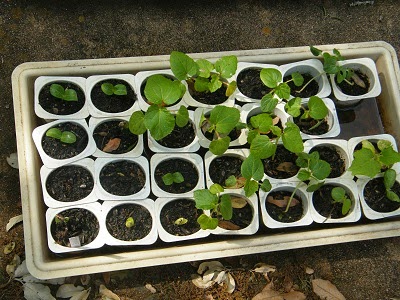
Still waiting to be planted are squash, okra, cucumbers, and cantaloupes. I planted them in pots while I figured out where to put them. The okra plants are getting pretty big and need to be set out soon. I think they'll go in the front garden since they're pretty.

I also started an assortment of basils. I went ahead and planted some of all the different varieties I have, but some of them germinated much better than others. I have a lot of Ms. Burns Lemon Basil, for instance. That stuff grows like crazy.