Tuesday, February 26, 2013

The Mockingbird Moon

Maybe I should call this the Mountain Laurel moon instead. The Texas mountain laurels have started blooming, filling the air with their sweet fragrance. That means it's officially spring!

I've still got tomatoes, peppers, and eggplants to plant out in the garden. I'm going to do that ASAP. I don't care if they say our last frost date is in March. I really don't think we're getting any more frosts.

In addition to the purple potato seedlings I talked about last time, I planted out my purple tomatillos at the end of the same bed where the potato seedlings are. I had just the right amount of room.

In the back, the potatoes grown from tubers are starting to sprout. It took them a long time, but they're finally starting to poke out.


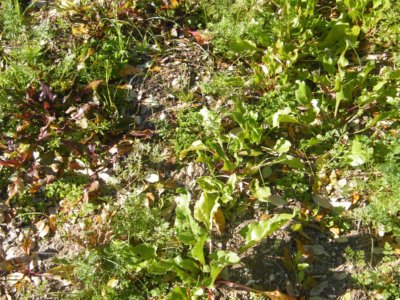
The beets I planted back in fall still aren't doing that well. They just haven't gotten enough rain, so they're just sitting there hardly growing. I'm really starting to wonder if I'll get a decent harvest from them at all, let alone be able to tell which varieties are best.

The second batch of beets are also still tiny. They only have two or three months left before it starts to get too hot for them.

The celery is also growing very slowly. I've heard celery needs a lot of water, and these just aren't getting much. I guess I need to buy a lot more drip hoses.

The kale and garlic are not doing much either, but at least the cabbage worms are finally gone. I haven't harvested any kale, and I might not. I get kale from my CSA, and the kale I'm growing is doing so poorly I think I might just leave it alone. I planned to save seed from this kale, since I used up the seed I had for this variety. Maybe I'll just leave it alone and let it do that.


Speaking of seed saving, the arugula is starting to make seed pods. The bees really like the flowers too.

The shallots seem to be doing ok. I've never grown shallots before, so I hope they do well. Onions are hard to grow here, so I'm looking for alternatives. Plus shallots are so expensive at the grocery store! I don't think I've ever eaten shallots before.

The fava beans seem to be doing fine. That's another thing I've never eaten before, but they grow during the winter, which is a good time to grow things here.

Some of the overwintered peppers are starting to put out some little leaves, though some look like they have died. I think once I can tell for sure which lived and which didn't make it, I'm going to transplant them into the front yard bed I just made. Peppers are pretty plants and would make good front yard plants.

I went ahead and put up some bird netting over the bamboo tee-pees I put up for the peas. It's not to keep birds away, but to give the peas something to climb on, since they were having trouble clinging onto the bamboo.

Well, spring is certainly in the air! I'm going to plant the rest of my nightshade transplants as soon as I get the chance, and I need to start seeds for some warm-weather things like basil soon. It's starting to become one of the busiest times of year for gardening!

Friday, February 22, 2013

Growing Potatoes from True Potato Seed

The potato seedlings I'm growing from some "Purple Potato Seed" I got a couple of years ago are doing great! This was seed that got thrown in as an extra in an online seed trade. I tried to grow some of them last year, and none of them made it, so I went ahead and planted the rest this year. Honestly, at this point I don't even remember where I got them from.

Now I have more than 50 healthy potato seedlings! And here I was thinking I'd be lucky to end up with just a few.

Most people plant potatoes using "seed potatoes" which are not the same thing as "potato seeds". Seed potatoes are tubers that you cut up and plant, so you end up with genetically identical clones. This is great if uniformity is what you want, but if you want to genetic diversity, you need to let your potatoes have sex.

Planting potato tubers, just like taking cuttings from a plant, is asexual reproduction. Sexual reproduction allows for the genes of the parent plants to recombine into new varieties. Potatoes have a lot of genes to recombine too, since they're tetraploids. That means they have four sets of chromosomes instead of the usual two, so there's even more combinations you can get in the offspring than with a diploid organism (like we are).

In a nutshell, when you let your potatoes flower, have sex, and produce fruits with seeds, each seed is genetically unique, and all your plants are going to be different from each other.

My goal in growing potatoes from seed is to find which of my genetically individual plants do the best for me, and start growing them again year to year, eventually resulting in the evolution of potatoes that actually grow well in my climate. Which is kind of a tall order considering how Central Texas is not potato country at all. Potatoes prefer cool weather and loose, acidic soil, but maybe out of my 50 plants, I'll find at least one that actually does all right in my alkaline rocky clay soil, and can produce a good crop of tubers before May, when it starts to get hot. I can then name my new potato whatever I want and become famous for developing a potato variety just for Central Texas! (Or something like that.)

To my surprise, a week or two ago I noticed that several of them were already producing little pea-sized tubers at the base of their stems! Staying true to what was on the seed packet, most of them are purple, but some of them are other colors, including a pinkish-red and creamy white. There's genetic diversity already showing!

The potatoes are also showing diversity in their leaves. Most of them have nice, big leaves, but a few of them seem sort of stunted, with small leaves. However, some of the small-leafed ones have big tubers growing on them, and some of the big-leafed ones don't. I really don't know what's better, so I still planted them all to give them a fair chance.

Here is one of the yellowish-white ones on the left, and a pinkish one on the right. Also, some of them have lots of little tubers while some have a few big tubers. This is a lot of fun! I just don't know what I'm going to get!

I ended up going ahead and rototilling that plot in the front yard I've been thinking of turning into a garden for a while now. I wanted to plant my potato seedlings ASAP, and there just wasn't room in the garden in the back.
Here are the potato seedlings in the new plot getting watered with a soaker hose. I got another sack of cheap dog food and mixed it into the soil for fertilizer. One thing I noticed while tilling is that the soil in the front yard is much less rocky than the back. I wonder if it will turn out to actually be a better spot for growing things. I just hope the deer don't find them. Potato leaves are supposed to be poisonous, but it probably just depends on how hungry the deer get. I have another bale of moldy hay I'm going to mulch them with.

From what I've read about potato seedlings, I shouldn't expect to get a good harvest this year, but I might get some small tubers I can save and re-plant next year, just like regular seed potatoes. I'm really getting my hopes up since so many of them already had little tubers in their pots before they even went in the ground. Hopefully those will just keep getting bigger.

It's also possible for them to flower and produce another generation of potato seeds, giving me further opportunity for breeding Texas-adapted potatoes.

And I do have the potatoes I planted from tubers in the back: Purple Viking and Red Pontiac. I just noticed yesterday that they're starting to sprout. Both of those varieties are supposed to be better for warm climates, so we'll see. Maybe I'll get a good crop from them to tide me over until my seedling potatoes start giving good crops.

Monday, January 28, 2013

The Cedar Moon

It's the first full moon of 2013, and it's been very warm lately. We haven't gotten significant rain since that good storm we had around New Year's Day, but for the last couple of weeks or so highs have been in the high 70's and low 80's. I wonder if this is going to be one of those years where it's warm in January, and then in February we have an ice storm.
Friday I got my seed potatoes from www.potatogarden.com. I got three pounds each of Purple Viking and Red Pontiac, both varieties that are supposed to do well in the South. Purple Viking was the best potato I grew back in 2010, though it still wasn't that great (I planted 3 pounds and harvested 5 pounds). I haven't grown Red Pontiac before, but it's a Florida heirloom, which sounds good.

Here are the seed potatoes being cut up. The Purple Vikings are on the left, and the Red Pontiac are ready to be cut up next on the right. I cut them and let them dry out for a day, then planted them in the bed that I had a cover crop of Austrian Winter Peas growing in over the winter. I hope that adds enough nitrogen to help them make a better crop this year than the last time I tried growing potatoes.

Here the potatoes are in the bed getting watered. I have another bale of moldy hay I haven't used yet. I plan on mulching the potatoes with that after they sprout, since potatoes like a deep mulch. I hope that also adds more nutrients for them.
My "purple potato" seedlings are also doing really well. These are from the seeds I got in a trade as a surprise. Some of them are growing really vigorously! I tried planting some last year and they didn't do well at all, so I didn't really count on these doing well either. I now have about 50 seedlings. I'm not sure where I'm going to put them.
Here are all my seedlings, including tomatoes, peppers, and eggplants. It's been so warm it's tempting to plant some of them out now, but instead they'll have to stay on their pots, soaking up some sun on the porch.
Out in the garden, the Arugula is bolting. It already started to bolt a little during our last warm spell, then it gold cold and it stopped in its tracks, and now it's picking up where it left off.

A lot of other plants look like they've hardly changed from last month. There just hasn't been enough rain for them to grow much. Here I have kale in the foreground, and garlic in the background. I haven't eaten any of my kale because it got eaten up by bugs so much, and hasn't been growing back new leaves very quickly.

The beet trial doesn't look much different either. I've been thinning them some more, and it looks like a few of them are just starting to form round roots. Some of them where the tops are poking out of the soil look about dime-sized.
I planted a second repeat of the beets in another patch, right around when we had our last rain, and they're just now starting to sprout.

I also planted some fava beans when it last rained, and they're just starting to sprout too.

The Tall Telephone peas are just starting to send out tendrils, and I'm trying a new type of support for them this time. I'm trying out bamboo teepees like I use with pole beans. I'm not sure if it will work with peas, since they climb in a different way than beans, but this variety gets so tall, I need something really tall to support them.

The shallots (left) and celery (right) also don't look like they've made much progress. I've heard that celery needs a lot of water, so they probably haven't been getting enough.

After the peppers got all mushy from freezes, I cut them all down to stumps to see if they might survive the winter and grow back in spring. So far it looks like they all have. They are all still green. If they do all survive, I'll have a lot of extra pepper plants since I've already started more seedlings. I'll have to find some people to adopt them out to.

This weekend is Groundhog Day. Down here in Texas it sure feels like it's already spring, and it's still January. I keep thinking of how lush my garden would be right now, if we would only get some rain to go with these warm temperatures.

Thursday, January 17, 2013

Using Green Tomatoes

I'm still not sure if growing fall tomatoes is worth it. My tomatoes froze before they had a chance to ripen, but I did like using the green tomatoes I picked right before our first freeze. I got several pounds of green tomatoes of all sizes.

First I made Green Tomato Hot Dog Relish, from page 222 of Ball's Complete Book of Home Preserving. Not only was it a way to use up the little green tomatoes I ended up with, but I also got to use some of the bell peppers I picked right before it froze. The red and yellow peppers looked nice with the green tomatoes.

The chopped vegetables needed to be salted overnight and then drained. I guess that was to remove excess liquid. They were then cooked with spices, sugar, and vinegar for one hour. Soon my whole house smelled like hot dog relish!

I ended up with five half-pints of relish. Looking forward to trying it out, once I use up the store-bought hot dog relish I already have.

Of course the big green tomatoes were saved for making Fried Green Tomatoes. I had enough for a couple of batches. Some were eaten as a side dish with some Cajun shrimp, and the rest went into making fried green tomato sandwiches. Yum!

Fried green tomatoes are easy to make. Slice the tomatoes into somewhat thick slices. Then dust them in flour, dip them in beaten egg, and then dust them in cornmeal. I pan-fry them in a cast iron skillet on medium or medium-high. You want the outside to be golden brown, and the inside to be cooked through. That way you end up with a nice crunchy coating on the outside, and a hot, tangy, soft cooked green tomato inside. Their good as a side dish with any kind of Southern Soul Food. Like I said, I had mine with shrimp this time, but they're also good with chicken or catfish. You can also make a BLT with friend green tomatoes instead of or in addition to fresh ripe tomatoes.

I know, I know, they're not exactly health food, but this is a once-a-year treat to look forward to when the first freeze kills the tomatoes.

Sunday, January 13, 2013

Pear and Apple Mincemeat

One of the Yuletide goodies I made this year that I had never made before were mincemeat pies. I still had some pears left over, and they were starting to go soft. I also had some apples that had been sitting around too long, and a bunch of half-used bags of dried fruit. I hadn't had mincemeat pie since I was a little kid, and Ball's Complete Book of Home Preserving has a couple of recipes for mincemeat in it.

I decided to go with the recipe for Pear Mincemeat on page 177, since it made less than the Brandied Fruit Mincemeat, and I didn't have enough fruit to make such a big batch. I also had to make some substitutions, though I think it's OK in these kind of recipes as long as I substitute similar things. I didn't have quite enough almonds, so I used some almonds and some pecans. I used some different dried fruit than what they had listed, but kept the total amount of dried fruit the same. I also used about half pears and half Granny Smith apples instead of all pears. That was mainly because I didn't have enough pears, but I also thought the different textures of the pears and apples would be more interesting.

I ended up with four and a half pints. I kept the half-full one in the fridge to use right away.

Next I had to find a recipe for mincemeat pie. The pies I enjoyed as a kid came frozen in a box, baked in the oven by my grandmother on Thanksgiving. I searched for a pie recipe, and found this mincemeat pie recipe from Joyofbaking.com. I liked the idea of making little individual pies instead of one big pie, and the stars on top are really cute.

The recipe worked out great, with one minor problem: the crust-to-filling ratio seemed all wrong. I made the crust exactly like it said, except for using brandy instead of water (a trick I just learned to make foolproof tender pie crusts - alcohol inhibits gluten formation!), but it only made enough to make 9 pies, not 24, and I used one and a half pints of mincemeat (the half-full one I had in the fridge, plus another pint jar I opened up), not only one cup like the recipe says.

Turns out it was because I used a standard muffin tin, not a mini muffin tin like the recipe says! Oh well, mine still turned out delicious, so delicious I forgot to take pictures of the finished product! I think I like it better this way, rather than making such tiny tarts. Making it in a standard muffin tin made each one a nice single-serving size. The star cookie cutter I have was just the right size for the top, and 9 single serving size tarts was more than enough for the number of guests I had.

Now I have three more pints of mincemeat for next year.

Tuesday, January 8, 2013

New Year 2013

The holidays are over, so it's time to look back on the old year and think about what to do with the new one.

2012 was my first year gardening at our new house. I'm starting to think that this site is not as good as the old one, which is too bad (since the old one was rented and we own this house). I got a soil test done, and I'm deficient in both nitrogen and phosphorous, and I'm low on organic matter. The soil is still rocky, but the rocks are different. It's interesting how that can change in a distance of only 5 miles or so. The rocks at the old house were much harder, weathered to these interesting curvy shapes, some with Swiss cheese-like holes in them, some with interesting fossils. It was a lot of work to dig them up, but they made nice landscaping borders. It actually made the rock-digging more enjoyable, to see what cool rock I get this time. The rocks here are much softer, and tend to chip and fall apart easily. They don't erode into interesting shapes, instead they crumble into little shards of chalk-like material. That actually makes them much harder to dig out, and once they're out, they don't make nearly as nice of a hardscaping material.

I'm also afraid I'm going to have trouble with shade. I have the vegetable garden in one of the few sunny spots in the backyard, but it's still surrounded by large live oak trees. Live oaks also send out a lot of roots that sprout more trees, so I think I'm going to have to dig a lot of tree roots out every year to keep them from completely invading the garden.

Well, you're supposed to "bloom where you're planted" as they say. So how did 2012 go? We moved into the new house in February, but weren't able to get the landlord to end the lease early, so we had access to the old house until May (and had to pay for both, ugh). That gave my winter crops plenty of time to finish out and even go to seed. I got a good crop of turnips, and collected seed from the peas, mustard, and lettuce.

In March we rented a rototiller to till up the sunny spot. I had always hand-dug new gardens, but this time I was in a hurry, because it was about time to get the tomato and pepper transplants in. We learned that you need to be careful who you rent tillers from, because using this one was horrible backbreaking work! The tiller was this ancient, lurching contraption. It was nothing like the tillers advertised on TV with little old ladies pushing them. I hope they're not all like that. It got the garden tilled, but we were sore for days afterward. In April we got two cubic yards of manure compost from GardenVille and added it to the soil. I hope that made a difference. We'll see next time I do a soil test.

Weather-wise we're still in drought conditions (though I still wonder if this may be "the new normal" instead). We got good rain in spring and the beginning of fall, but in late fall and early winter we had this really dry spell. It didn't rain at all in November, which hasn't happened in a hundred years. At least the summer wasn't as bad as 2011, so I actually got to harvest some things. Can't wait until I can get some really big rainwater tanks for the garden.

The stand-out crop for 2012 was peppers! I was overwhelmed by peppers! I had such lousy peppers before that I probably over-planted this time to make up for it, and then all the peppers I planted did great. The tomatoes did OK, but not as well as they did in 2010. This time one big problem was that I didn't cage them. Now I know how important it is to cage your tomatoes, because so many of them rotted by sitting on the ground. It was also disappointing that I planted so many Spear's Tennessee Green tomatoes and then they turned out to be one of the worst tomatoes I've ever tasted.

I tried again to plant fall tomatoes. I planted Arkansas Traveler and Cherokee Purple, and the tomatoes never had a chance to ripen before frost, even though that came late this year. I got a lot of green tomatoes to eat, but in a normal year where we get our first frost in November, I probably wouldn't have gotten that. I'm just not sure if fall tomatoes are worth it.

Transplanting the garlic from the old garden to the new just didn't work out. Even though they seemed to recover on top, I guess it was too much of a shock for them to be able to catch up and make good bulbs. I hope I get better garlic this year. I had such a good harvest in 2010, but haven't had anything like that since.

I tried to control the dreaded squash vine borers by putting row covers over the squash, and then taking it off when it looked like the squash were ready to flower. It didn't seem to help. I still didn't get to harvest one squash. Maybe I took the covers off too early. The squash were also on the end of the garden where they might have gotten too much shade, which retarded their growth. Maybe the varieties I planted were just not good for this climate. I also didn't get to harvest any melons, and didn't really get any good cucumbers. Again, this might be a variety problem. The luffa gourds took too long, and didn't ripen before our first freeze killed them.

2013 Garden New Year's Resolutions:

1. Getting a new shed - This might happen in 2013 or it might not, depending on whether my husband gets time to do it or not. Eventually we would like to tear down the garden shed we have now and build a new one. The current shed wasn't very well made to begin with and is now rotting in several places. It's also taking up a good chunk of the sunny spot in our yard, which could be growing more vegetables! Why waste precious sun on a shed? So the new shed will be built in the shade, and the garden will be expanded into the place where the shed is now. Once that's done, my garden will be doubled in size, and will end up about the same size as the garden was at the old house. The only thing we're having trouble deciding is whether to build the shed ourselves or to just get one of those sheds from Lowe's delivered. The former would be a lot more work, but probably yield a better product than the latter.

2. Try growing potatoes again - I grew potatoes in 2010, but the results were very disappointing. My yields were hardly more than what I used for seed. I think it was because of lack of nitrogen in the soil. According to Texas A&M, potatoes need a pretty rich soil. I don't know why Carol Deppe thinks potatoes are so foolproof to grow. She must have naturally good potato growing soil, up there in the Pacific Northwest. The Texas Hill Country is just not a good potato region, with our alkaline, rocky, clay soils. However, I'm not giving up yet, because I did grow good potatoes years ago when I gardened at a community garden in Austin. That soil had been worked on and improved for many years, but that lets me know it is possible! If I do manage to get a decent crop of potatoes, it will at least let me know I've improved my soil quite a bit. To give them the best start possible, I set aside a planting bed in fall specifically for potatoes, and planted a cover crop of Austrian Winter Peas to add nitrogen. I just turned them under yesterday, and that will give them some time to break down before I plant the potatoes. Variety choice is also important. I'm going with Red Pontiac and Purple Viking. Red Pontiac is a variety from Florida, so hopefully that means it does well in the South. Purple Viking is the variety I grew in 2010 that did the best, and it's just really cool looking. I've also seen in recommended in other places for Texas, so I'm giving it another chance.

I'm also trying again at potato seedlings. Last year I tried planting some of the "Purple Potato Seeds" I got as a surprise in a trade, but they didn't make it. I went ahead and planted the rest of the packet this year. I'm not going to put a huge amount of effort into them, but it would be neat if any of them made it and formed some tubers. Who knows? Maybe I could start a whole new potato variety adapted to this very unnatural potato climate.

3. Grow sweet potatoes from Sand Hill Preservation Center - In 2010 I got a good crop of sweet potatoes from the heirloom sweet potato sampler I got from Shumway's. I planted their babies in 2011, but that drought was too much even for sweet potatoes. This year I would like to try again, but I think this time I will order from Sand Hill instead of Shumway's. The main problem with Sand Hill is they're a little mom and pop business in Iowa, so I'll get my slips much later in the year than from Shumway's. The advantage of Sand Hill is that they're a little mom and pop business from Iowa, and they have a much bigger selection of sweet potato varieties than a major catalog like Shumway's, which only stocks the most common, popular varieties. Now that I have experience from 2010 under my belt, I feel confident enough to risk some "wild card" varieties from Sand Hill, in the hopes I'll get something really interesting. I'll probably re-order my favorites from 2010, and then also order a sampler pack where I don't get to choose the varieties. They have so many varieties that I just can't choose anyway. I'm really looking forward to it.

4. Try again with row covers on the squash - I still didn't get a good crop of squash last year, but I'm not giving up on squash yet. This year I'm going to try leaving the covers on longer, and I'm going to try putting the squash in a sunnier spot, further away from the oak trees. I'm also growing two varieties that might do better in this climate. Tatume is a C. pepo that's an old Mexican variety used as a summer squash. Most pepos are very susceptible to squash vine borers, but those are the modern, bush varieties that are most popular with modern gardeners. Tatume is a vining variety (the few descriptions I've been able to find of it even call it "aggressive"), which really helps with the borers, since those short stems of bush squash just get eaten right up. Also if it's from Mexico, I'm pretty sure they also have squash vine borers in Mexico, so maybe it's adapted a resistance to them.

The other variety I'm trying is Waltham Butternut, which is your standard butternut everyone grows. I've never grown a butternut before, but I've heard they're supposed to be resistant to borers because they have solid stems like cushaws. The only other C. moschata I've tried to grow before was Tromboncino, and it didn't make it, but I think that's because I tried to grow it up a fence. If you trellis you squash, they can't root at the nodes, which make them less hardy. From now on, all my squash is going to sprawl on the ground.

5. Grow more beans - Last year the Rattlesnake beans did well, though I mostly let them go to seed. I'm replanting that seed this year. I also let my Pinkeye Purple Hull cowpeas go to seed, since I had very few seeds to begin with, and this year I'm planting them again to see if I can get enough to eat this time. I'm also going to try growing Christmas Lima beans. Lima beans are supposed to be one of the most heat-tolerant species of bean. I'd also like to grow some bush green beans in fall. By fall, spring-planted pole beans are usually worn out from the summer, but I think I would have enough time to grow a quick crop of bush green beans in fall before it freezes, to have green beans in time for Thanksgiving.

6. Finish my beet trial - The beet trial I started in September is still going on, but they aren't doing very well because we had such a dry fall. We're getting some rain again, so I planted another beet trial plot to give them a second chance. It's good to have repeats anyway.

7. Do a paste tomato trial - I have five varieties of paste tomatoes in my collection now: Amish Paste, Opalka, Rio Grande, Hawkins Plum, and Big Month. I've started seeds for all five of them and am going to do a trial to see which one is the best paste tomato. And I'll get a whole lot of tomatoes for canning out of that too (I hope). I'm also growing Red Brandywine, which isn't really a paste tomato, but when I grew it last year it was so prolific, I wonder if it would beat paste tomatoes in a trial.

8. Be more choosy about varieties - Looking back over my post, one more thing stands out to me. Varieties matter. I've had a lot of failures in the last few years that were probably due to growing the wrong varieties. Trying to grow squash varieties that are especially susceptible to squash vine borers, for example, or tomato varieties that don't do well in hot climates. Part of it is me buying the wrong varieties. If a catalog says a variety is from the Northeast or Pacific Northwest, it's probably not going to do well here, and I really shouldn't bother, no matter how many garden books or shows or websites go on about how great it is. Also, I like to do seed trades online through GardenWeb, but a lot of times with those people send me seeds I didn't really want. Then I go ahead and plant them anyway, because I think since I have the seeds, I need to go ahead and plant them. I really should just re-trade them, or donate them to one of those nonprofits that take seed donations. Growing seeds that I know aren't going to do well before I even plant them is just a waste of time, space, water, and emotional energy. I'm still learning about which varieties do best for me (a process that takes years), but I can try to make success more likely.

That's all I can think of right now. I heard a while ago that they were expecting 2013 to be an El Nino year, which got my hopes up because that means an end to the drought, but then just a few days ago I heard that they changed their minds, and expect it to be another La Nina instead. That's too bad. I just don't want another year like 2011 for a long, long time.

Saturday, December 29, 2012

The Mistletoe Moon

It's the last full moon of 2012. Winter has still been unusually warm and dry. We've had a few mild freezes, but still plenty of days where I could wear short sleeves in the afternoon. We also noticed our water bill went up, probably because I've had to water the garden so much. I really wish it would rain. We have a chance of rain on Monday, so I hope it doesn't turn out to be another disappointment.

The kale and collards are still getting badly eaten up by cabbage worms. It just hasn't gotten cold enough to kill the bugs. It's also too dry for them to grow very quickly to make up for the leaves that get eaten. I'm going to have to buy collards for the traditional New Year's Eve black-eyed pea, collard, and cornbread dinner.
The Red Giant mustard and arugula are still getting eaten but not as badly. I've actually been able to harvest some. I guess this really shows that spicier greens are better defended against caterpillars.

I just planted the celery, which had been in pots. I've never grown celery before, but so far it's doing well. I've heard that celery needs a lot of water, though, so we'd better get some rain soon now that they're out in the garden.

The shallots seem to be doing fine. That's another thing I haven't grown before, so I hope they turn out to be easier to grow than onions, which I've never had much luck with.

The beets are struggling along due to lack of water. Chioggia is still doing the best, but that could be because it's right in the middle of the patch, while Bull's Blood is doing the worst, but it's on the edge. This is why it's better to have multiple repeats of any experiment.

The peppers are finally starting to look wilted after that last freeze. They were going along fine for the first few freezes, but that last one might have been a bit too much for them.

The luffa gourds aren't looking too good either. I was trying to give them as much time as possible to ripen the gourds they have, but they're still green. I doubt I'll get ripe gourds from them.

In the garage I've got my baby nightshades under lights. In the cellpack to the left I've got potato seedlings. I tried to grow some potatoes from seed last year, but they didn't make it once I transplanted. I'm trying again with the rest of the seeds, though I'll probably also buy some tubers. On the right I've got the tomatoes, peppers, and eggplants. They'll all go in their own individual pots once they get bigger.

Next I need to figure out what my 2013 Garden New Year's Resolutions will be!